
The complete guide
How To Choose And Place Solar Landscape Spotlights
The problem with a garden after dark
You spend money and weekends on a garden, then for half the year you only see it in daylight. Come home at six in winter and the whole thing is a black rectangle. The front of the house looks flat, the path is a guess, and the tree you planted might as well not exist.
The obvious fix is outdoor lighting. The obvious problem with outdoor lighting is cable. Mains fittings mean a trench, a run back to the house, often an electrician, and a decision you cannot easily undo. Plenty of people look at the cost and the disruption and just leave the garden dark.
Solar landscape spotlights sidestep all of it. There is no wiring, no transformer and nothing added to the power bill. You fix them where you want light, aim the head, and they charge themselves. If you decide in a month that the angle is wrong or the light should be somewhere else, you unscrew two fixings and move it.
How solar spotlights actually work
The mechanism is not complicated. A solar panel collects daylight and stores it in a battery. When ambient light drops, the LED comes on and runs off that stored charge. In the morning, the cycle starts again.
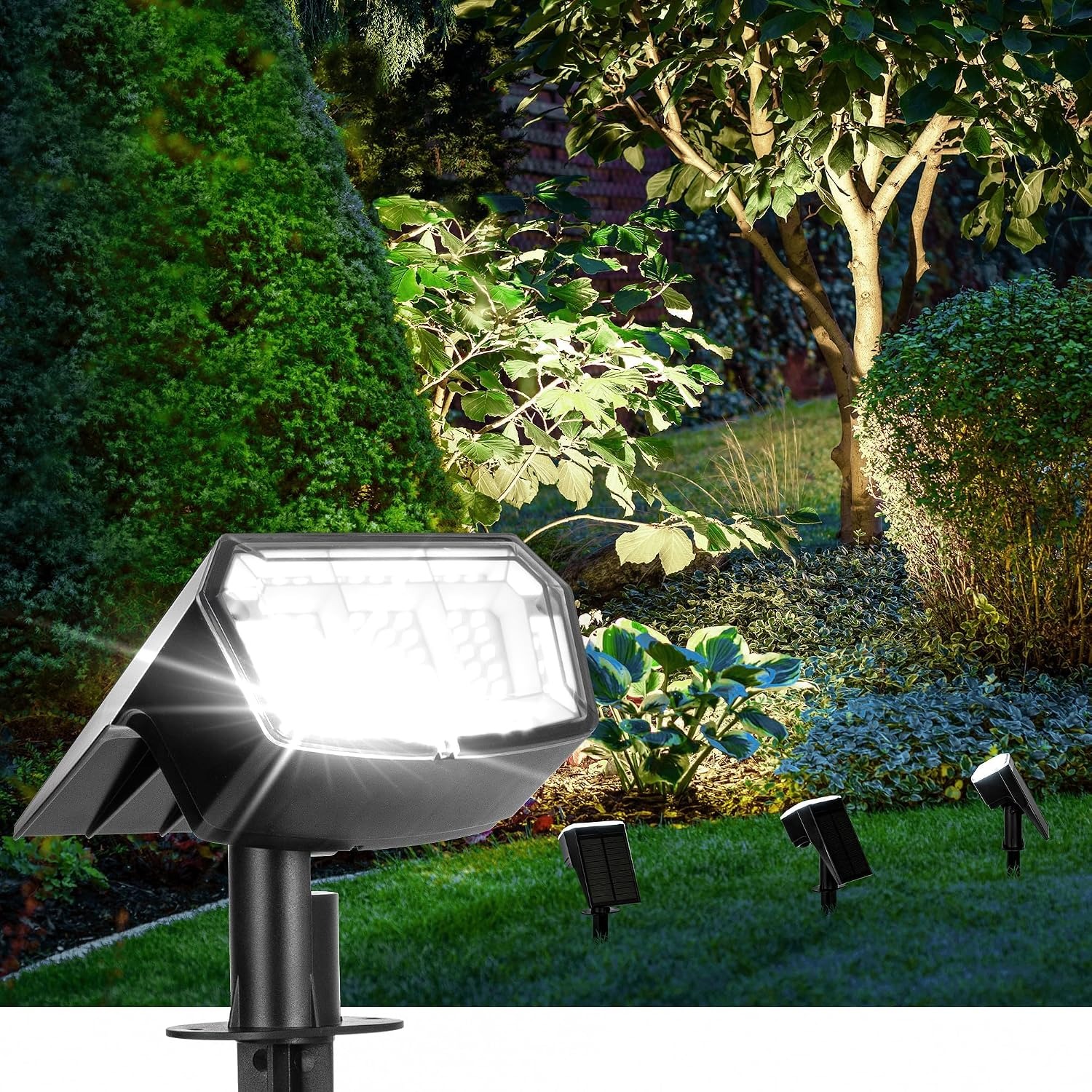
This set uses LEDs rated at up to 700 lumens per light, at a colour temperature of 6500 Kelvin. That is cool white, a clean daylight tone rather than a warm yellow. Cool white tends to look sharp on render, brick, stone and green foliage. If your house is a warm cream colour and you prefer a cosy glow, be aware that 6500K is the crisp end of the scale.
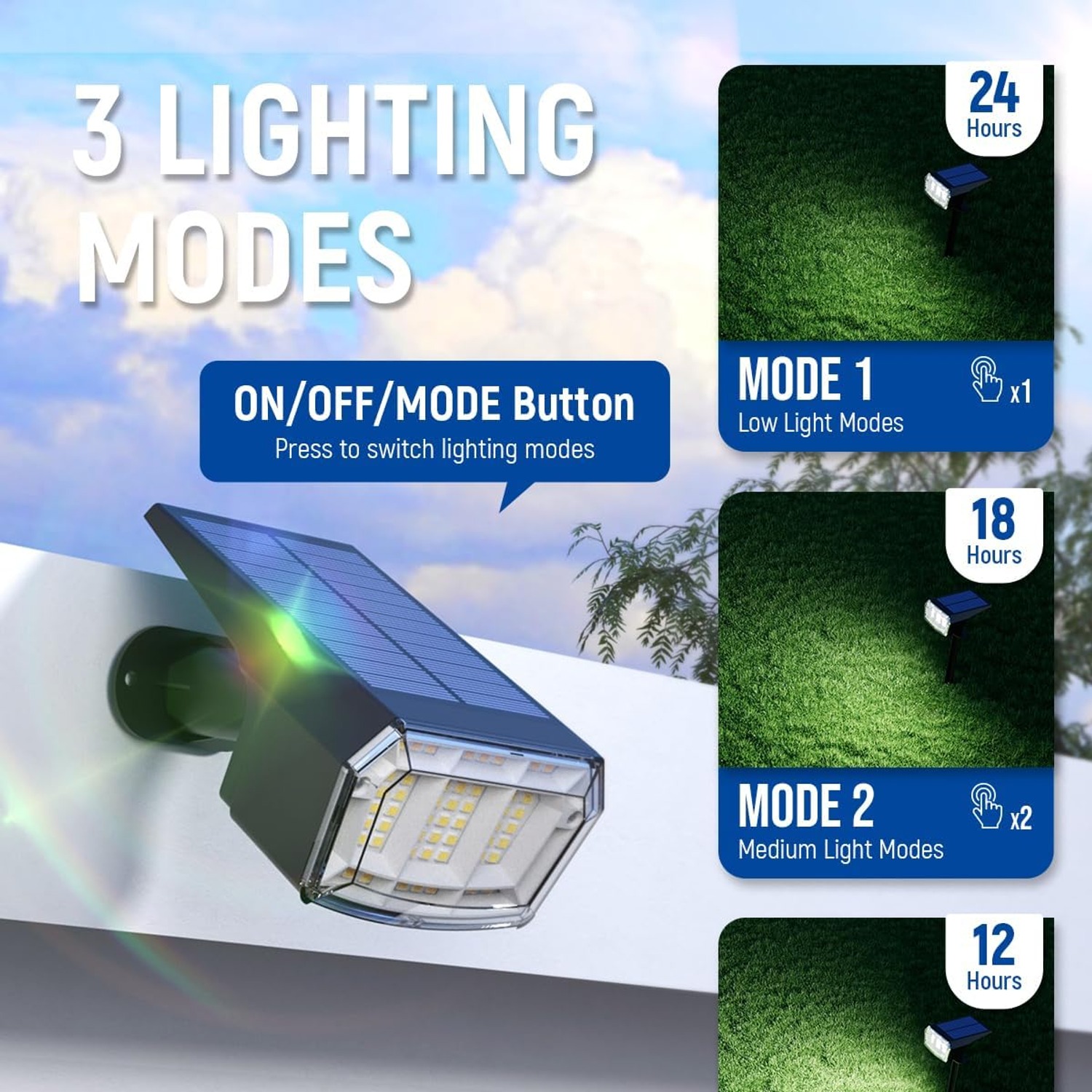
There are three brightness modes, and this is the control that matters most. Brightness and run time pull against each other. Run everything on maximum and you get a dramatic first few hours and an early finish. Drop to a lower mode and the same stored charge spreads much further into the night. Most people end up on a middle setting for general garden lighting and save the high mode for a specific feature.
Charging is the part people underestimate. A solar panel in deep shade produces very little, no matter how good the light is. Winter makes this worse because the days are short and the sun sits low. That is not a fault, it is physics, and the practical response is to mount the panel where it genuinely sees sky.
Who these suit
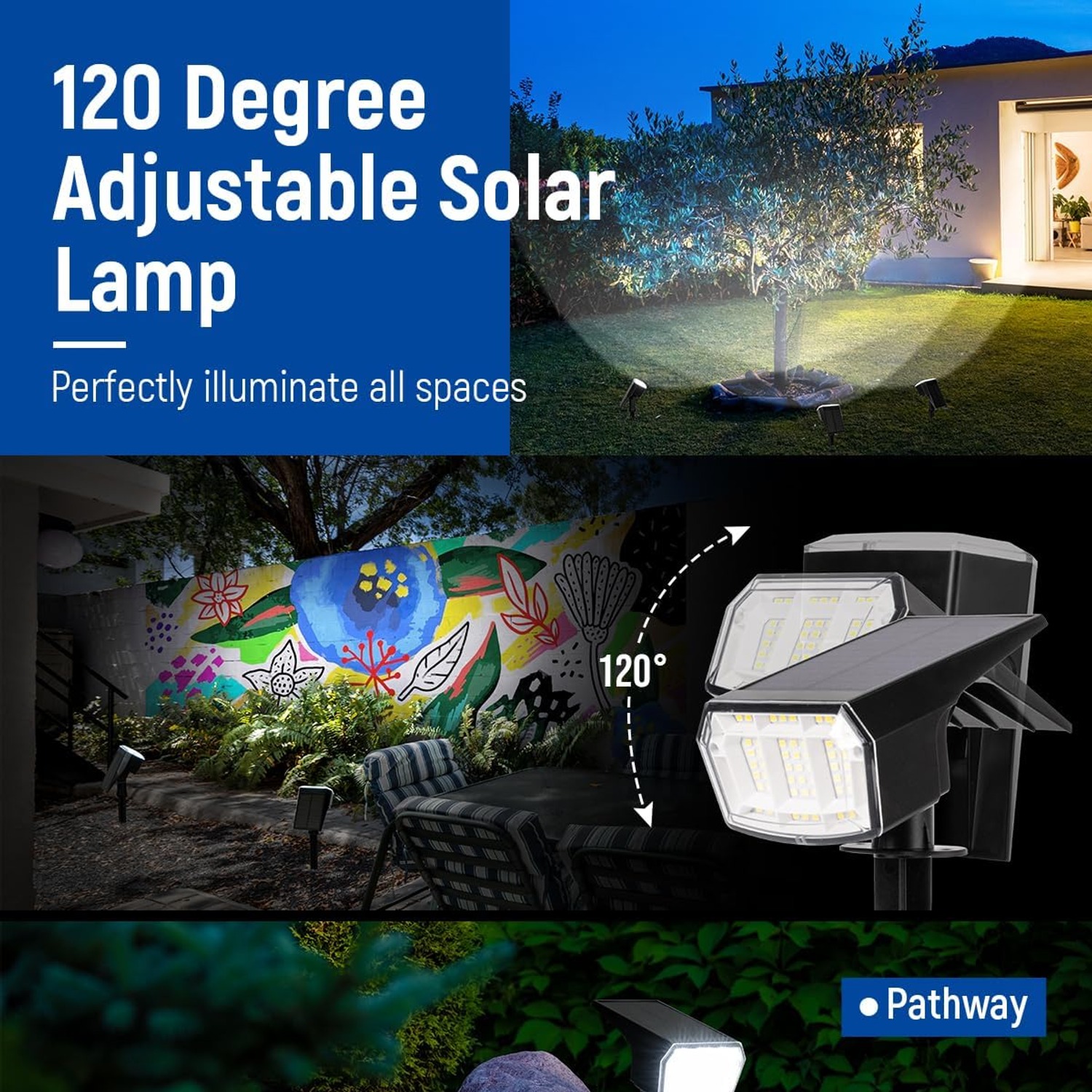
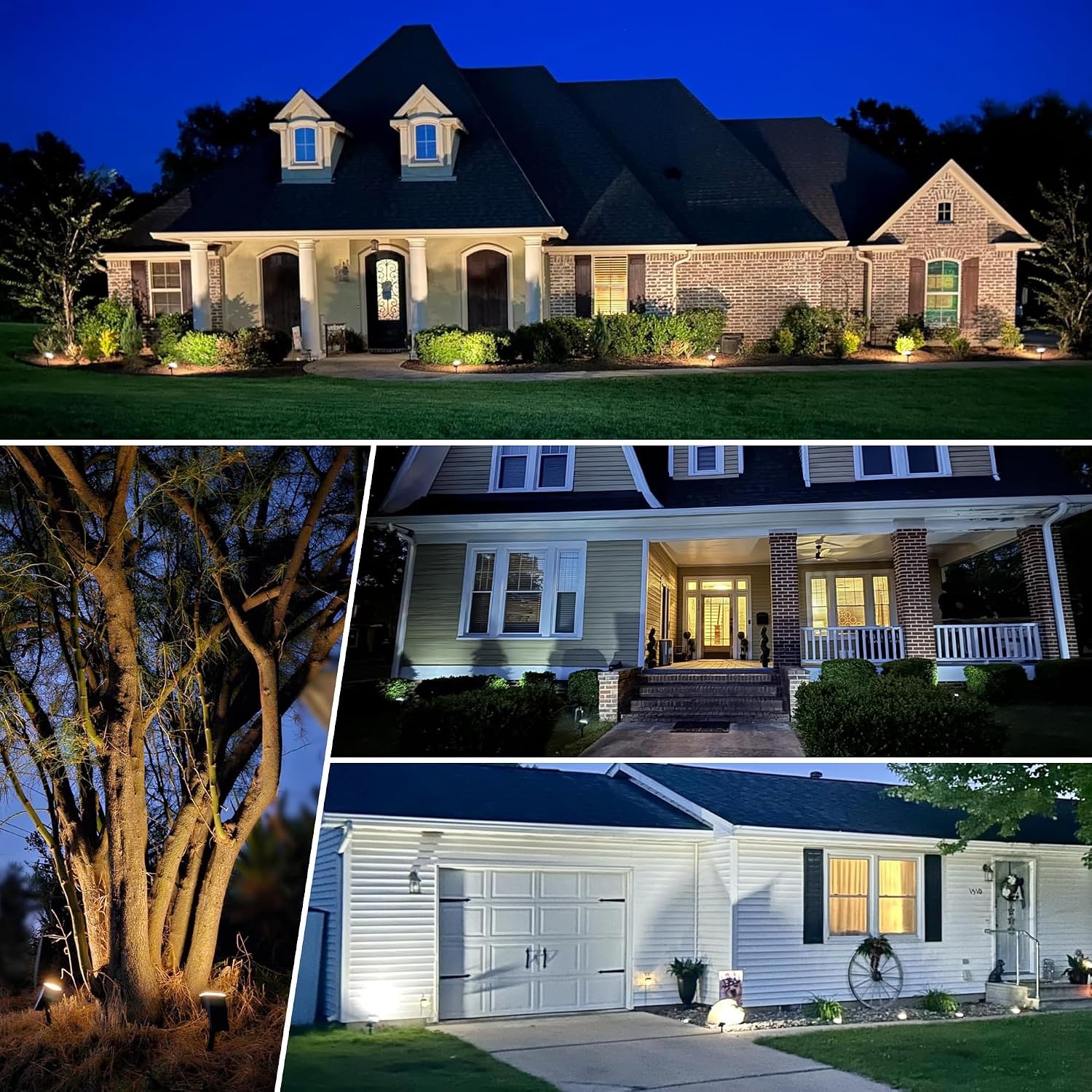
These work best for anyone who wants accent lighting rather than floodlighting. Think uplighting a tree trunk, washing a section of fence, marking a gate, lighting a house number, picking out a sculpture or a feature planting bed, or giving a patio corner some definition.
They suit renters particularly well, because nothing is permanent and nothing involves the electrical system. They suit anyone with an outbuilding, a long driveway or a back fence that is simply too far from the house to justify a cable run. And they suit people who like adjusting things, because moving a solar light costs you ten minutes instead of a call-out fee.
They are less suited to one job in particular, lighting a large open area evenly. Four focused spotlights are not a floodlight array. If you need to make an entire back lawn usable at night, you are looking at a different product category.
Choosing where to put four lights
Four is a useful number. It is enough to do a proper job on a small to medium garden, and not so many that you have to plan a scheme.
A sensible split for a typical property looks like this. One light on the front of the house, aimed up at the facade or across the entry. One on the best tree or shrub you own. One at a boundary or gate where you want to see your footing. One spare, held back until you have lived with the first three for a week and worked out what still feels dark.
That last point is worth taking seriously. Lighting looks different in practice than it does in your head. Shadows fall somewhere unexpected, a beam bounces off a window, a plant turns out to look better lit from the side than from below. Install three, live with them, then decide.
For uplighting a tree, place the light near the base and tilt up along the trunk. Narrow angles make the trunk dramatic, wider angles spread into the canopy. For a wall, come in at a shallow angle so the texture of brick or render catches the light. Hitting a flat wall head-on usually looks like a hotspot.
Aim, glare and neighbours
The single biggest mistake with any outdoor spotlight is aiming it at nothing. A light pointed across open space just throws glare at whoever walks into it, and that includes your neighbours and anyone at a bedroom window.
Aim at a surface. A wall, a trunk, a hedge, a fence panel, a sign. The surface does the work, bouncing a soft wash of light back into the space. You get the effect you wanted and nobody gets a beam in the eye.
If a light sits near a window, drop it to a lower brightness mode. Cool white at 700 lumens through a bedroom curtain is not a popular choice in a household.
Weather, materials and what to expect
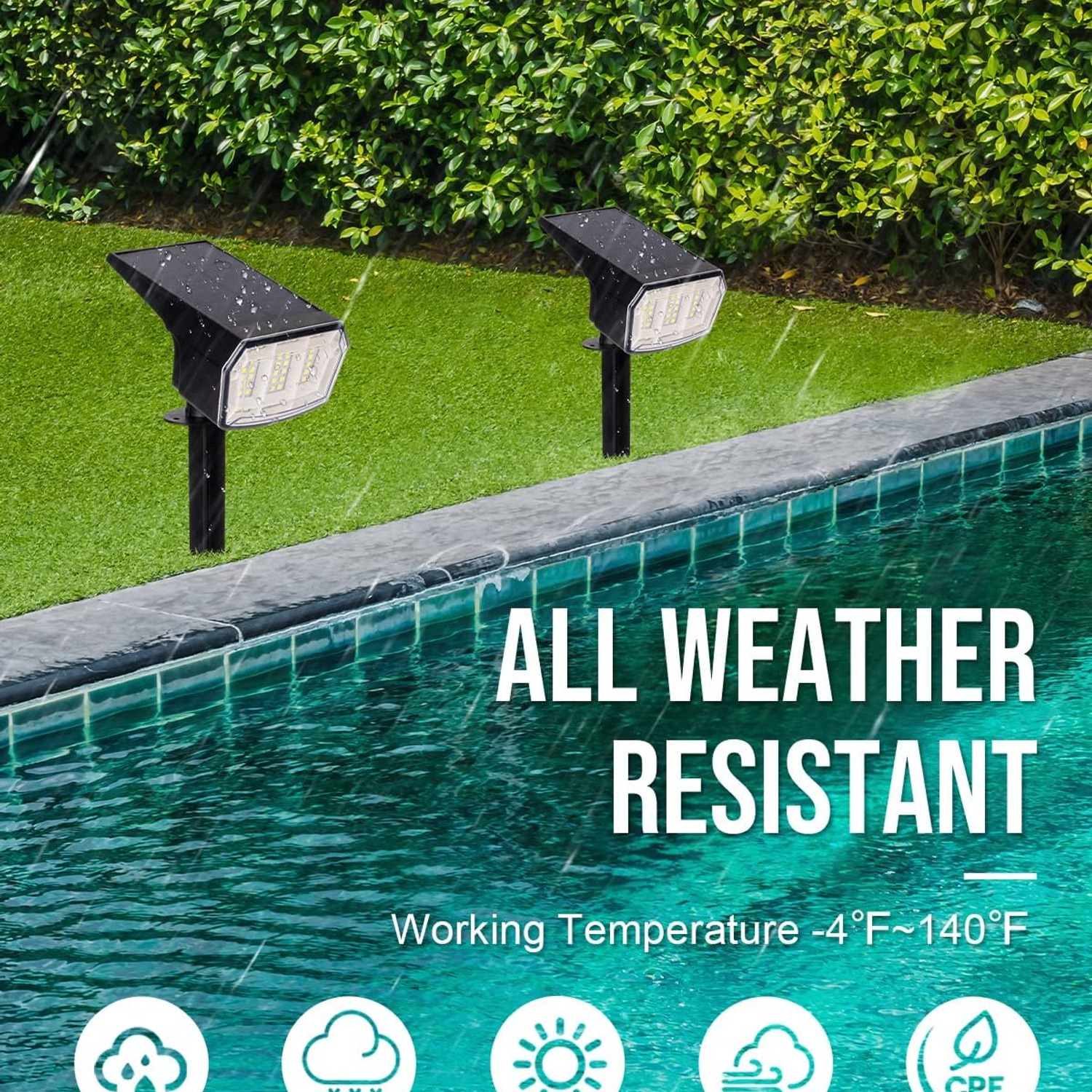
These spotlights are rated IP65 waterproof. That rating covers rain, snow, wind and frost, which is why they are built to stay outside rather than being packed away each autumn. The housing and shade are moulded in ABS, a tough plastic used widely in outdoor fittings because it handles weather and the occasional knock from a wheelbarrow.
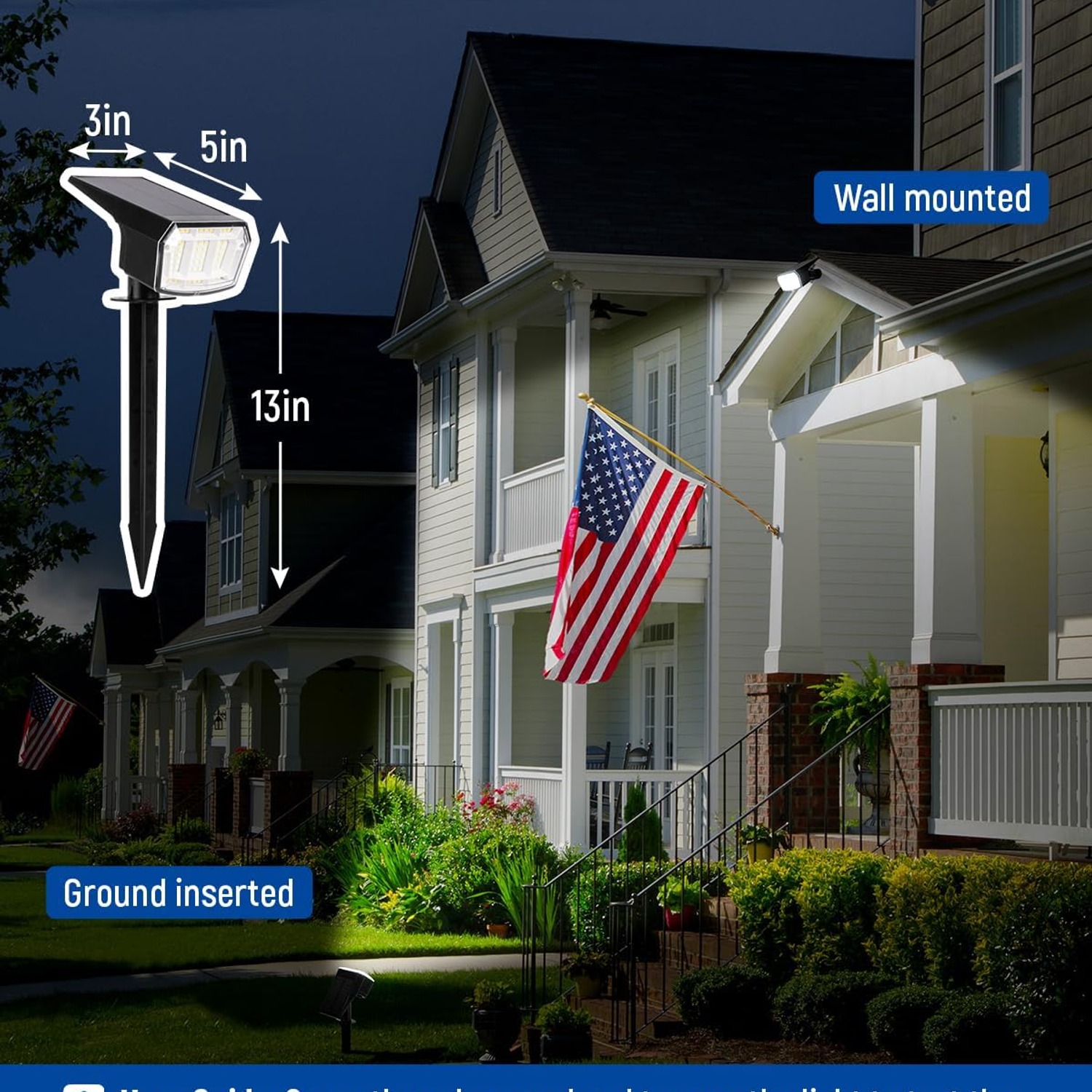
Each light measures 10.2 cm wide by 1.3 cm high and weighs 454 g. They are small, which helps them disappear in planting during the day. The shade is clear and the shape is described as prism, giving a modern look rather than a traditional lantern style.
Control is handled through an app over Wi-Fi, with a remote control included in the box. The remote earns its keep once lights are mounted above head height, because changing mode from a lawn chair beats dragging a ladder out.
Keeping them working
Solar lights fail in one boring, predictable way. The panel gets dirty, charging drops, and the owner assumes the battery has died.
Wipe the panel with a soft damp cloth every few weeks. Pollen in spring, dust in summer, leaf debris in autumn and snow in winter all block the panel. Thirty seconds of cleaning restores performance that people often write off as a fault.
Clear snow after a fall rather than waiting for it to melt. If you are storing a light away for a long stretch, charge it fully first and keep it somewhere dry. Avoid solvents and scouring pads on the lens, because scratched plastic scatters light and dulls the output.
The short version
Four solar landscape spotlights, 700 lumens each at 6500K cool white, IP65 rated, app and remote controlled, mounted on a wall with no wiring and no running cost. Use them to light specific things rather than everything. Give the panels sun, aim the beams at surfaces, use the lower brightness modes for longer nights, and wipe the panels every few weeks. Do those four things and a dark garden becomes somewhere you actually look at after dinner.