


The complete guide
How To Choose A Kids Play Tent And Tunnel That Actually Gets Used
The problem with most indoor play gear
There is a particular kind of toy that looks brilliant in the box and becomes a nuisance by the second weekend. Usually it is large, usually it is rigid plastic, and usually it ends up pushed against a wall where it stops being a toy and starts being furniture nobody chose.
The reason is simple. Children want to change what they are playing with. Adults want the floor back at six o'clock. A toy that cannot do both ends up losing on one side or the other, and in most homes the adults win eventually.
A play tent and tunnel set solves this by being soft, light and collapsible. It opens into something big enough to crawl through, then folds into a flat disc that slides behind a door. That one feature, more than anything else, is what decides whether a set gets used for years or gets quietly moved to the garage.
How a pop-up frame works
Inside the fabric channels of each piece runs a thin flexible frame. The listing gives the material as fibreglass, aluminium, plastic or spring steel. What they share is springiness. When the set is folded, that frame is held under tension in a tight coil. When you take it out of the bag and let go, it releases and the whole thing jumps into shape.
That is why setup takes seconds. There are no poles to thread, no clips to line up and no instruction sheet to lose. It also means you should open the set with a bit of care, in an open space, away from faces and lamps. The frame moves quickly.
Folding is the part people worry about. The trick is to stop trying to squash it and instead twist the loops down on top of each other, which lets the frame coil back into the smaller circle it wants to be. The first attempt is fiddly. By the fourth you will do it without looking.
What you actually get in this set
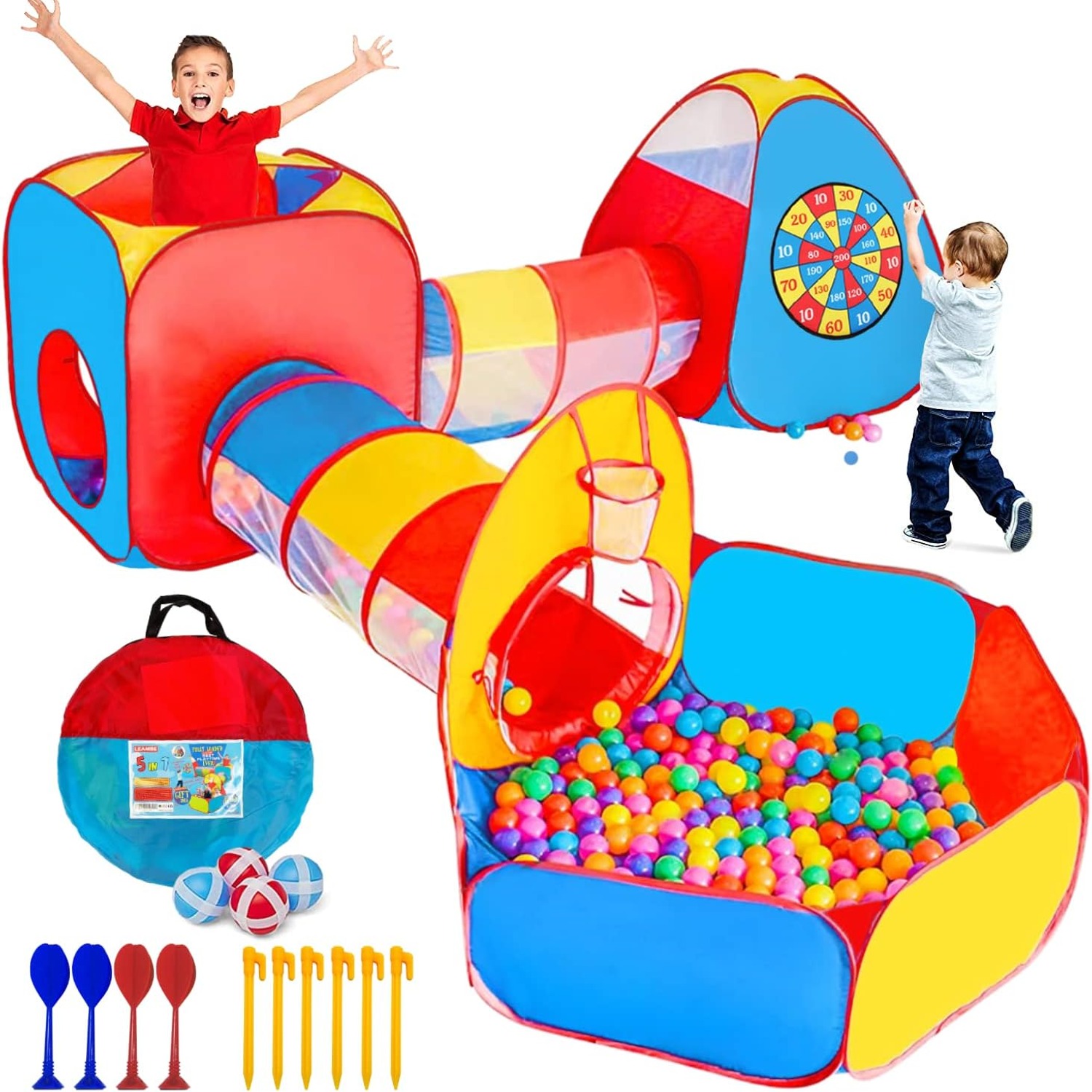
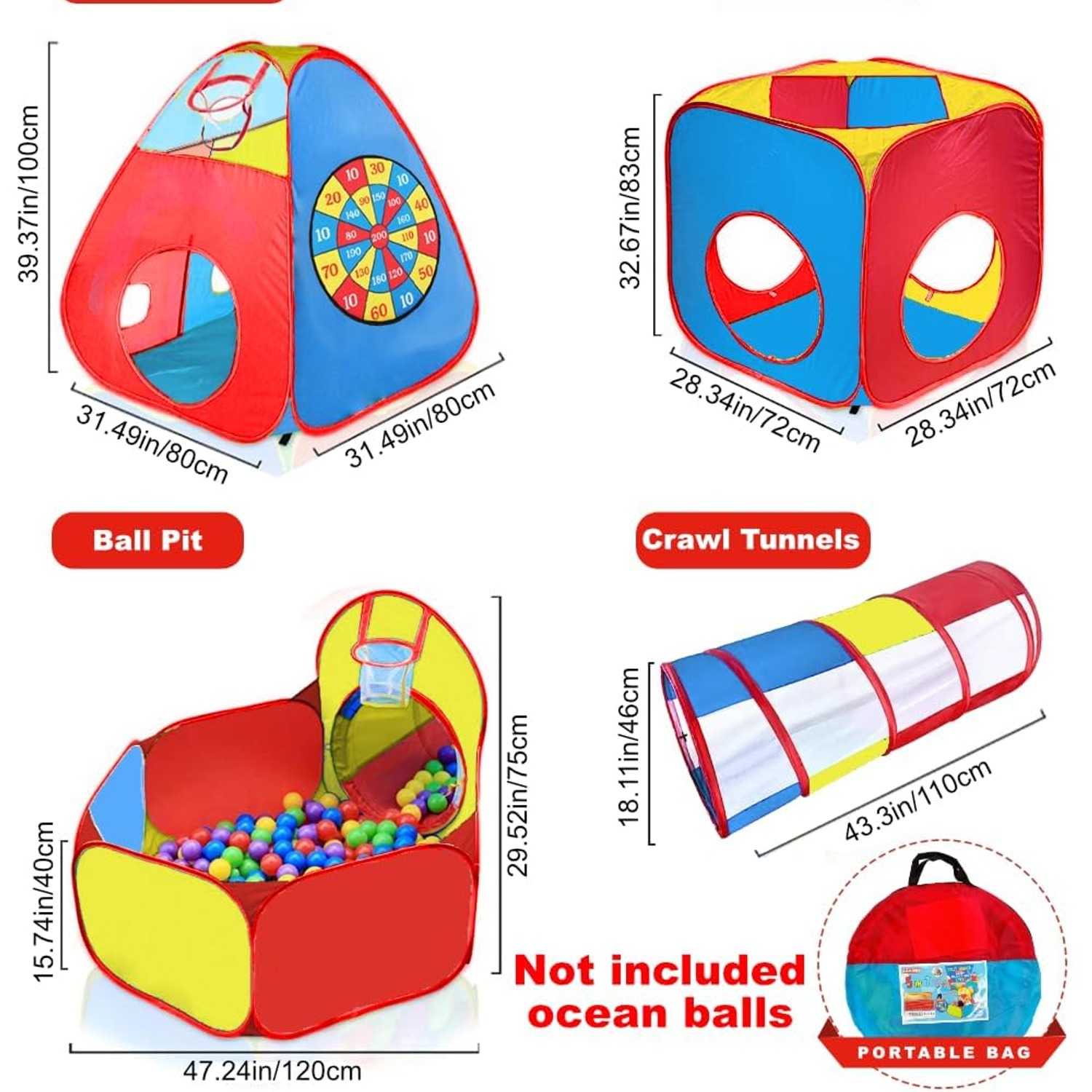
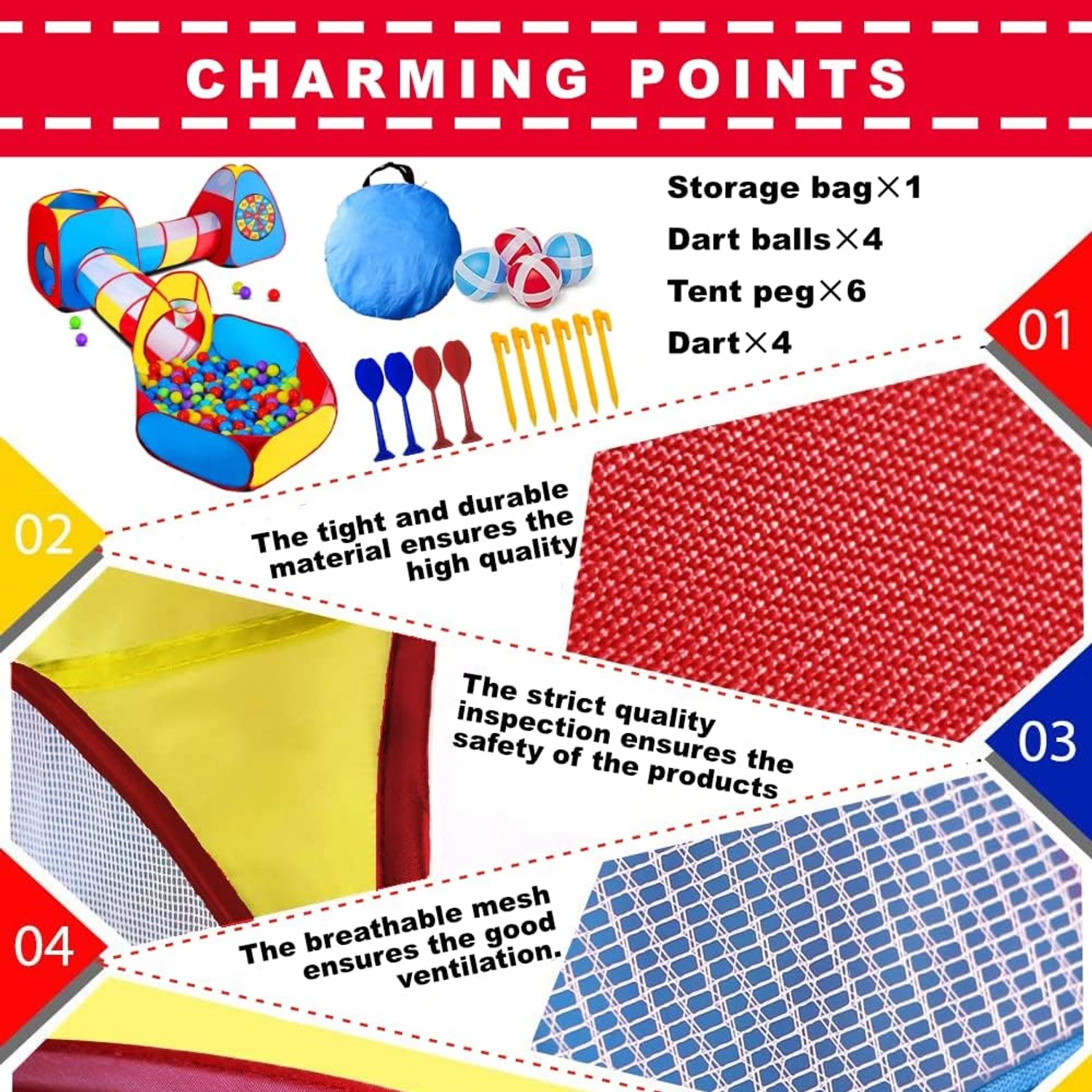
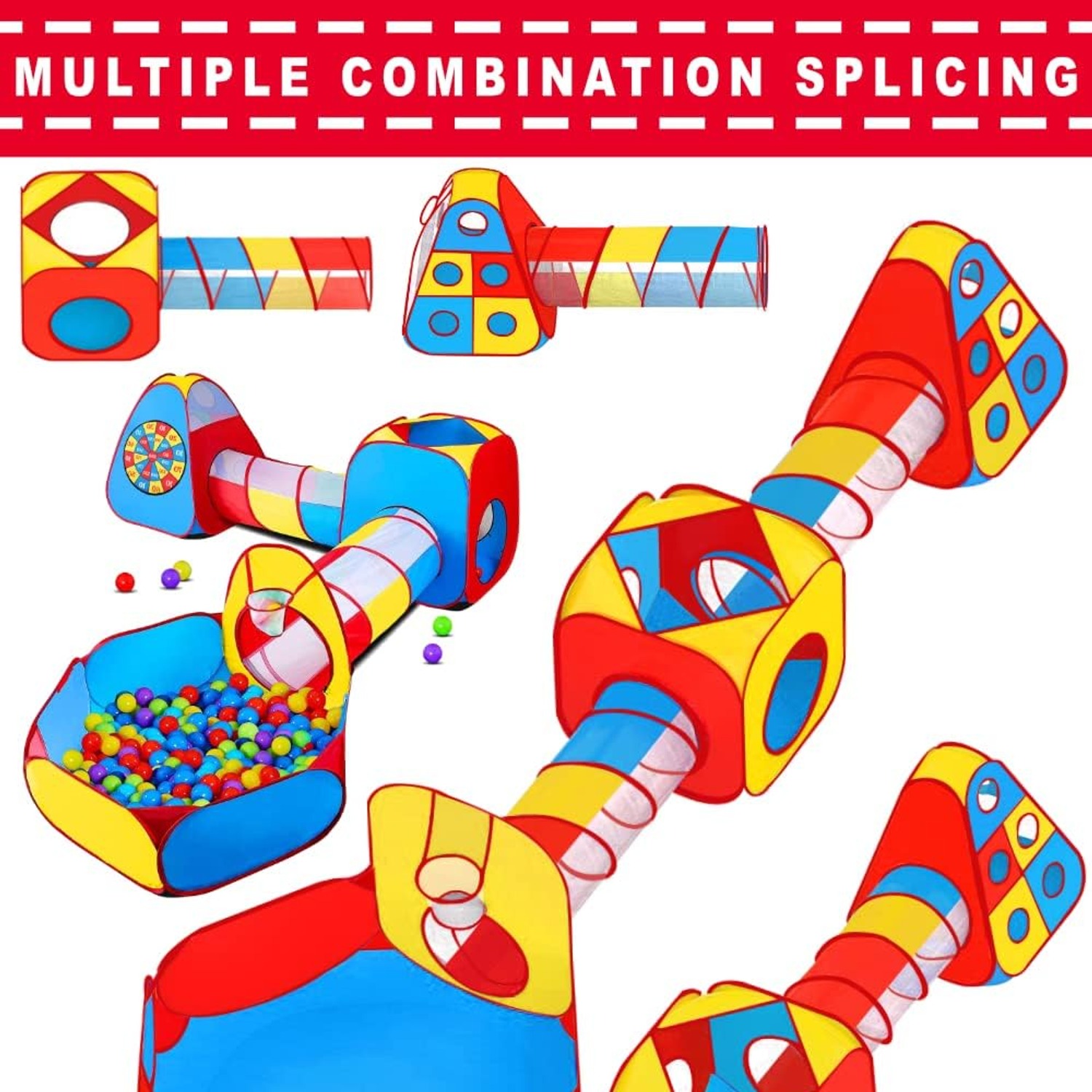
This is a five-in-one layout rather than a single tent. Inside the parcel there are two play tunnels, a triangular ball pit area, a square tent, a toddler ball pit, two ball hoops and a target wall game with four dart balls. A carry bag is included.
The number of pieces matters less than what you can do with them. Because the tunnels connect to the tents, the shape of the set can change every time it comes out. A straight corridor down the hall one day, an L-shaped den in the corner the next. Children get a surprising amount of mileage out of rearranging things themselves, and that is where a connectable set beats a single fixed playhouse.
Balls for the pit are not supplied. That is standard for sets like this, partly because ball sizes vary and partly because shipping several hundred plastic balls would make the parcel enormous. If you want a properly filled pit, around 500 balls is the usual figure, depending on diameter. If you just want something to throw at the hoops, a bag of fifty does the job.
Fabric, mesh and why airflow matters
The panels are 190T polyester. The number refers to thread density, and in practical terms it means a light, smooth fabric that wipes clean and dries fast. It does not absorb spills the way a cotton sheet would, which is useful when the set is being used by a three-year-old holding a drink.
Built into the walls are breathable mesh sections. These do two jobs. They keep air moving, so a child crawling through a closed tunnel on a warm afternoon is not sealed into a pocket of still air. And they let you see in from across the room, which means you can supervise without hovering. Parents tend to underrate this until they have owned a tent without it.
Total weight is 2.48 kg for the whole kit. That is light enough to carry in one hand, which makes the set genuinely portable rather than theoretically portable.
Who it suits
The recommended age is 3 years and up. That guidance is worth following, mainly because of the dart balls and hoops, which suit a child with a bit more coordination.
In practice the sweet spot runs from about three to seven. Younger children at the bottom of that range mostly want the tunnels and somewhere to hide. Older children start inventing games with the hoops and the target wall, and they build more elaborate layouts.
It also works well as a shared toy. Two children can use the set at once without being on top of each other, which is often the point. If you have a child who needs a quiet corner of their own, the square tent on its own serves that purpose nicely.
Choosing where to put it
Measure before you commit to a full layout. The parcel is 50 x 49 x 8 cm, but the assembled footprint with every piece connected needs a decent stretch of clear floor.
A hallway is often the best indoor spot, because tunnels suit a long narrow run. Living rooms work better for the tent and ball pit combination with one tunnel attached. Bedrooms usually take the square tent on its own.
Outdoors, pick flat ground clear of sticks, stones and anything sharp. Grass is kinder on the fabric than concrete. Bring the set in if the weather turns, since it is a play set rather than a camping tent and no waterproof rating is given.
Keeping it in good condition
Care is straightforward. Wipe the panels with a damp cloth and a small amount of mild soap, then let them air dry fully. Do not put any part of it in a washing machine or a tumble dryer, and skip bleach and the iron. The frame is sewn into the fabric, so machine washing risks bending it out of shape.
After outdoor use, shake the sand and crumbs out before folding. Store the set dry in its bag, somewhere out of long-term direct sunlight, because UV will slowly weaken any polyester fabric left in a sunny window for months.
Every so often, run your hand along the seams and check the frame channels. Catching a loose seam early is much easier than fixing it after a tunnel has collapsed mid-crawl.
Gift considerations
If you are buying this as a present, two things work in your favour. It arrives flat, so wrapping is simple. And it needs no assembly, so it can be opened and played with inside a minute, which is not true of most large toys.
It suits birthdays, holidays and the stretch of winter where a child is climbing the walls. If it is going to a home with limited space, mention that the set can be used in parts. People sometimes see the full photo and assume they need a games room.
The short version
A play tent and tunnel set earns its place by being easy to put up, easy to put away and flexible enough that a child can change the layout themselves. This one covers all three. It opens in seconds, weighs 2.48 kg, packs into a carry bag, and gives you tunnels, tents, a ball pit space, two hoops and a target game in one kit.
Balls are not included, assembled dimensions are not listed, and it is not a wet-weather item. Within those limits, it does the job well for children aged three and up, and it does not take over your living room when playtime ends.