


The complete guide
How to Choose Wall Bike Storage for a Garage That Actually Works
The problem with bikes on the floor
A bike is a wonderfully efficient machine right up until you stop riding it. Then it becomes a two-metre-long object with handlebars that catch door frames and pedals that bark shins. Multiply that by a family of four and your garage stops being a garage. It becomes a bike park with a car wedged in somewhere.
Most people start by leaning bikes against a wall. That works for a week. Then one falls over, takes the next one with it, and the derailleur lands on concrete. The floor approach also wastes the one thing a garage has plenty of, which is vertical space. From waist height to ceiling, most garage walls are doing nothing at all.
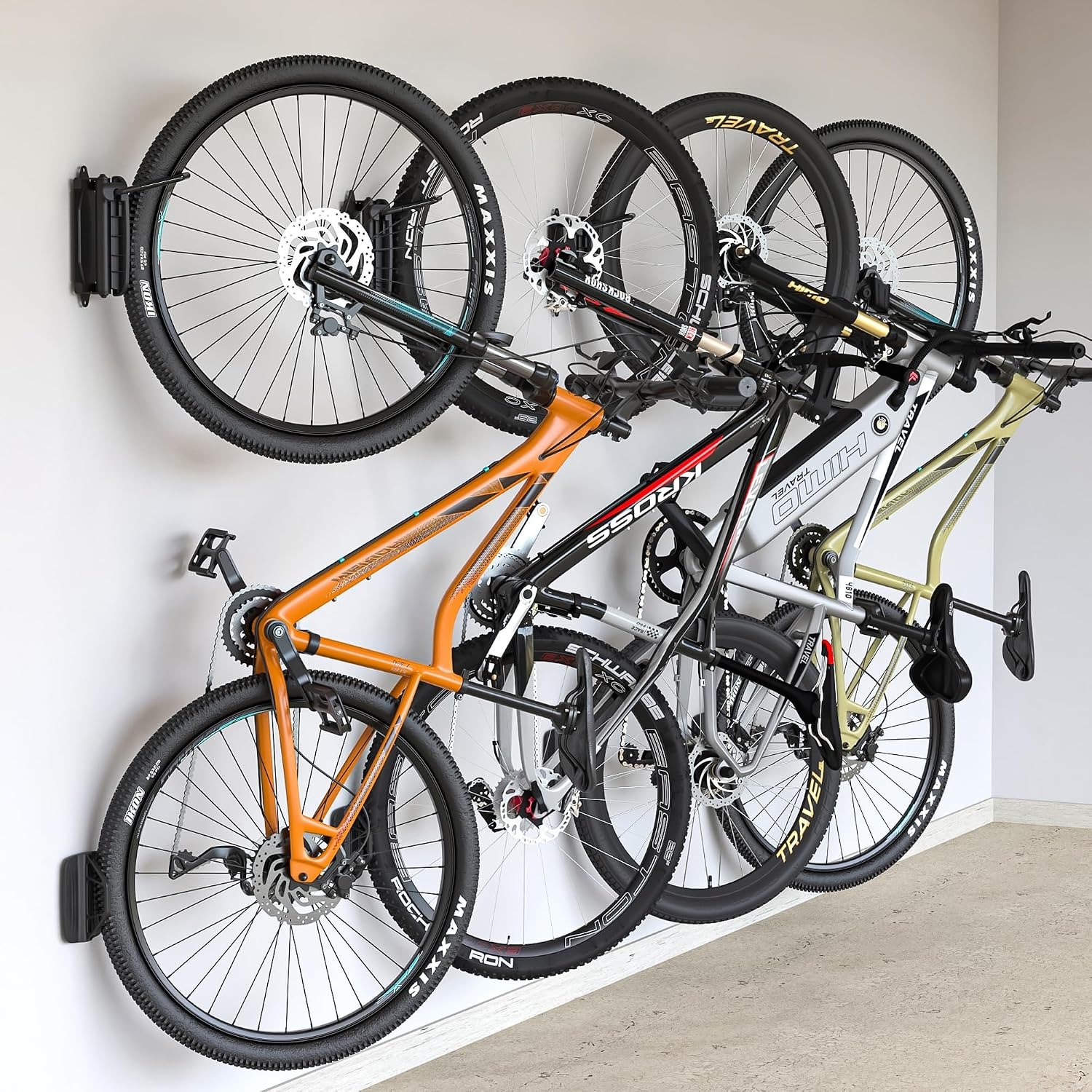
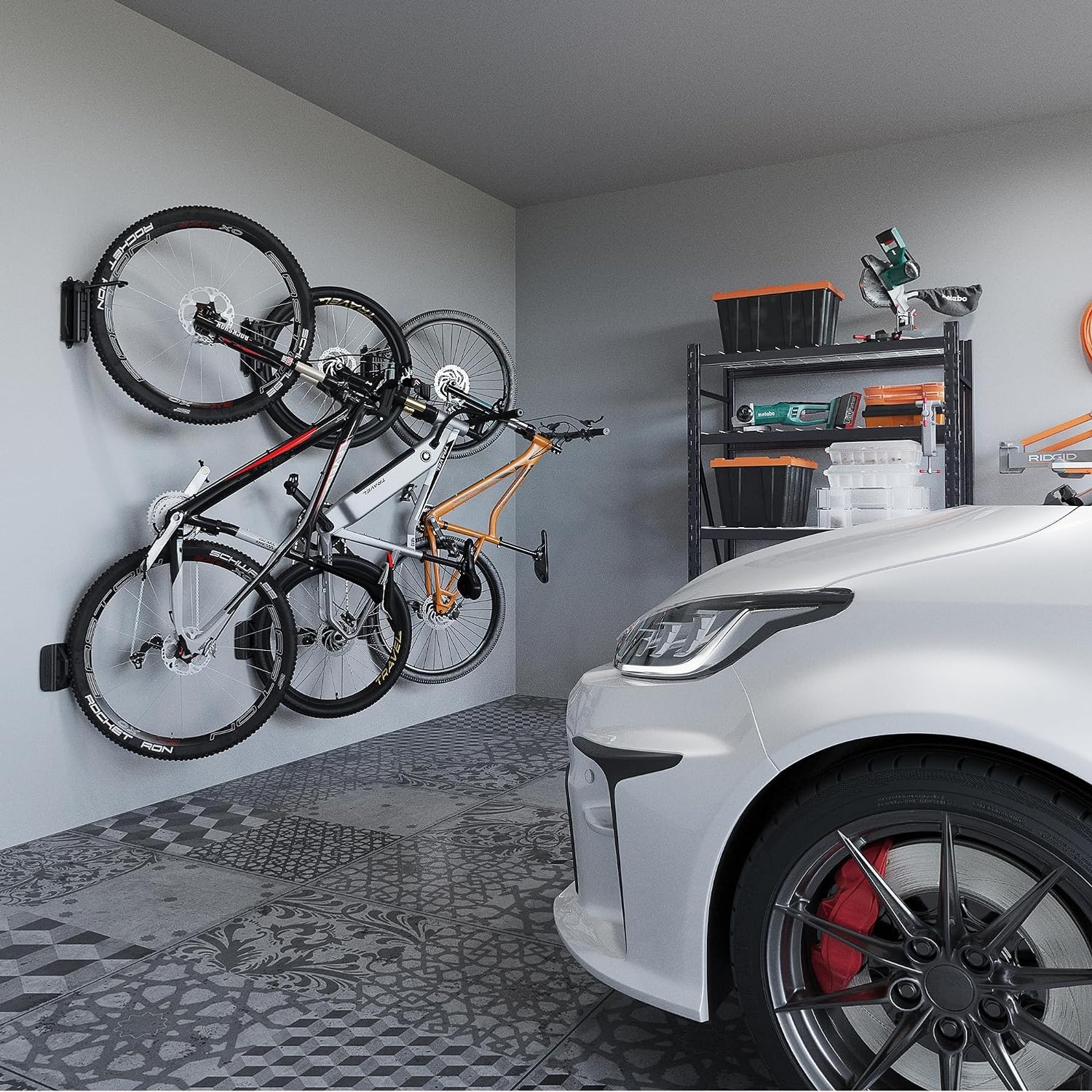
Wall bike storage moves the whole fleet into that empty space. Hung by the front wheel, a bike occupies a strip of wall roughly as wide as its handlebars and as deep as its tyre. Four bikes that used to sprawl across the floor end up in a neat row you can walk past without turning sideways.
How a swivel hanger works
The basic version of this idea is a fixed hook screwed into a wall. You hang the front wheel on it and the bike sticks straight out, perpendicular to the wall. It gets the bike off the ground, but it still eats a metre of floor depth. In a single-car garage, that metre is the difference between opening the car door and not.
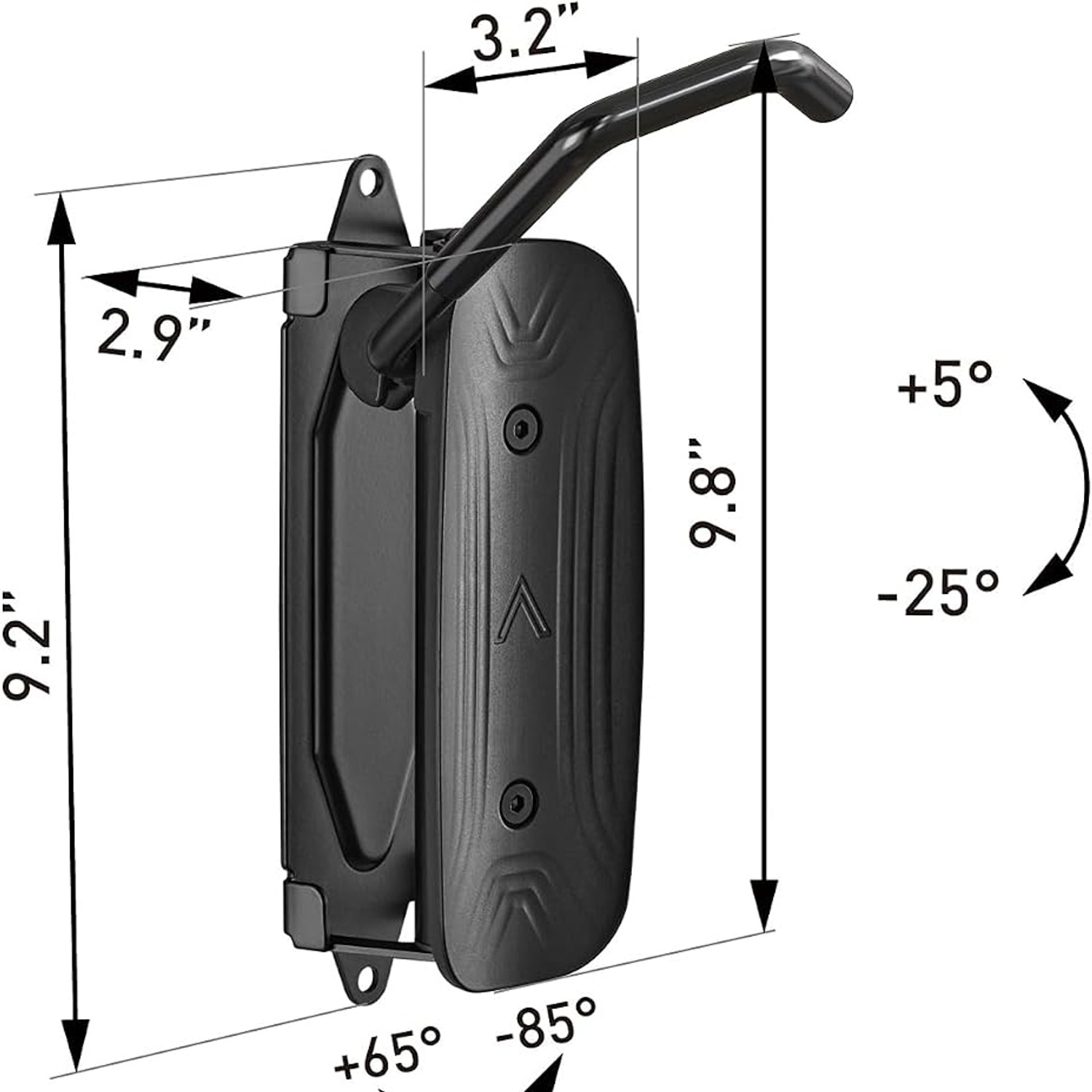
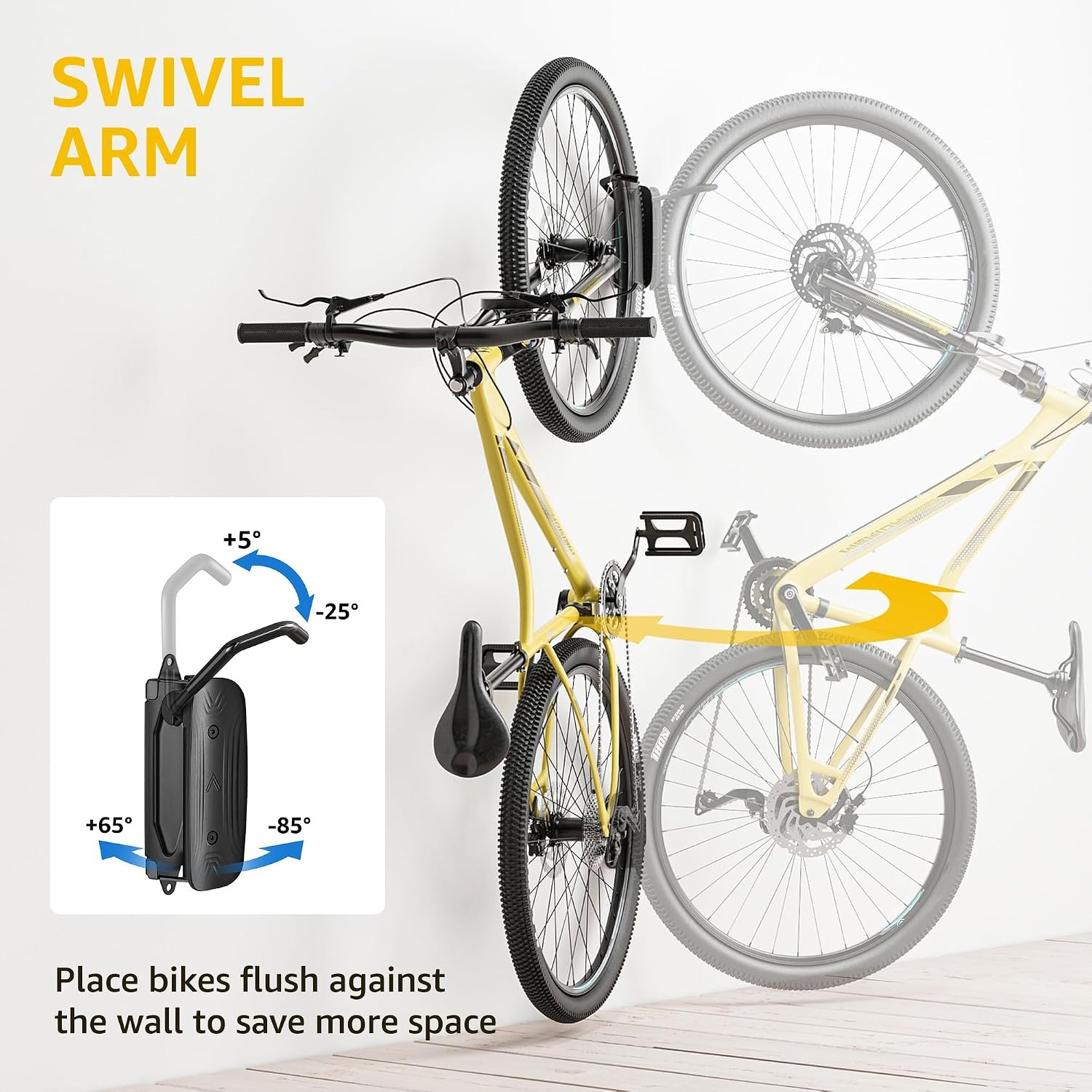
The swivel version fixes that. The arm turns on a bearing through 150 degrees, so once the front wheel is hooked on, you rotate the bike until the frame lies flat along the wall. The rear wheel rests against the wall and the whole bike sits nearly flush. Then you have your metre back.
The practical routine is quick. Lift the bike, drop the front rim into the hook, let the rear wheel settle against the wall, and swing it to the side. Getting it down reverses that. After a few goes it takes about five seconds, which matters more than you might think. Storage that is annoying to use does not stay used.
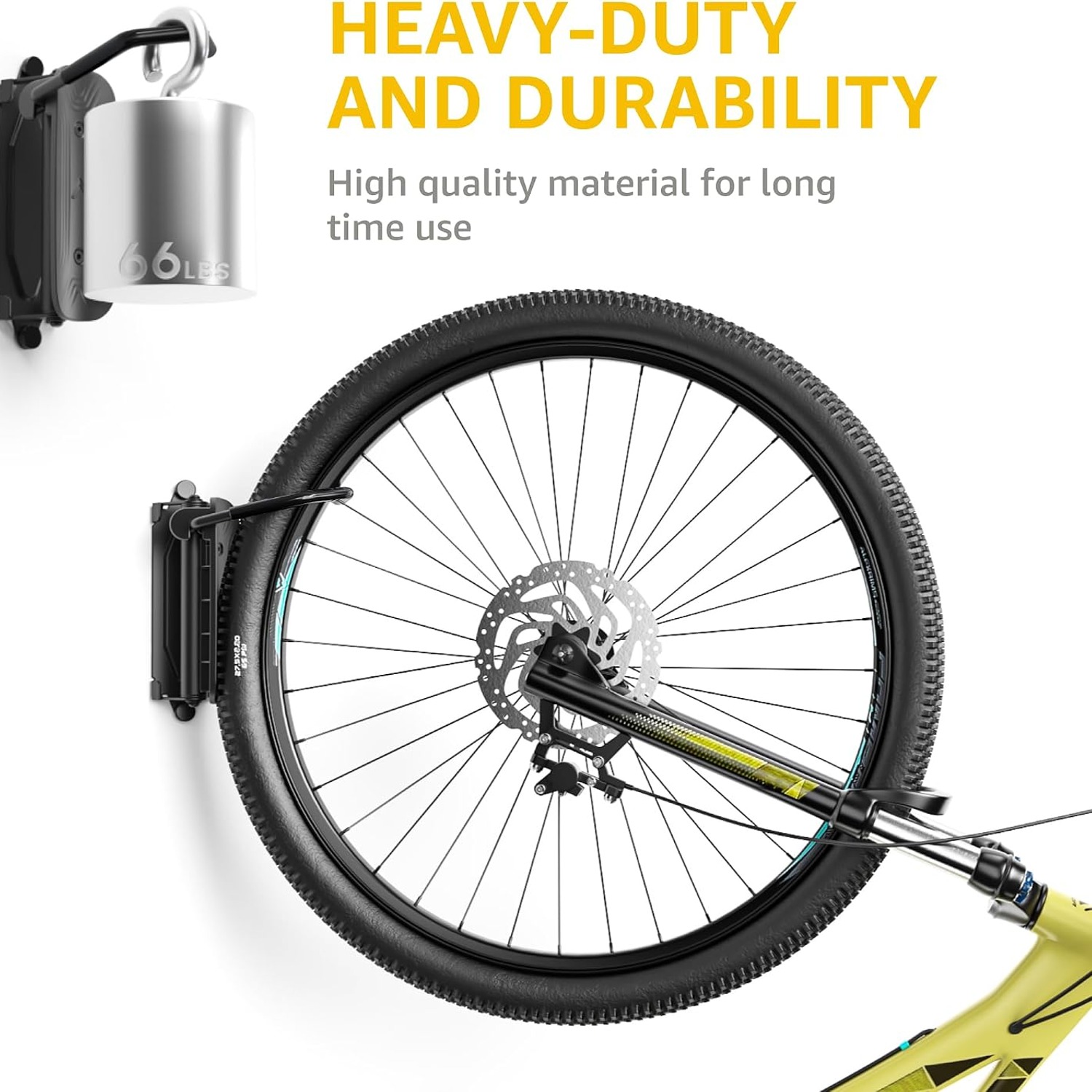
The hook on each hanger is rubber coated. This spreads the bike's weight across the rim bed rather than concentrating it on a narrow strip of bare steel, and it keeps metal off your paint. Each hanger in this set carries a stated capacity of 29.94 kg, which covers the overwhelming majority of pedal bikes.
Who this suits
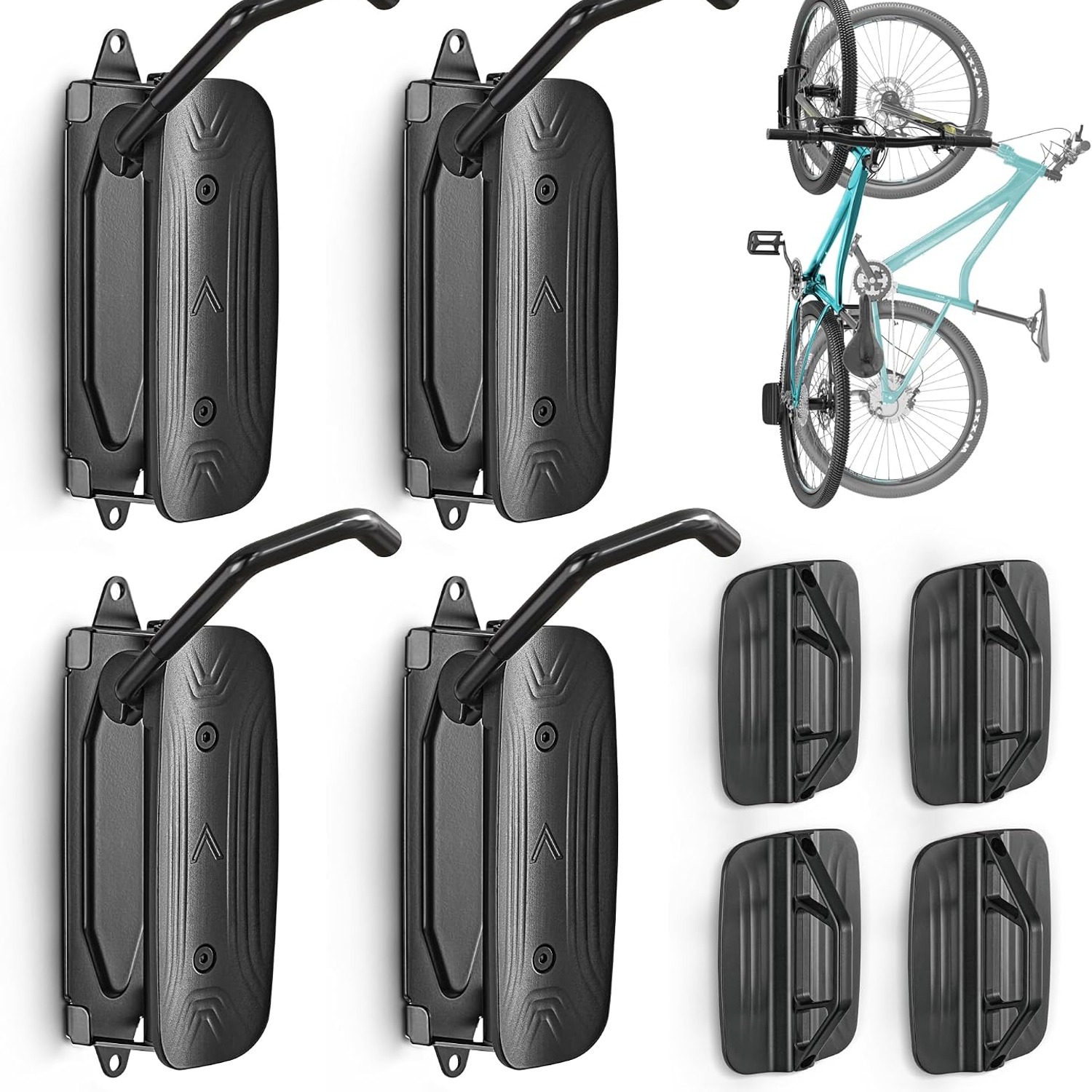
Households with more than two bikes get the most out of a four-pack. Two adult bikes, a teenager's and a kid's is the classic combination, and staggering the mount heights lets all four sit side by side without the bars fouling each other.
Flat and apartment dwellers often have the opposite problem, which is one or two bikes and no garage at all. The swivel still earns its keep there, because a hallway or living room can take a bike that sits flat against the wall far more easily than one sticking out into the walkway. Just check your tenancy agreement before you drill, and make sure you are fixing into something solid.
Shed owners and workshop users are the third group. A shed wall usually has timber framing, which is ideal, and clearing the floor means you can finally reach the things stacked behind the bikes.
The people this does not suit are fat bike riders and anyone running very wide plus-size tyres. The hook takes tyres and rims up to 3.54 in (90 mm) deep, and beyond that it simply will not sit properly. Heavier e-bike owners should also check the bike's weight against the 29.94 kg figure before committing.
Choosing where to put it
The wall matters more than anything else. You need solid masonry, brick, concrete, or a timber stud. The included fixings cover both scenarios, with screws and bolts for wooden studs and for masonry. What you cannot do is fix into unsupported plasterboard. It will feel fine on day one and let go a month later.
On a timber-framed wall, a stud finder is worth borrowing. Studs are usually spaced at regular intervals, often around 40 cm or 60 cm apart depending on how the wall was built, which may partly dictate your hanger spacing. On masonry you have free choice of position, which is simpler.
Height is the next decision. Hold the bike up against the wall and mark where the front rim naturally sits when the rear wheel is just clear of the floor. Add a few centimetres of clearance and that is your hanger position. For most adult bikes you will end up somewhere in the region of 1.8 to 2 m, but measure rather than guess.
Spacing is where people most often get it wrong. If you mount four hangers in a straight line at equal height, the handlebars will fight each other. Stagger them instead, alternating higher and lower by 20 to 30 cm, and allow roughly 35 to 45 cm horizontally. The bars then pass above and below each other. Put the bike you ride most at the easiest end, and the kids' bike somewhere a child can reach.
Fitting it
Each hanger is 7.4 cm deep, 8.2 cm wide and 23.5 cm high, and weighs 898 g, so it is a small thing to handle. Mark your holes with the hanger held level, drill with the right bit for the wall type, fix the hardware, and then test it. Testing means hanging off it with your own hands and giving it a proper pull before any bike goes near it. If it moves, stop and find out why.
Budget 10 to 15 minutes per hanger. Four of them, including the time spent working out your layout, is comfortably an evening job. Safety glasses are worth wearing when drilling masonry, and a dust sheet under the drill point saves the sweeping up afterwards.
Keeping it in good shape
There is not much to maintain. Wipe the steel arm occasionally with a dry or barely damp cloth and dry it off, because a powder-coated finish lasts best when it is not sitting under moisture. Brush grit out of the rubber hook now and then, since trapped sand is the one thing likely to mark a rim.
The more important habit is checking the wall fixings. Every few months, grab each hanger and pull. Vibration, temperature swings and the daily lift-and-drop of a bike can all work a fixing loose over time. Thirty seconds of checking is a lot cheaper than a bike on the floor.
Avoid solvents and scouring pads on the finish. Soap and water is plenty.
The short version
Four bikes on the floor of a garage will beat you eventually. Hanging them vertically gets the floor back, and the 150 degree swivel is what turns a decent hook into genuinely useful wall bike storage, because the bike ends up flat to the wall instead of jutting into the room.
Before you buy, check two things. Measure the depth across your widest tyre and rim, and confirm it is under 3.54 in (90 mm). Then work out what your wall is made of, because masonry and timber studs are fine and bare plasterboard is not. Get those two right and the rest is a drill, a level and about an hour.