
The complete guide
Choosing a Stainless Steel Vacuum Jug, A Practical Buyer's Guide
The problem with the second cup
Nobody complains about the first cup of coffee. It is the second one that causes trouble. By the time you have poured for everyone, buttered the toast and sat down, what is left in the pot has slipped from hot to lukewarm, and lukewarm coffee is a small daily disappointment.
The usual fixes are not great. Reheating in the microwave flattens the flavour. Leaving the pot on a hotplate cooks the coffee until it turns bitter. Brewing a fresh batch for one person wastes both time and beans. A thermal jug solves it differently. You brew once, pour it straight into the jug, and the drink holds its temperature while you get on with your morning.
That is the whole argument for a stainless steel vacuum jug. It is not a clever gadget. It is a container that stops the clock for a while.
How an insulated carafe actually works
An insulated jug has two walls with a sealed gap between them. Heat moves in three ways, by touching, by air movement and by radiation. The gap cuts off the first two almost entirely, and the polished metal surfaces slow the third. What is left is a slow leak of temperature rather than a fast one.
This is why a vacuum insulated carafe works equally well in both directions. The same structure that keeps coffee hot keeps iced water cold. This jug is rated under a cold 24 hour feature on its listing, which tells you the cold-side performance is the figure the maker chose to stand behind.
A few practical things follow from the physics. A full jug holds temperature better than a half-empty one, because there is less air inside to warm or cool. Every time you open the lid you let the gain or loss restart. And pre-conditioning the jug, a rinse of very hot or very cold water before you fill it, makes a genuine difference to the first hour.
Why stainless steel and not glass
Older thermal jugs used a glass vacuum liner. They worked well, but they were fragile in a way that did not suit real life. One knock on the edge of the sink and the liner cracked, often invisibly, and the jug stopped insulating with no warning.
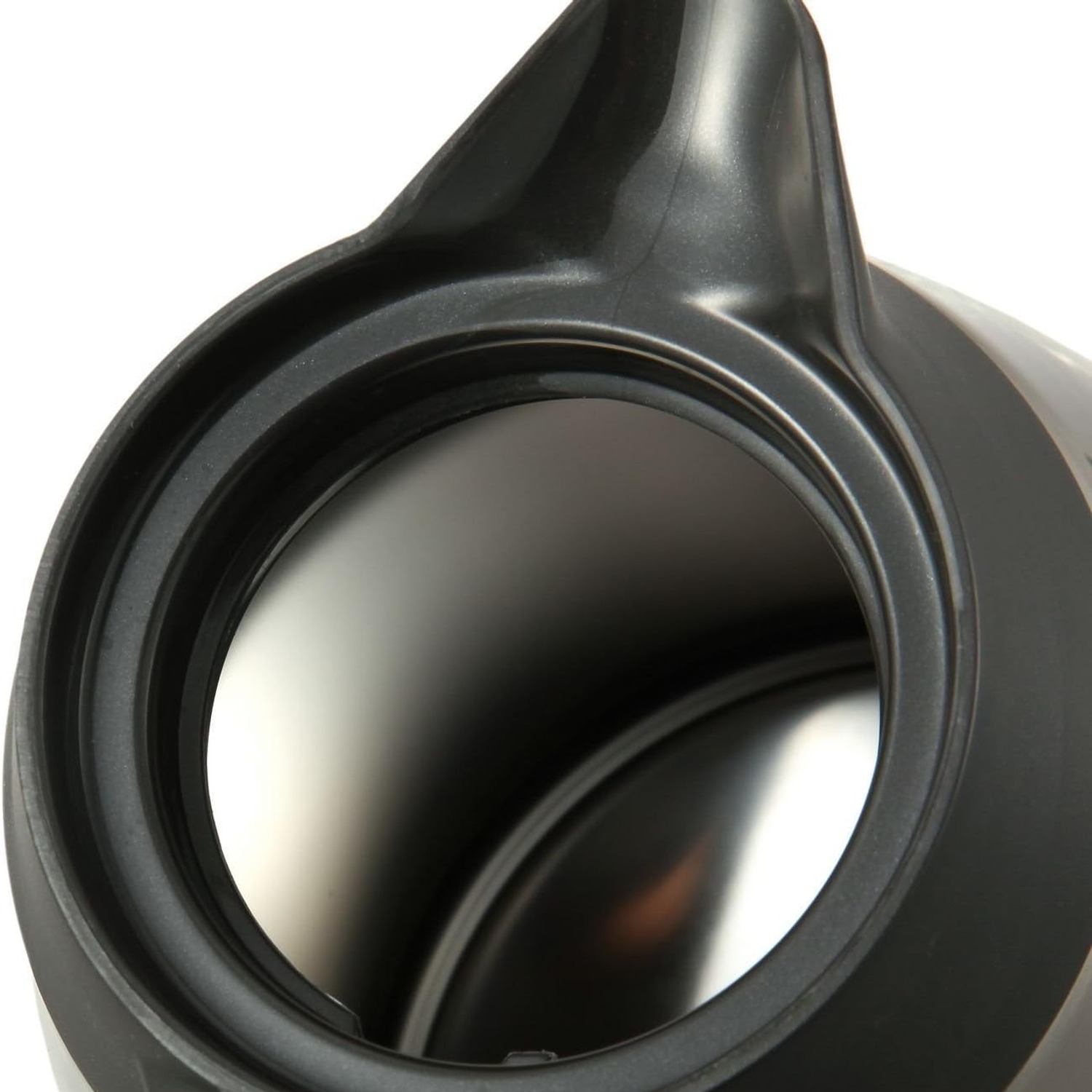
Stainless steel changed that. This jug is listed as break resistant, and the body material is given as stainless steel. It handles the ordinary rough treatment of a kitchen bench, a car boot or a campsite table far better than glass ever did. It also does not hold onto flavours the way plastic can, which matters if you switch between coffee in the morning and squash in the afternoon.
The trade-off is that metal shows fingerprints and water spots. A wipe with a dry cloth keeps the finish looking tidy, and that is about the extent of the maintenance.
Is 1.5 litres the right size?
Capacity is where most people get it wrong, usually by buying too small. A 1.5 litre jug holds roughly four to five mugs, or six smaller cups. That is a sensible match for a family breakfast, a meeting of a handful of people, or a day out where you want drinks on tap rather than rationed.
Smaller jugs around 0.5 litres are really personal flasks. They are fine for one commuter, but they run out the moment a second person wants a cup. Larger catering urns hold more, but they are heavy, awkward to store and far too much for a household.
Think about how you actually drink. If you brew a cafetiere and it disappears in two pours, a 1.5 litre vacuum jug matches your habit almost exactly. If you are the only coffee drinker in the house and you nurse one cup for an hour, you may be better served by a smaller flask.
Weight is worth a thought too. Empty, this jug is 700 g. Filled, it is around 2.2 kg, which is a normal one-handed pour for most adults but is a genuine hot-liquid hazard around small children. Keep full hot jugs away from the edge of a table.
Where it earns its keep
At home. The obvious one. Brew in the morning, pour through to mid-morning, no reheating. It also stops the family arguing over who finished the pot, because there is usually some left.
At work. An office coffee carafe takes the pressure off a shared machine. One person makes a batch, everyone helps themselves for the next hour, and the kitchen is not a queue.
Outdoors. As a camping vacuum jug it does two jobs. Hot drinks on a cold morning, cold water on a hot afternoon. The break resistant metal body is the right choice for anything that travels in a boot with the folding chairs.
Entertaining. A thermal jug on the table during a long lunch means nobody gets up to put the kettle on. Filled with iced water and a few slices of lemon, it keeps a drink cold without a bucket of melting ice.
Getting the most out of it
Pre-heat or pre-chill before you fill. Thirty seconds with hot tap water, tipped out, and your coffee will hold its heat noticeably longer. The same works in reverse with cold water and ice.
Fill it properly. A jug filled to the top performs better than one filled halfway, so brew the amount you will actually drink.
Keep the lid shut between pours. Each opening lets warm or cool air in, and over a morning those small losses add up.
Do not use it to store. Insulated jugs are for serving, not for keeping things overnight. Coffee left in any container for hours tastes stale, no matter how warm it still is.
Cleaning and looking after it
Hand washing is the way to go. Warm water, a drop of washing-up liquid and a long-handled bottle brush will reach the bottom of a 1.5 litre jug without you contorting your arm. Rinse thoroughly, then leave it standing open until it is completely dry inside.
Avoid bleach, chlorine-based cleaners, steel wool and gritty scouring powders. They can mark or pit the stainless surface. For coffee stains, warm water with a spoonful of bicarbonate of soda left to sit for twenty minutes usually lifts the discolouration on its own.
Store it with the lid off or only loosely in place. A sealed jug with a trace of moisture inside will smell stale within a week, and that smell is harder to remove than any stain.
And the obvious safety points. No microwave, no oven, no freezer, no direct heat. Metal and microwaves do not mix, and extreme temperature swings are hard on any sealed insulated container.
What this one gives you
The facts are short and useful. Capacity is 1.5 litres. The material and colour are both stainless steel. Item weight is 700 g, and the parcel measures 22 x 15.1 x 13.5 cm. The listed special features are break resistant, cold 24 hour and durable.
The short version
If you drink coffee or tea by the pot, or you want cold water on the table all afternoon, a 1.5 litre stainless steel vacuum jug is one of the least glamorous and most used things you can put in a kitchen. It holds enough for a group, it survives being carried around, and it is rated for 24 hours of cold retention.
Pre-heat it, fill it full, keep the lid on, and wash it by hand. Do those four things and it will quietly do its job for years without ever asking for attention.