




The complete guide
How to Choose Plastic Champagne Glasses That Do Not Look Like Party Cups
The problem with real glass at a real party
Everyone agrees that crystal looks best. Everyone also knows what happens around the third hour of a wedding reception, a backyard birthday or a New Year countdown. Someone sets a flute on a wooden arm rest. A dog's tail finds it. A child reaches past it for a plate of cake. Then you are on your knees with a dustpan and a torch, checking the grass for slivers while the music keeps going.
Break-resistant drinkware exists for that exact gap. Not for the formal dinner where everything is indoors on a steady table, but for the much more common situation where people are standing, moving, carrying plates, holding babies and stepping backwards into each other. A pack of 16 plastic champagne glasses covers that situation without you having to think about it.
There is a second reason too. Plenty of venues simply will not allow glass. Pool decks, marinas, some function rooms, most council parks, almost every campground. If you want bubbles at any of those, plastic is not a compromise, it is the only option on the table.
How break-resistant drinkware actually works
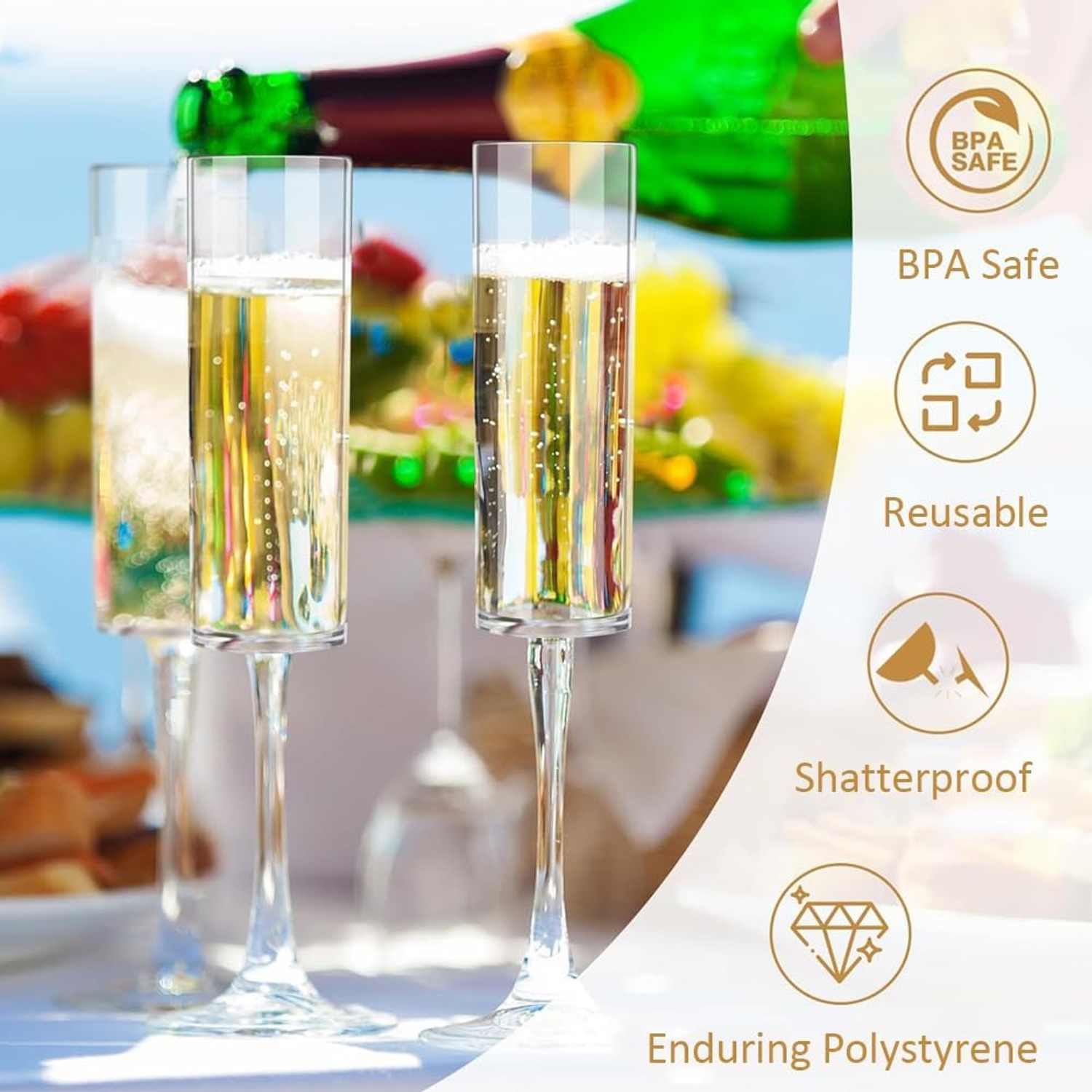
A thin glass flute is strong in compression and terrible under impact. It is designed to be clear and light, which means the walls are thin, and thin brittle material shatters. Plastic behaves differently. It flexes slightly under impact and absorbs the energy instead of fracturing along a line, which is why a dropped plastic flute usually bounces, skids and spills rather than exploding.
This set is listed as break resistant. That phrasing matters and we will stick to it. Break resistant means a knock that would end a glass flute usually does not end this one. It does not mean you can stand on it, reverse a car over it or throw it across a room. No plastic drinkware survives everything, and anyone who tells you otherwise is selling you something.
The listing also describes the material features as insulated, durable and safe. In practice, the insulated part shows up as slightly slower warming from your hand than you get with a thin glass wall. On a warm afternoon outdoors, that is a small but genuine advantage.
What you are actually getting
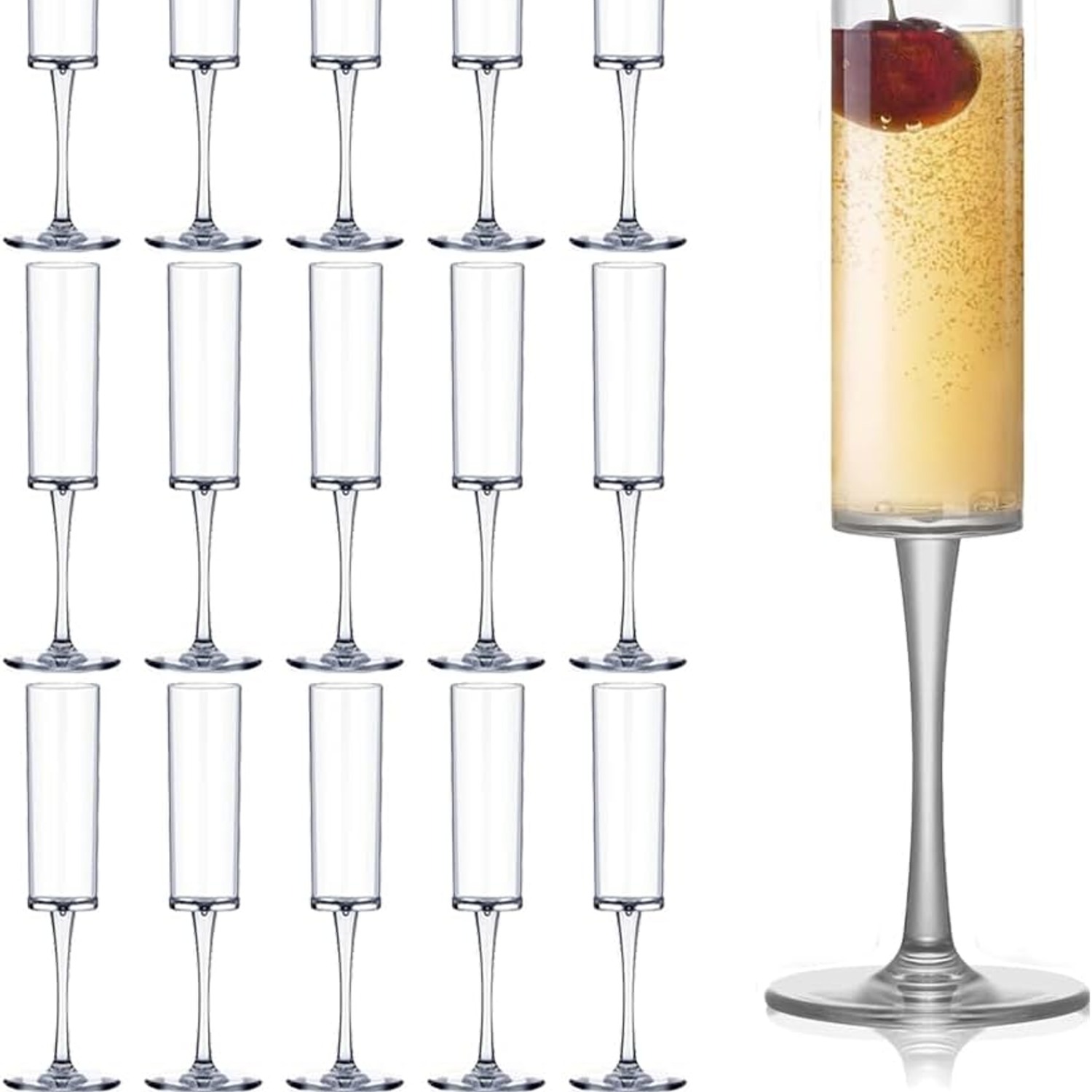
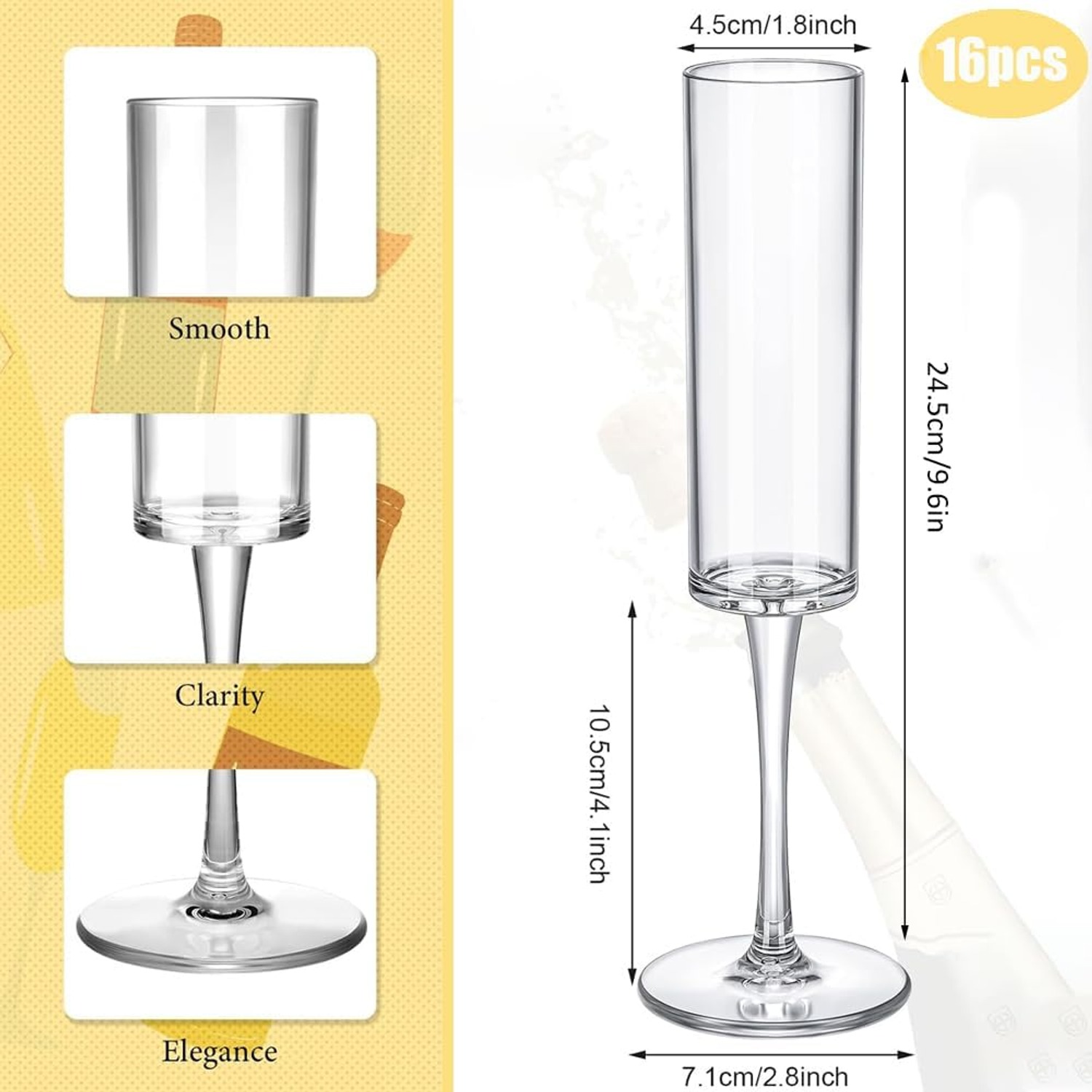
Sixteen flutes. A goblet shape, which means a rounded bowl on a stem rather than the narrow straight-sided tulip some sets use. A transparent finish with a minimalist look, so there is no printing, frosting or colour to clash with your table setting.
The size is listed as 6 OZ with a capacity of 170 g. That is a proper toasting pour. A standard 750 ml bottle fills somewhere around four to five of these depending on how heavy your hand is, which means one bottle covers a third of the pack. Worth knowing when you are working out how much to buy.
The whole pack weighs 1.46 kg. That is light. You can carry it in one hand from the car to the venue, or stack two or three packs in a crate without it becoming a job for two people.
The exact per-glass dimensions, the specific plastic type and the country of origin are all unlisted. If any of those is a deciding factor for you, ask us first.
Who these suit
Hosts who entertain outdoors are the obvious group. If your celebrations happen on a deck, by a pool, in a garden or on a boat, the best shatterproof drinkware is simply the sensible choice and you stop thinking about it after the first event.
Wedding and event planners buy sets like this in multiples. Sixteen is a useful unit, since it covers a bridal party and the head table, or two rounds of eight. For a hundred guests you want six or seven packs, which is still under 11 kg total and fits in one car boot.
Families with young children get a lot of use out of them, and not just for champagne. Sparkling juice in a flute makes a six year old feel very grown up at Christmas lunch, and nobody has to hover.
Holiday house owners and short-stay hosts are another group. Guests break things. Guests always break things. A reusable set that handles being washed, stacked badly and dropped occasionally saves you replacing glassware every season.
How to choose, honestly
Start with the count. Work out your guest number, then add about 20 percent, because people put a flute down, forget it and pick up a fresh one. If you are hosting 25 people, two packs is the right answer, not one and a half.
Then look at the shape. Goblet flutes like these feel more substantial in the hand than tall thin ones and are harder to tip. Narrow tulip flutes preserve bubbles slightly longer but blow over in a breeze. For outdoor use, the sturdier shape usually wins.
Next, think about clarity. Clear drinkware shows what is inside it, which is good for a rosé prosecco and unforgiving for fingerprints. A quick polish with a soft cloth before guests arrive makes a visible difference in photos.
Finally, decide whether you want single use or reusable. Disposables are cheap per event and expensive over five years. Reusable plastic flutes cost more today and nothing at all the next six times you host. These are listed as reusable, which is the better maths if you entertain more than once or twice a year.
Looking after them
The care instruction here is simple and it is non-negotiable. Hand wash only.
Use warm water, not hot. A small amount of mild dish soap. A soft cloth or a soft sponge. Rinse and either air dry upside down on a tea towel or wipe each flute dry by hand. That is the whole routine and it takes about eight minutes for the full pack of 16.
What to avoid is just as short. No dishwasher, because the combination of heat, strong detergent and a long drying cycle is what turns clear plastic cloudy. No scourers or abrasive pads, because fine scratches build up and dull the finish. No boiling water. No bleach or solvent cleaners.
For storage, keep them upright with a little space between them. Flutes with stems do not nest like tumblers, so forcing them together puts pressure on the rims. A shallow box with cardboard dividers, or just a shelf, works fine. Keep them out of direct sunlight if you store them somewhere like a shed, since prolonged UV is unkind to most plastics.
If a flute does get marked by a marker pen or a stubborn stain, warm soapy water and patience beat scrubbing every time.
A few small tips that help on the day
Chill the bottles properly rather than relying on the glass to do the work. Plastic holds a chill reasonably well but it cannot rescue warm wine.
Pour in rounds rather than filling everything at once. Sixteen flutes poured early means sixteen flat drinks by speech time.
Use stem tags or small stickers if people are putting glasses down and losing track. It cuts the number of abandoned half-full flutes dramatically and saves you washing twice as many.
Count them back into the box at the end of the night. It takes a minute and it is how a set survives five years instead of two.
The short version
If your celebrations happen anywhere other than a steady indoor table, break-resistant flutes solve a real and annoying problem. This pack gives you 16 clear goblet-shaped plastic champagne glasses at a 6 OZ size with a listed capacity of 170 g, weighing 1.46 kg for the whole set. They are described as break resistant and reusable, and the care instruction is hand wash only.
Buy enough for your guest count plus a bit. Wash them gently by hand. Store them upright. Do that and one pack will carry you through a long run of toasts, birthdays, pool afternoons and quiet Friday nights on the deck.