



The complete guide
Tofu Cat Litter, A Practical Buyer's Guide
The problem with the litter tray
Nobody enjoys this part of cat ownership. The tray sits somewhere in the house doing an unglamorous job, and the three complaints that come up again and again are smell, dust and the gritty trail of litter that ends up everywhere except the tray.
Clay litter has been the default for decades and it works well enough. But it is heavy, it kicks up a fine haze every time you pour a bag, and every clump you scoop goes into a bag and then into the bin. If you live in a flat, or your tray is in a bathroom or a hallway, those small annoyances add up fast.
Plant based litters came along to deal with that. Tofu litter is the most common type you will see, and it is worth understanding what it actually is before you buy.
What tofu cat litter is made from
The name throws people. There is no block of tofu in the bag. The litter is made from the same kind of soy processing by-products used in tofu production, pressed into pellets alongside other plant starches.
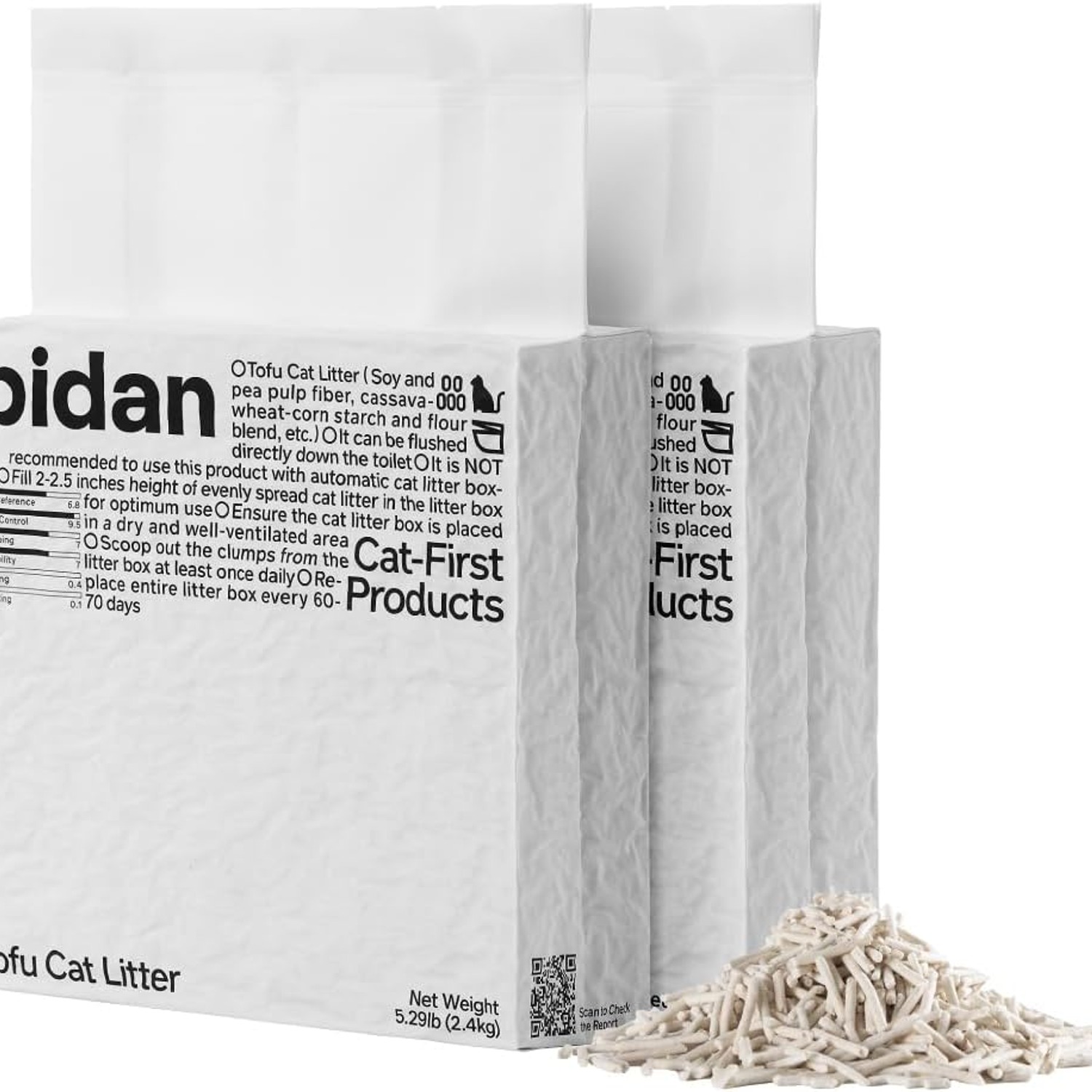
This particular litter lists its main ingredients as soy and pea pulp fibre, a cassava, corn and wheat starch and flour blend, and a silica and calcium carbonate blend with trace components. The soy and pea fibre does the absorbing. The starches help the pellets bind into clumps when they get wet. The mineral blend contributes to structure and moisture handling.
You get two bags in this pack, each listed at 5.3 lb, with a stated net capacity of 4.81 kg. The whole pack weighs in around 5.19 kg as displayed. That is a meaningful difference from carrying an equivalent clay supply up a flight of stairs.
How the clumping works
This is the part that decides whether a litter is any good.
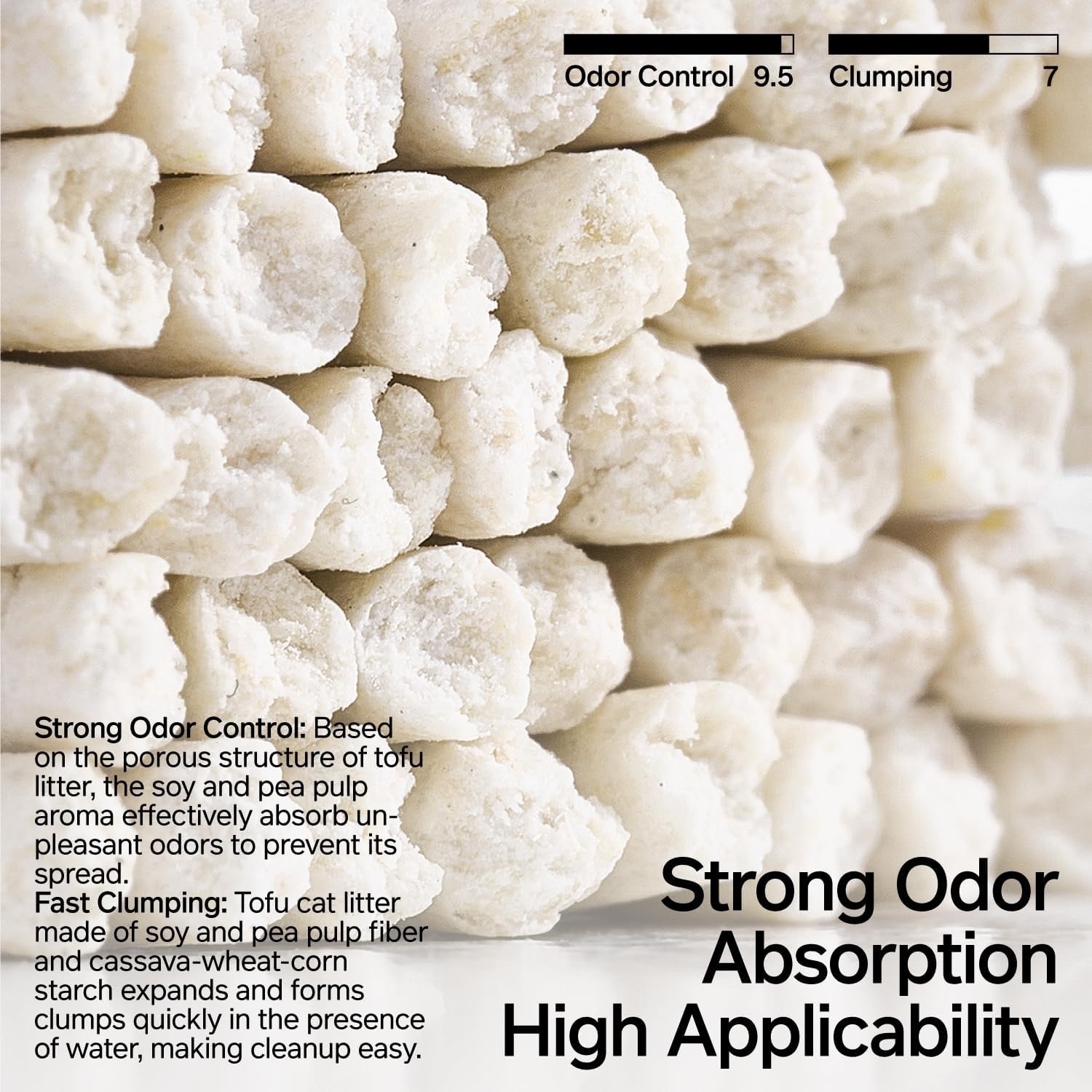
When your cat urinates, the pellets in contact with the liquid swell. The starch content makes them tacky, and they bind to the pellets around them. Within a short time you have a solid lump sitting in the bed of loose litter. You lift it out with a scoop and the rest of the tray is untouched.
That matters more than people realise. A litter that absorbs but does not clump means the moisture spreads through the whole bed, and so does the smell. You end up changing the entire tray far more often. Firm clumping means you are removing the problem rather than diluting it.
Depth is the thing that makes or breaks this. Fill your tray to around 5 to 6 cm (2 to 3 in) and spread it evenly. If you go shallow to make a bag last longer, the liquid hits the bottom of the tray before the pellets have absorbed it, and you get a soft mess stuck to the plastic instead of a clean clump. Every bit of litter you save by skimping, you lose in scrubbing.
The maker is honest about one limitation. If your cat produces a large volume in one sitting, that one patch can get saturated beyond what the pellets can handle, and the clump may come out softer than ideal. More depth helps. If it keeps happening, a cassava-based litter with stronger binding might be the better fit for your cat.
Dust, tracking and the floor around the tray
Two separate issues, often confused.
Dust is the fine powder that gets airborne. It comes from litter breaking down into smaller and smaller particles. Because this litter forms firm clumps that resist crumbling, there is less of that breakdown happening, and less powder getting stirred up when you pour or scoop. If anyone in your house has a dust sensitivity, or your tray lives in a small room with no window, this is the feature that will matter most to you.
Tracking is the litter that physically leaves the tray on your cat's paws. The fix is pellet size and weight. Fine grain litter slips between toes and gets carried off. These pellets are larger and carry enough weight that they tend to fall away rather than stick. You will still get some, every litter tracks a little, but a mat in front of the tray will catch most of it.
Flushing, and when not to
Small amounts of this litter can be flushed. The practical approach is to send it down in several small batches, letting the cistern refill between each one, rather than tipping a full scoop in at once.
Do not flush if you are on a septic tank. Do not flush if you live in an older building with narrow or temperamental pipework. And check your local water authority rules, because some areas discourage flushing any cat waste due to parasite concerns.
If flushing is off the table for you, binning it works exactly as it would with any other litter. You simply do not get the convenience benefit.
Who this suits, and who it does not
It suits people in flats and small homes where dust and smell have nowhere to go. It suits anyone tired of hauling heavy bags. It suits owners who want a plant based option but are not willing to give up clumping performance to get it.
It does not suit automatic litter boxes. The product details state clearly that it is not recommended for them, so if you have a self-cleaning tray, look elsewhere. It may not be the best choice for a cat with an unusually large single output, for the clumping reason covered above.
Multi-cat homes can absolutely use it. You will just go through it faster and should scoop more often. The usual rule of one tray per cat plus a spare still applies.
Making the switch without upsetting your cat
Cats notice texture changes under their paws and some of them object strongly. The way to avoid a protest is a gradual blend.
Mix the new litter with your current one at the next tray change. At the following change, increase the proportion of tofu litter. By the third change you should be fully switched over. Two changes is usually enough for most cats.
If your cat starts going outside the tray, go back a step and slow down. Do not add a scented product on top to encourage them, it usually has the opposite effect.
Day to day care
Scoop daily. That single habit does more for tray smell than any product feature.
Top up the litter after scooping so the depth stays where it should be. A tray that slowly gets shallower will start clumping badly and you will blame the litter rather than the level.
Keep the unopened bag somewhere cool and dry. Pellets that pick up moisture from a damp cupboard will not perform properly once they reach the tray. If you open a bag and do not use it all, fold the top down and clip it.
Wash the tray itself whenever you do a full change. Hot water and a mild detergent, rinsed well and dried completely before you refill.
The short version
This is a two bag pack of plant based pellet litter, 4.81 kg net, made from soy and pea pulp fibre with a starch blend. It clumps quickly, resists breaking into dust, and the larger pellet size keeps most of it in the tray rather than on your floor. Small amounts can be flushed.
Fill the tray to 5 to 6 cm (2 to 3 in), scoop every day, and switch your cat over gradually across two tray changes. Skip it if you run an automatic litter box. If your cat has a very heavy single output, be aware the clumps in that spot may come out soft.
Delivery is tracked across Canada, free on orders of $75 or more and $25 below that.