


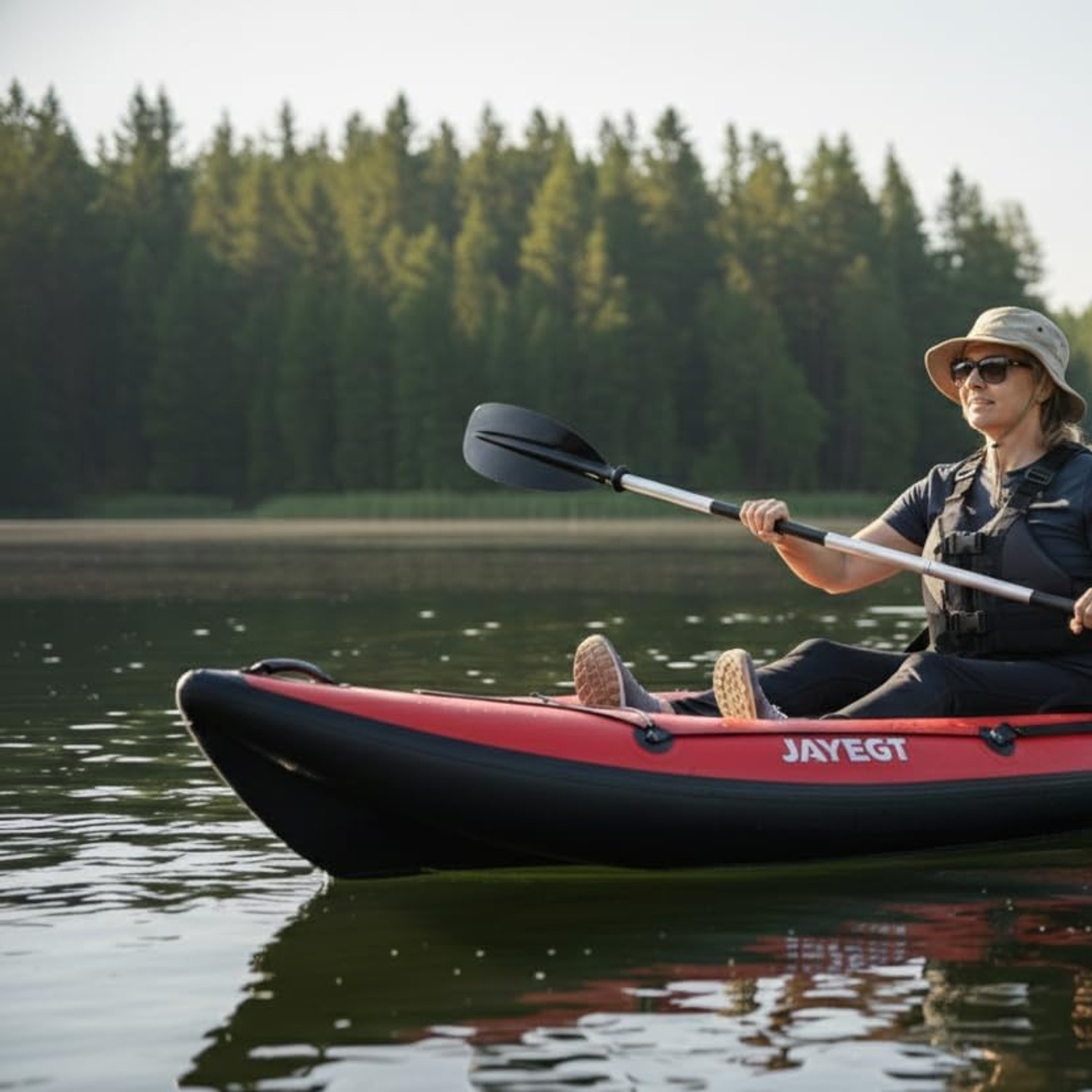
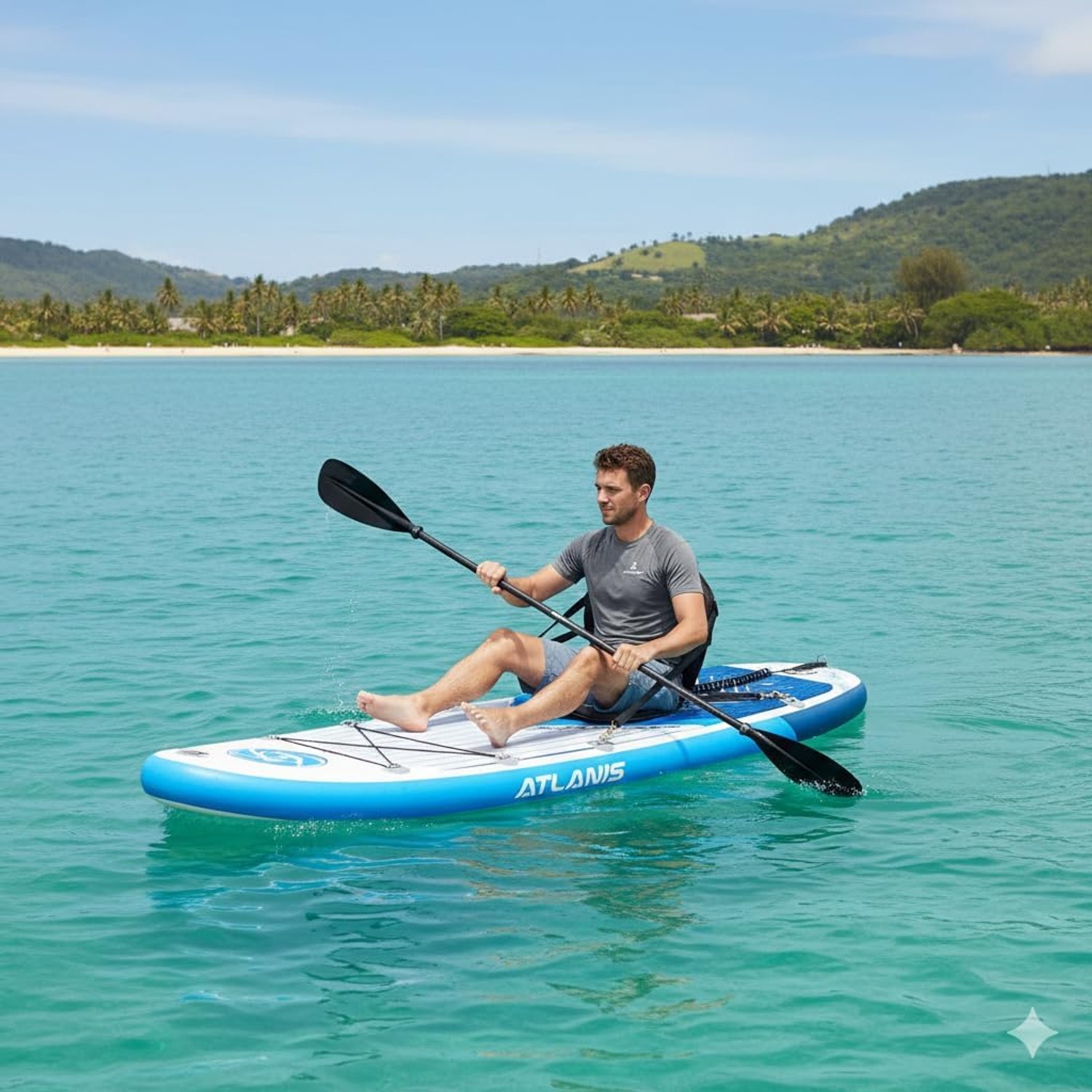
The complete guide
How to Choose a Kayak Seat That Keeps You Comfortable All Day
The problem with the seat your kayak came with
Kayaks are designed around the hull first. The seat is usually whatever the manufacturer could mould into the plastic without adding cost or weight. On a sit-on-top that often means a shallow dip with a bit of texture. On cheaper sit-insides it might be a thin pad glued to the floor.
Both are fine for a short paddle. The trouble starts around the forty-minute mark. Your tailbone finds the hard spot. Your lower back, with nothing to lean on, slowly rounds forward. You start shifting your weight from one side to the other, which throws off your stroke and makes you work harder for the same distance. By the time you get back to the launch you are stiff, and you tell yourself the kayak just is not that comfortable.
Usually the kayak is fine. The seat is the problem, and it is the cheapest part of the whole setup to fix.
What a padded kayak seat actually changes
Two things, mainly: cushioning underneath and support behind.
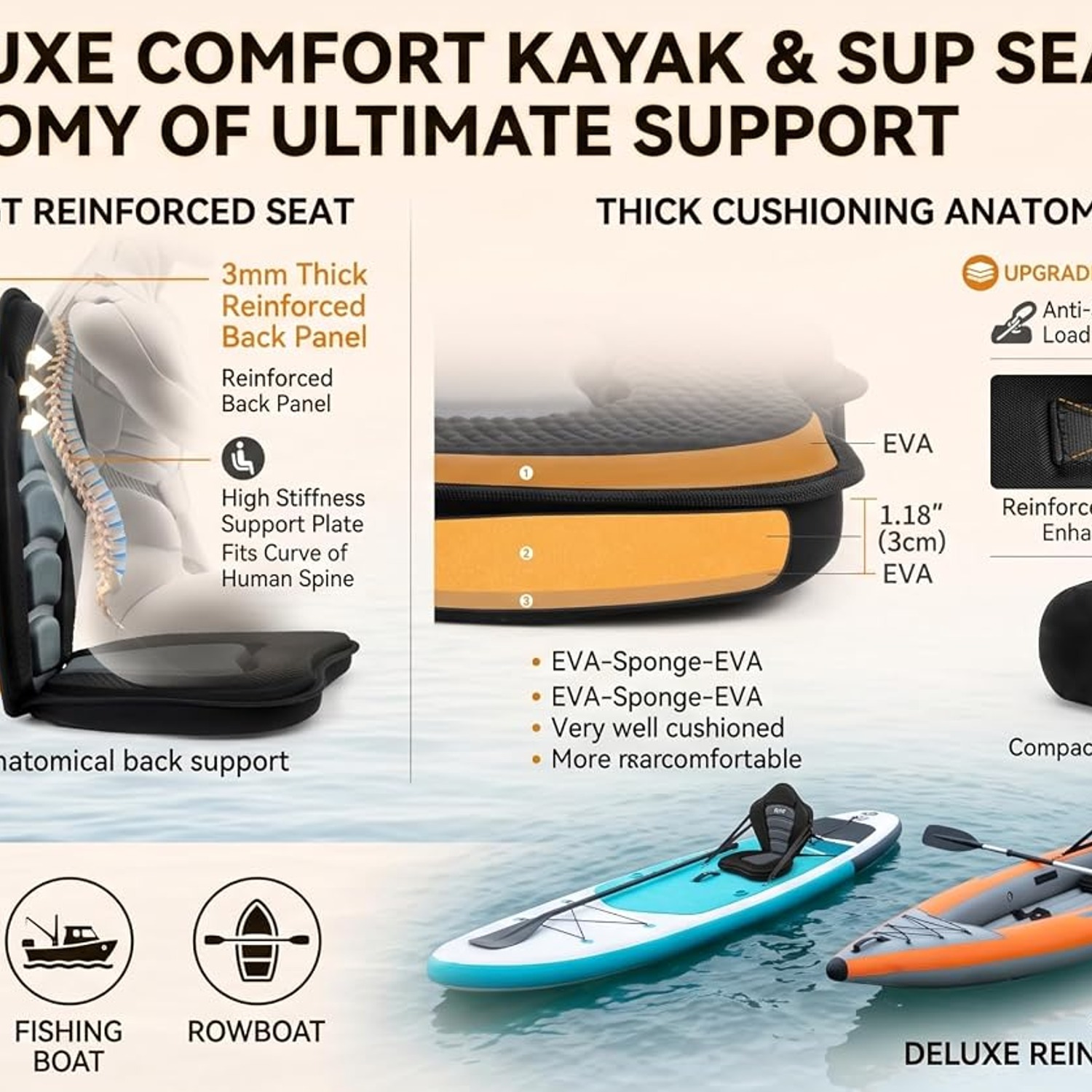
The cushioning spreads your weight across a wider area instead of concentrating it on your sit bones and tailbone against hard plastic. That alone buys you a lot more time on the water before anything starts aching.
The backrest does something less obvious but more important. When you have nothing behind you, your core muscles hold your torso upright for the entire paddle. That is tiring, and as those muscles fade your posture collapses forward, which cramps your breathing and shortens your stroke. A contoured backrest gives you something to settle against. You still engage your core when you are pulling hard, but between strokes you can rest against the back support instead of holding yourself up.
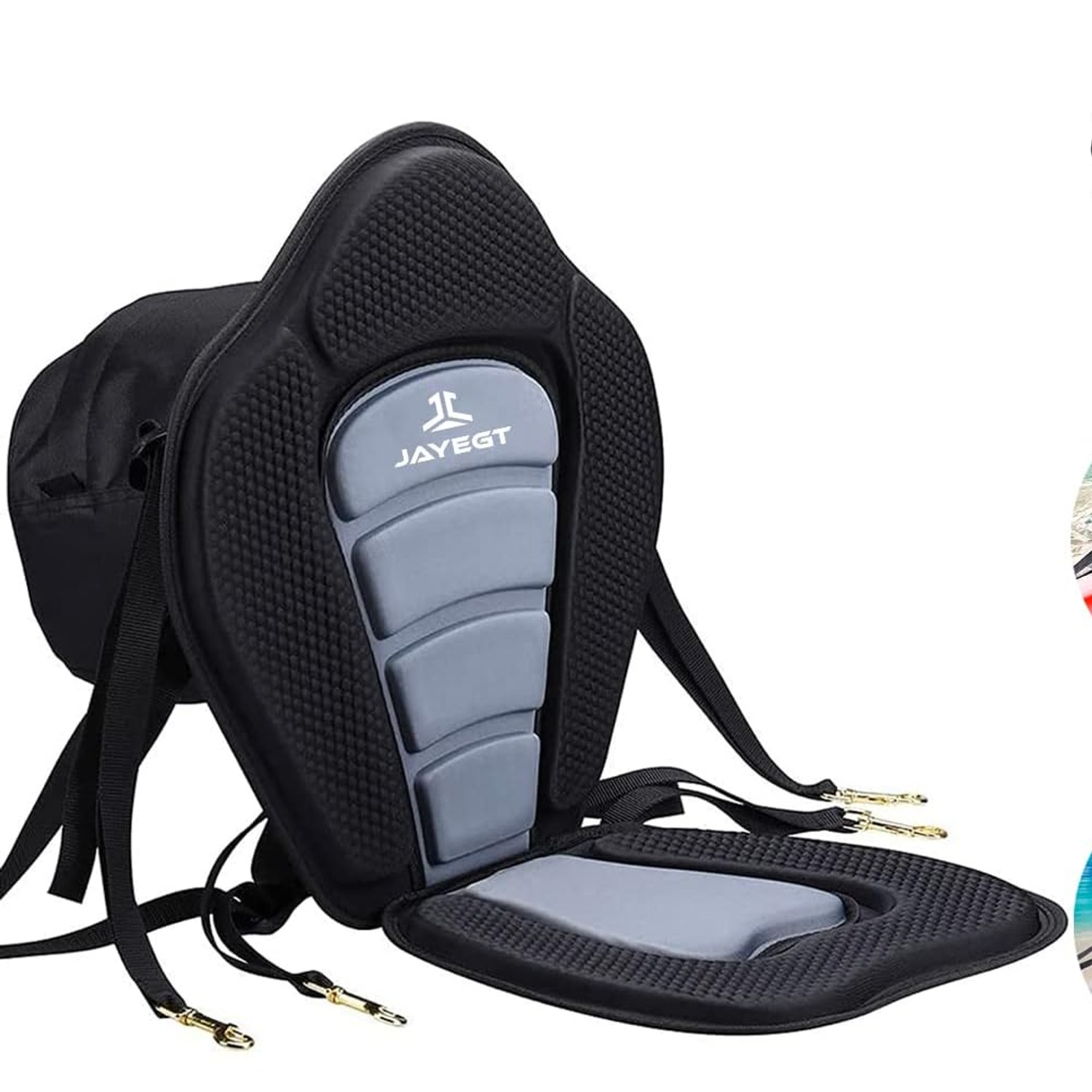
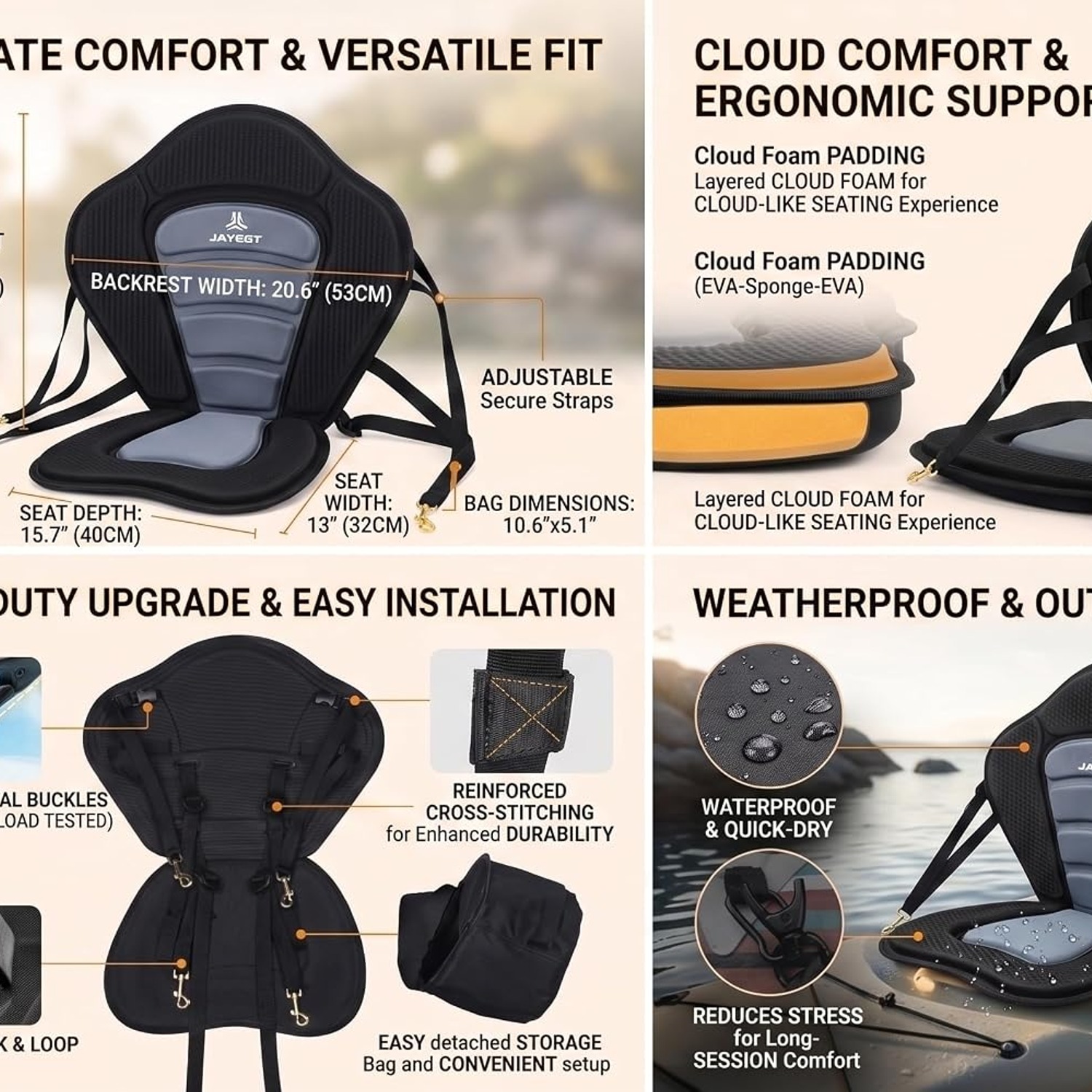
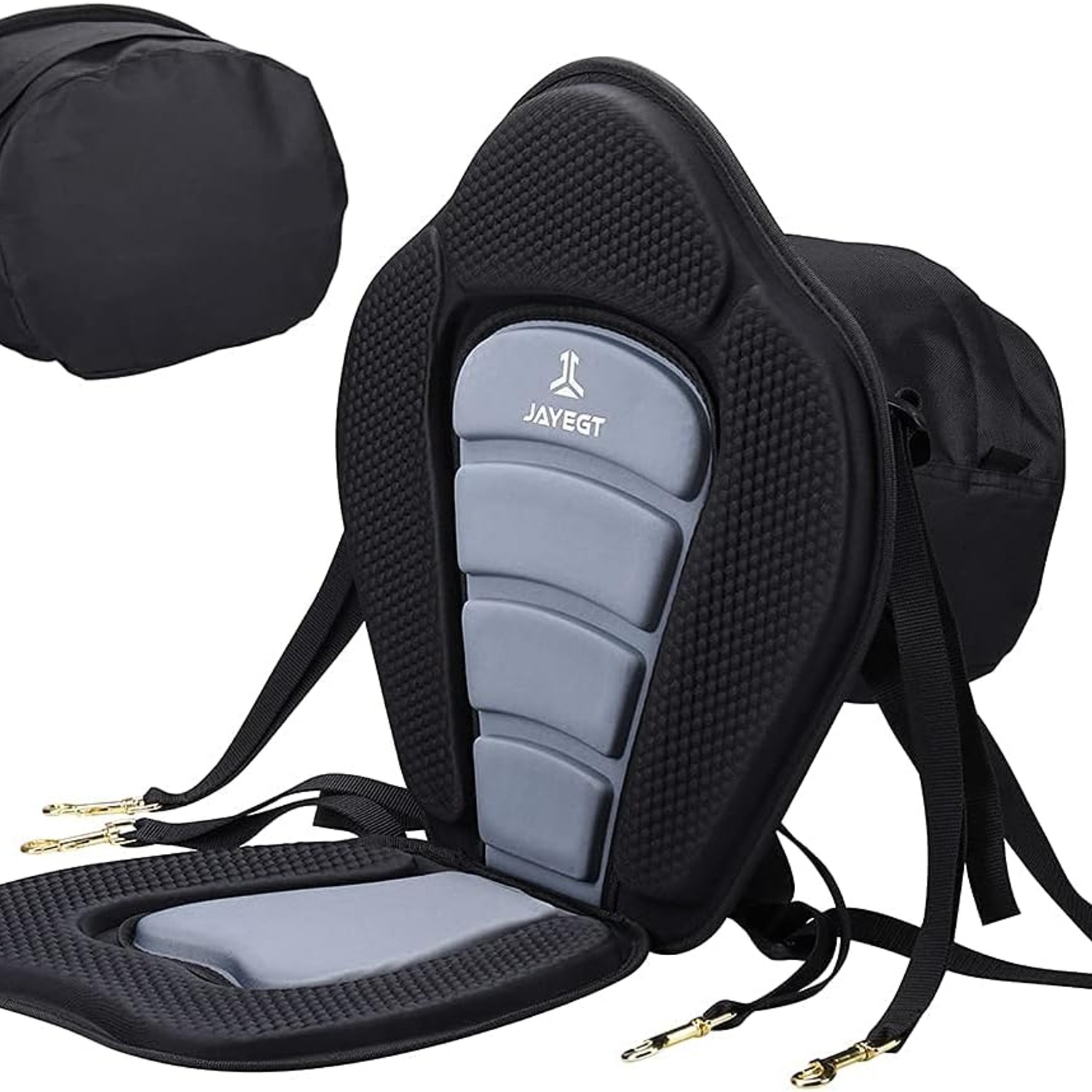
This seat has both. The base is padded and nylon-covered, and the backrest is contoured and soft on the inside face with an anti-slip finish so it does not creep around while you move.
How it attaches, and why that matters
The attachment is the part people underestimate. A cushion that slides every time you lean is worse than no cushion at all, because you spend the whole trip correcting for it.
Four adjustable straps with metal spring hooks handle that here. You clip the hooks to deck fittings, D-rings, seat well anchors or deck bungees, then pull the straps tight so the seat is held front and back. Once it is tensioned properly it should stay where you put it.
The straps adjust over a wide range, which is what makes the seat a universal fit across most kayaks, canoes and small boats. That flexibility is genuinely useful if you paddle more than one boat, or if you are buying for someone else and do not know their exact model.
One honest caveat about universal fit: it means the straps adjust widely, not that every hull shape is a perfect match. Hull geometry varies a lot. Before ordering, measure the flat area where you sit. The seat base is 40 cm wide and 29.7 cm deep. If your cockpit or seat well is narrower than 40 cm, it is going to be a squeeze.
Who this suits
Recreational paddlers who do two to four hour trips are the clearest fit. That is the distance where an unsupported back really starts to tell, and where a padded kayak seat with back support makes the difference between finishing happy and finishing sore.
Anglers get a lot out of it too. Fishing from a kayak means long stretches of sitting still, often twisted to one side to cast or work a rod, and sit-on-top fishing boats usually have plenty of deck fittings to clip onto. The detachable storage bag earns its place here as well, holding small tackle, a phone and spare leader within arm's reach.
Canoeists use it as a canoe seat cushion on bench seats, where the straps wrap and clip to give both padding and something to lean back into. Anyone with an existing back niggle will notice the difference quickly, though a seat is comfort equipment and not a medical device.
If you are a whitewater paddler or race in a narrow sea kayak with a fitted bucket seat and a thigh brace setup, this is not aimed at you. Those boats rely on close contact with the hull, and adding a cushion loosens that.
How to choose, in practical terms
Start with measurements, not pictures. Take a tape measure to your boat and write down the width and depth of the flat seating area, plus the distance between the fittings you would clip the straps to. Compare that against the 40 cm width and 29.7 cm depth of this seat. That one check prevents most fit disappointments.
Next, look at your attachment points. Count what you have around the seat area: D-rings, pad eyes, deck lines, side handles. You need at least two usable points behind you and two in front. If you have nothing, you can add aftermarket pad eyes, but factor that in before you order.
Then think about weight and packing. This seat is 1.33 kg and packs to 38 x 51 x 44 cm. If you carry your boat any distance from the car, or you are already loading a paddle, PFD, dry bag and water, every kilo counts. A seat in this weight range is barely noticeable in the overall load.
Finally, consider whether you want storage built in. The detachable bag here is coated in water-resistant material and sized for small personal items. If you already run a deck bag you might leave it off, and that is an option since it detaches. If you do not, having keys and a phone behind you rather than buried at the bow is a small convenience you will use every trip.
Looking after it
Kayak gear lives a hard life. Sun, salt, sand and damp storage are what kill fabric and hardware, not the paddling itself.
Rinse the seat with fresh water after every salt water trip, and brush grit out of the straps and off the metal spring hooks. Sand is abrasive and works its way into the webbing where it grinds away at the fibres each time you adjust the straps.
Spot clean the fabric with mild soap and a soft cloth. Skip the machine wash, the tumble dryer and bleach, all of which are rough on padding and coated fabric. Air dry it fully, standing up with airflow around it, and keep it out of harsh direct sun while it dries. UV is the slowest and most reliable way to wreck outdoor fabric.
Store it dry, somewhere cool, and loosely rather than folded hard under other gear. Padding that is compressed into a sharp crease for months tends to stay that way. Before each trip, give the straps a quick look and squeeze the hook springs to check they still snap shut.
The short version
Your kayak's factory seat is almost certainly the weakest part of your setup, and it is also the easiest and cheapest thing to improve. A padded base stops the hard-plastic ache, and a contoured backrest lets you stop holding yourself upright for the whole paddle.
This one is black, nylon-covered, 1.33 kg, with a 40 cm wide and 29.7 cm deep seat base, four adjustable straps with metal spring hooks, and a detachable water-resistant storage bag. It is a universal fit across most kayaks, canoes and small boats, and it carries a one year manufacturer warranty.
Measure your seating area first. If it is 40 cm wide or more and you have fittings to clip to, this is a straightforward upgrade that you will notice on the very next trip.