

Clearance Warehouse Canada
Company
Shop By Category
T&Cs
Shop Online
  • Free delivery across Canada on orders of $75 or more
  • Lawn and garden, home improvement, bedding, car, kids and health lines in one place
  • Dispatch within 2 working days, then delivery in up to 7 working days by tracked courier
  • Tracking number emailed as soon as your order ships

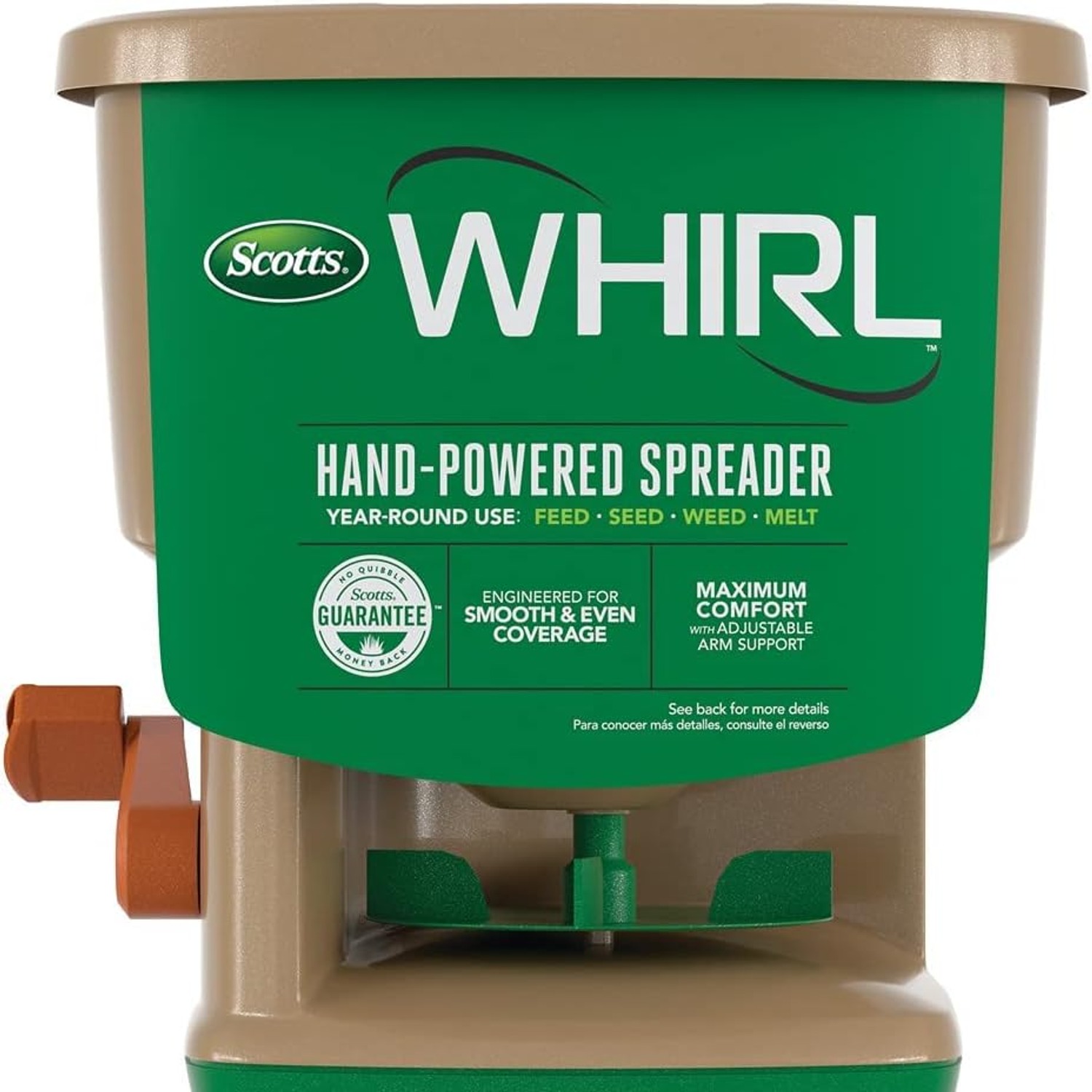
Hand Spreader | Handheld Seed Spreader | Hand Held Fertiliser Spreader

Make short work of spreading seed and fertiliser

Hand Spreader

$40.49 $48.59 Save $8.10
  • One-Handed Control
  • 1.5 m Spread Path
  • Adjustable Arm Support
  • Stores Anywhere

Price: $40.49 $48.59

  • Delivery time: up to 7 working days by tracked courier, after dispatch within 2 working days
  • Free delivery on orders $75+, otherwise a flat $25
  • Pay by card or PayPal, handled by the payment provider
  • 15 days from delivery to return an unused item, plus your statutory rights
Product specifications
Item FormGranules
Application MethodWalking and operating the spreader
CoverageFull
Target SpeciesLawn grass
Included ComponentsSpreader only
Item Weight227 g
Product Dimensions33.27 x 22.1 x 21.59 cm
Number of Items1
Number of Packs1
Unit Count1 count
Country of OriginUSA
Warranty1 year manufacturer
Weight227 g
Shipping & returns

Tracked delivery across Canada. It is free on orders of $75 or more, and a flat $25 below that. Allow up to 7 working days in transit after dispatch within 2 working days.

You have 15 days from delivery to return an unused item in its original packaging for an exchange or a refund. You cover the cost of shipping it back.

If it arrives faulty, damaged or not as described, tell us right away and our customer service team will sort it.

Shipping details · Refunds and returns

One-Handed ControlHand-cranked operation with a trigger, so you set the pace yourself.
1.5 m Spread PathThrows a 1.5 m (5 ft) swath for quick, even passes over a small lawn.
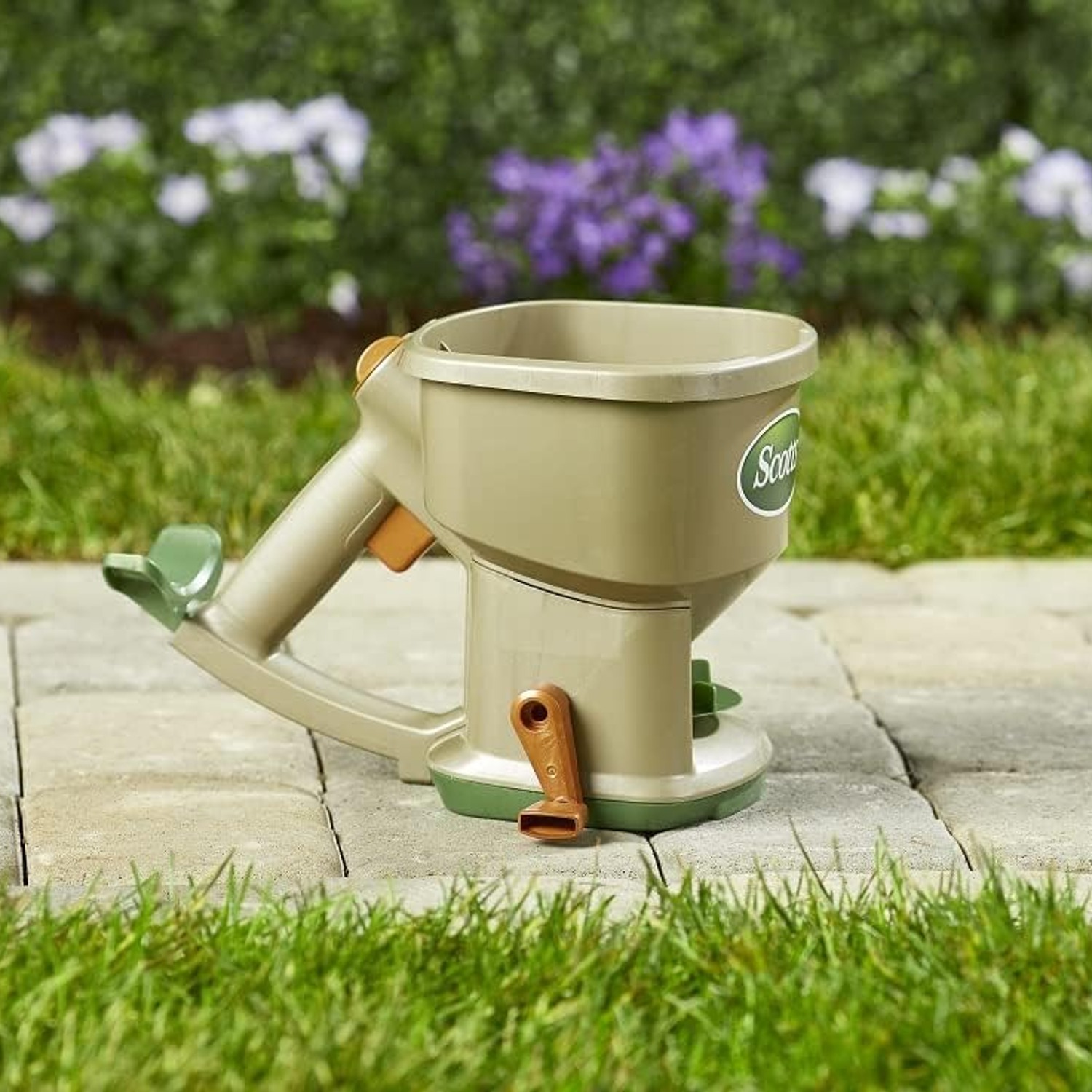
Adjustable Arm SupportThe support arm takes the load off your wrist on longer jobs.
Stores AnywhereCompact 33.27 x 22.1 x 21.59 cm footprint fits on a garage shelf.

Feed, seed and de-ice a small yard in minutes with a hand spreader that fits in one hand and stores on a shelf.

A hand-cranked spreader with an adjustable arm support and a 1.5 m (5 ft) spread path, built to hold enough product to cover up to 139.4 square metres (1,500 sq ft).

A handheld, hand-cranked spreader built for small yards, narrow strips of lawn and the awkward corners a push spreader cannot reach.

The hopper holds enough product to cover up to 139.4 square metres (1,500 sq ft), which is plenty for most suburban front lawns in one fill.

An adjustable arm support shares the weight so your wrist is not doing all the work during a full pass.

It spreads granular products, so the same tool handles lawn feed, grass seed, weed treatments and winter ice melt.

At 227 g and 33.27 x 22.1 x 21.59 cm, it tucks onto a shelf instead of taking up floor space in the shed.

Hand Spreader

Most lawn spreaders are built for lawns that do not exist in the average street. The big push models with bicycle wheels assume a wide, open run of grass and a garage with floor space to spare. If your lawn is a front strip, a back square and two awkward side paths, a hand spreader does the same job with none of the wrestling. You fill it, set the rate, walk and turn the crank.

Hand Spreader

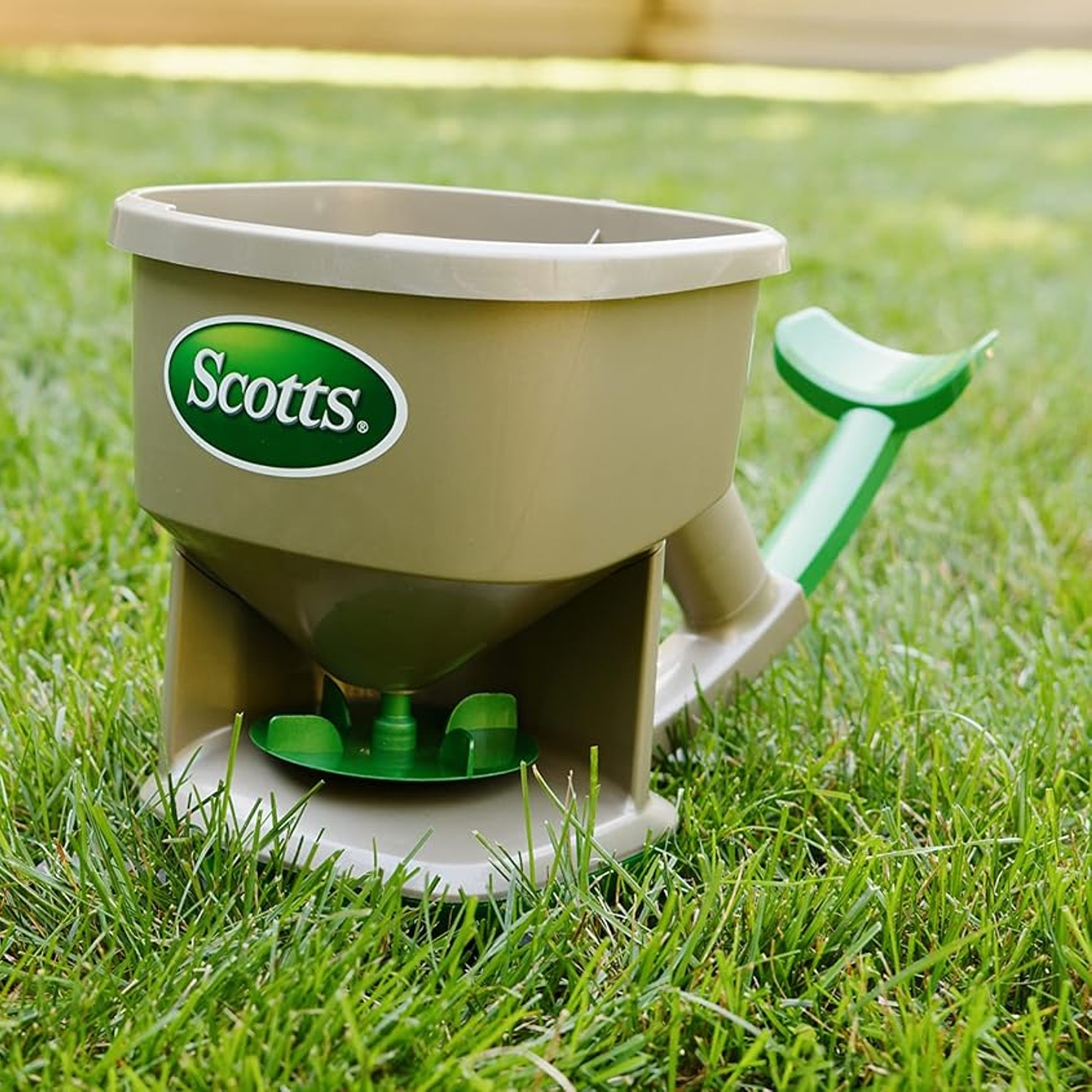
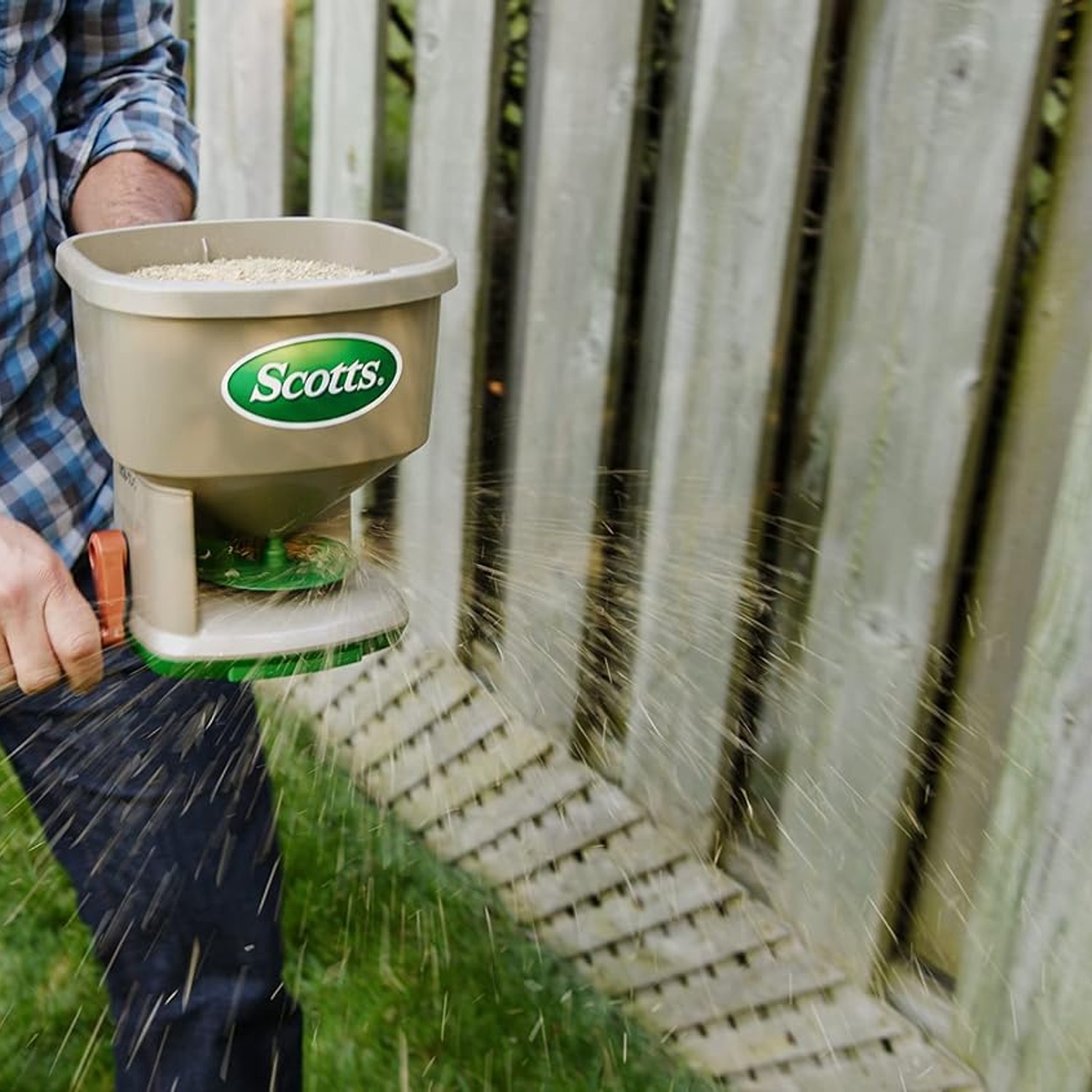
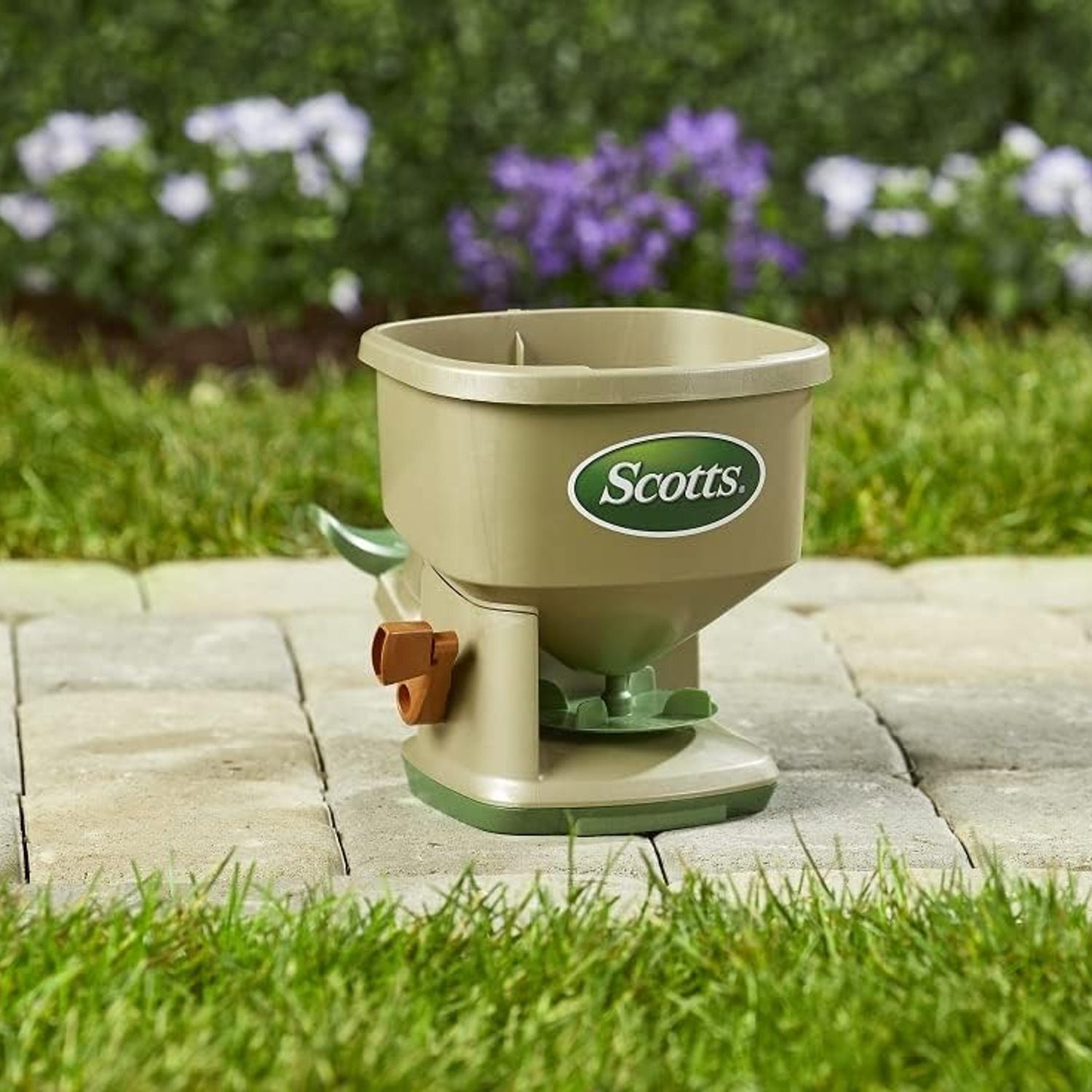
The way it works is simple mechanics. Granules drop from the hopper onto a spinning plate, and the plate flings them outward in an even fan. Turning the crank spins the plate, pulling the trigger opens the gate, and the rate setting controls how wide that gate opens. Because you control both the crank speed and your walking speed, you get a feel for the pace quickly, usually within the first two passes.

Hand Spreader

With a 1.5 m (5 ft) application path, coverage adds up faster than people expect. A full hopper handles up to 139.4 square metres (1,500 sq ft) of product, which covers a typical suburban front lawn without a refill. Walking in slightly overlapping lines, the way you would mow, gives the most consistent result and avoids the striped look that comes from gaps between passes.

Hand Spreader

It is a year-round tool rather than a spring-only one. Lawn feed in the growing season, grass seed for overseeding and patch repair, weed treatments where the label allows a spreader, and ice melt or salt on paths and driveways in winter. Anything granular that pours freely is a candidate. Wet or heavily clumped product is the main thing to avoid, since damp granules bridge in the hopper and stop feeding evenly.

Hand Spreader

Storage is the quiet advantage. At 227 g and 33.27 x 22.1 x 21.59 cm, it sits on a shelf next to the secateurs instead of blocking the shed door. For anyone in a townhouse, a flat with a courtyard, or a home where the garage already has a bike and a mower competing for space, that matters as much as the spreading itself.

Not sure yet? That is fine.

You can change your mind. You have 15 days from delivery to return an unused item in its original packaging for an exchange or a refund. You cover the cost of shipping it back.

If it turns up faulty, damaged or not as described, tell us and our customer service team will sort it. Read the full detail on our refunds and returns page, or ask us anything before you order.

Frequently Asked Questions

What is a hand spreader?

It is a small, handheld tool that spreads granular products evenly over the ground. You hold it in one hand, pull a trigger to open the hopper gate and turn a crank to spin the spreading plate. It does the same job as a large push spreader, just on a smaller scale.

How does it actually spread the granules?

Granules fall from the hopper onto a plate underneath. Turning the crank spins that plate, and it throws the granules outward in a fan. The trigger controls whether granules are flowing, so you can stop the flow at the end of a pass without stopping walking.

How wide is the spread path?

The listed application swath is 1.5 m (5 ft). That is the width of grass covered on a single pass at a steady walking speed. Overlapping your passes slightly helps avoid thin lines between them.

How much area does one fill cover?

The hopper holds up to 139.4 square metres (1,500 sq ft) worth of product. The actual area depends on the rate setting and the density of what you are spreading. Heavier products fill the hopper at a lower volume.

Does it come assembled?

Yes, it arrives already assembled, so you can fill it and start spreading. There is no tool-based build step. Give the crank a turn before the first fill to check everything moves freely.

What is included in the box?

The included components are listed as spreader only. No lawn feed, seed or ice melt is supplied with it. You buy the granular product separately to suit the job.

What can I put in it?

It is designed for granular products, which covers lawn feed, grass seed, granular weed treatments and ice melt or salt. The item form is listed as granules. Liquids, powders and anything damp or clumped are not suitable.

Can I use it for grass seed?

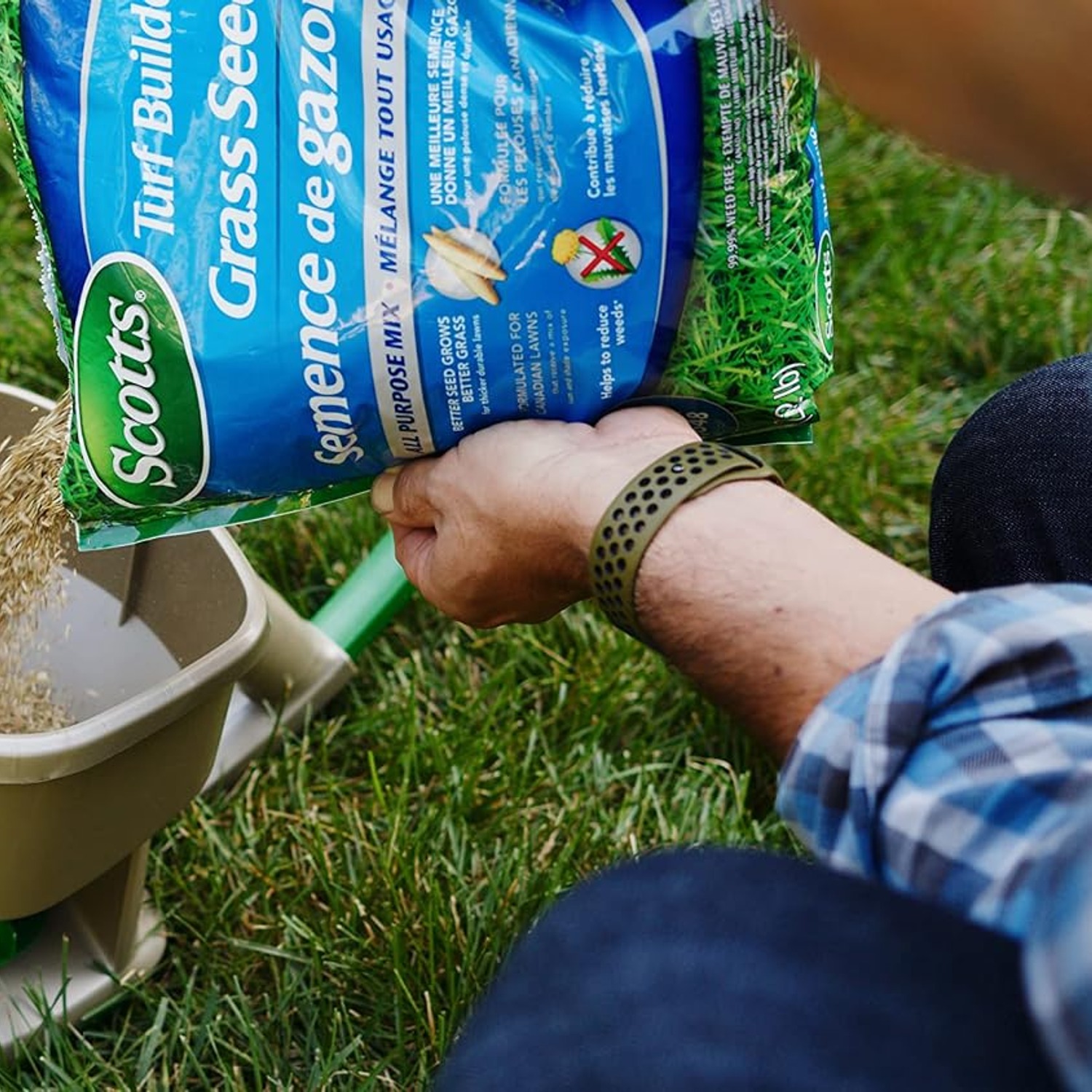
Yes, that is one of its main uses. A handheld seed spreader gives much better coverage than throwing seed by hand, which tends to land in clumps. Set a low rate for seed and make two passes at right angles for even results.

Is it any good for ice melt in winter?

Yes, ice melt is one of the listed year-round uses. Spreading salt or ice melt with a tool gives a thinner, more even layer than tipping it from a bag, which saves product. Rinse the hopper well afterwards, since de-icing salt is corrosive.

How big a lawn is this suitable for?

It suits smaller yards best, roughly the size you could mow in fifteen or twenty minutes. For anything over a few hundred square metres you will be refilling often and your arm will feel it. Large open lawns are better served by a push model.

What is the arm support for?

The support arm is adjustable and braces against your forearm, so the weight of a loaded hopper is spread rather than hanging off your wrist. It makes a noticeable difference once you are past the first few minutes. Adjust it before you fill the hopper, not after.

Is it hard to turn the crank?

No, the crank is designed to be turned at a steady, relaxed pace while you walk. The resistance is light. Most people find the rhythm of crank and step within a pass or two.

How do I set the spread rate?

There is a rate setting that controls how far the hopper gate opens. Start with the setting recommended on your product bag, then adjust if you find you are going through product too quickly or too slowly. When in doubt, use a lower setting and make two passes.

What is the best way to get even coverage?

Walk at a constant pace in straight, slightly overlapping lines, the way you mow. Keep cranking at a steady speed and release the trigger when you turn at the end of a row. For seed or feed, a second pass at ninety degrees to the first evens out any gaps.

How much does it weigh?

The spreader itself weighs 227 g empty. Once filled, the weight depends entirely on what you load into it. Fertiliser and ice melt are considerably heavier than grass seed at the same volume.

What are the dimensions?

It measures 33.27 x 22.1 x 21.59 cm. That is small enough to sit on a standard garage or shed shelf. The compact size is one of the reasons it suits homes with limited storage.

What colour is it?

The colour is not specified in this product record. We only list details the supplier provides, rather than guessing. The specifications table shows everything confirmed for this item.

What is it made from?

We do not state materials that are not confirmed by the supplier. All confirmed details appear in the specification list on this page.

Where is it made?

The country of origin is listed as USA. That is the figure given in the supplier's product details. Nothing further about manufacturing is specified.

Is there a warranty?

Yes, the listing states a one year manufacturer warranty. Keep your order confirmation as proof of purchase. Warranty terms are set by the manufacturer, not by us.

How do I clean it after use?

Empty out any leftover granules, then rinse the hopper with clean water. Shake out the water and let it dry fully with the gate open before storing. This matters most after spreading fertiliser or salt, both of which attract moisture.

Why should I not leave product in the hopper?

Granular fertiliser and ice melt both draw moisture from the air. Left sitting, they clump and can seize the gate or corrode metal parts. Emptying it takes thirty seconds and saves a lot of trouble next season.

Can I store it outside?

It is better kept indoors or in a dry shed. Damp storage invites rust on moving parts and can cause the gate to stick. A shelf in a garage is ideal given its small footprint.

Will it work with wet or clumped product?

Not well. Damp granules bridge inside the hopper and stop feeding onto the plate, which gives patchy coverage. Break up clumps and use dry product for a consistent spread.

Can one person manage it, or do I need both hands?

One hand holds and supports the spreader while the other turns the crank and works the trigger. So you use both hands, but it is a one-person job with no setup or towing involved. The arm support carries most of the load.

Is it suitable for spreading on gravel or paths?

For ice melt on paths and driveways, yes, that is a listed use. For fertiliser, keep it on the grass, since granules landing on hard surfaces simply wash into drains. Release the trigger as you approach edges to limit overthrow.

Does it work for garden beds as well as lawn?

The listed target species is lawn grass, so lawns are what it is designed around. Some gardeners use handheld granular spreaders for broad beds, but you will have less control around individual plants than with hand application. Check your product label for what it allows.

How is it delivered?

Delivery is tracked across Canada. Orders of $75 or more ship free, and orders under that are $25. You will receive tracking details once your order is dispatched.

Does it make a good gift?

It works well as a gift for anyone with a small lawn, a new homeowner or someone who tends to overseed by hand. It is a practical tool rather than a novelty, and the compact size means it will not become a storage problem. Pair it with a bag of seed or feed if you want to round out the present.

What if it is not right for me?

Get in touch with our team and we will walk you through the return process. Keep the item unused and in its original packaging where possible, since that makes the process quicker. If something arrives damaged or faulty, send us a photo and we will sort out a replacement or refund.

Hand Spreader Buyer's Guide, Choosing and Using a Handheld Seed Spreader

6 min read Clearance Warehouse

The problem with spreading by hand

Everyone has tried it. You tear open a bag of lawn feed, grab a handful and fling it across the grass. Two weeks later the lawn tells on you. There are dark green stripes where the handfuls landed thick, pale patches where they did not, and in bad cases a few scorched spots where fertiliser piled up.

The same thing happens with grass seed. Thrown by hand, seed lands in clusters. The clusters sprout as dense tufts that compete with each other, while the bare ground between them stays bare. You end up buying more seed to fix a problem that was really about distribution, not quantity.

A hand spreader solves this with simple mechanics. The granules drop onto a spinning plate, the plate throws them outward in a fan, and the fan is the same width every time. Your job is to walk at a steady pace. That is the whole trick, and it is why the result looks uniform instead of patchy.

How a handheld seed spreader works

Lift the lid, pour in your granules, close it. There is a rate setting that controls how far the gate under the hopper opens, which in turn controls how much product flows through. Most bags of lawn product print a suggested setting on the back, and that is the sensible place to start.

Then you walk. Pull the trigger to open the gate, turn the crank at a comfortable speed, and keep your walking pace even. Release the trigger when you reach the end of a row, turn around, and pull it again as you start the next one. Releasing at the turn is important. If you keep the gate open while pivoting, you dump a concentrated patch of product right where you turned.

This model throws a 1.5 m (5 ft) swath, which means a single pass covers a decent band of grass. With a full hopper you have enough capacity to cover up to 139.4 square metres (1,500 sq ft), so a standard front lawn usually goes down in one fill.

The adjustable arm support deserves a mention. A loaded hopper is not heavy in absolute terms, but holding anything out in front of you while cranking gets tiring. The support braces against your forearm so the load sits on your arm rather than your wrist. Set it before you fill the hopper, because adjusting it while holding a full load is awkward.

Who this suits

Think about the shape of your garden, not just its size. Push spreaders need room to run. They want long straight stretches and a turning circle at each end. If your lawn is a narrow front strip, a square out the back, and two side paths between the house and the fence, a push model spends more time being manoeuvred than spreading.

A handheld spreader goes wherever you go. Down a side path, around a washing line, between beds, into the corner behind the shed. This is why it tends to be the right pick for townhouses, terraces, courtyard gardens and ordinary suburban blocks.

The other group it suits is anyone short on storage. At 33.27 x 22.1 x 21.59 cm and 227 g, this sits on a shelf. A push spreader occupies real floor area in a shed that is probably already holding a mower, a bike and a bag of potting mix. For a lot of households, that is the deciding factor.

Who should look elsewhere? If you are maintaining a large open lawn, a sports ground or anything that takes real time to mow, a walk-behind spreader will serve you better. You would spend too long refilling a hand unit and your arm would let you know about it.

Choosing a spreader, what actually matters

Capacity against your lawn size. Match the hopper to the area so you are not refilling constantly, but do not oversize either. A hopper you cannot comfortably hold when full is a hopper you will not use. Around 139.4 square metres per fill is a sensible target for a handheld tool.

Swath width. Wider is faster but needs more care with overlap. A 1.5 m path is easy to judge by eye, which makes it forgiving for anyone who has not used a spreader before.

Rate control. You want a gate you can set rather than one fixed opening. Grass seed goes down at a far lower rate than ice melt, and a spreader with no adjustment will waste one and under-apply the other.

Comfort. Arm support, grip shape and how the crank sits relative to your hand all matter more than the spec sheet suggests. You find out five minutes in, not in the first thirty seconds.

Storage. Measure the shelf before you buy. The best hand spreader for small lawns is the one you can actually put away without moving three other things first.

Using it across the year

This is not a spring-only tool, which is a large part of its value.

In spring and autumn, it handles lawn feed and overseeding. Autumn overseeding in particular benefits from even distribution, since you are filling in thin areas rather than treating the whole lawn equally. Two passes at right angles to each other, both at a low rate, give better coverage than one pass at a high rate.

Through the growing season, granular weed treatments go down the same way, assuming the product label permits spreader application. Always check the label, since some treatments specify a particular method.

In winter, it becomes a salt spreader for driveways and paths. Tipping ice melt from the bag is wasteful and uneven, and you usually end up with too much in some places and bare ice in others. A thin, consistent layer works better and uses less product. Just be disciplined about rinsing afterwards, because de-icing salt is hard on metal.

Care, the five minutes that matter

Empty the hopper every time. Not most times, every time. Both fertiliser and ice melt pull moisture out of the air, and leftover granules turn into a solid crust that jams the gate and corrodes whatever they are sitting against.

Rinse the hopper with clean water, tip it out, and leave it open to dry fully. Wipe the crank mechanism and trigger dry rather than leaving water sitting in them. Store it somewhere dry, indoors or in a shed, not on a bench outside under a tarp.

At the start of each season, turn the crank a few times before you fill it and check the gate opens and closes cleanly. If anything feels stiff, a rinse and a dry usually sorts it. This routine takes a few minutes a year and is the difference between a tool that lasts and one that seizes up by its second winter.

The short version

If your lawn is small or awkwardly shaped, a hand spreader does everything a push spreader does without the bulk. You get a 1.5 m spread path, enough capacity for about 139.4 square metres per fill, an arm support that makes longer jobs bearable, and a tool that stores on a shelf.

It handles feed, seed, granular weed treatments and ice melt, so it earns its place year round rather than sitting idle for nine months. Keep it dry, empty it after use, and walk at a steady pace. That is genuinely all there is to it.

Browse the shop

Not sure which spreader suits your lawn?

Tell us the rough size of your lawn and what you plan to spread, and we will point you to the right option.

Ask us a question

Page summary

It weighs 227 g and measures 33.27 x 22.1 x 21.59 cm. It spreads granular products such as lawn feed, grass seed, weed treatments and ice melt, with an application swath of 1.5 m (5 ft) and a hopper that holds enough product to cover up to 139.4 square metres (1,500 sq ft). Operation is by walking while pulling the trigger and turning the crank, with an adjustable arm support to reduce fatigue. The spreader ships assembled and is supplied on its own, with no product included. A one year manufacturer warranty is listed.