


The complete guide
How to Choose and Use a Garden Edging Tool
The problem with a lawn that has no edge
Mow a lawn and it looks fine for about a day. Then you notice the bits that are still messy: grass leaning over the path, a bed line that has drifted and gone fuzzy, a driveway lip with turf creeping across it. None of that gets fixed by mowing, because a mower cuts the top of the grass, not the side of it.
Edging is the step that makes a garden look cared for. It is also the one most people skip, usually because the tools to hand are not right for it. A spade is too flat and too wide. Shears mean crouching. A string trimmer sprays debris and leaves a ragged line. What you actually need is a blade shaped to slice straight down through turf, mounted on a handle long enough that you can stand up while you use it.
That is what a half moon edger is for, and it has barely changed in design for a century because the shape works.
How a manual edging tool works
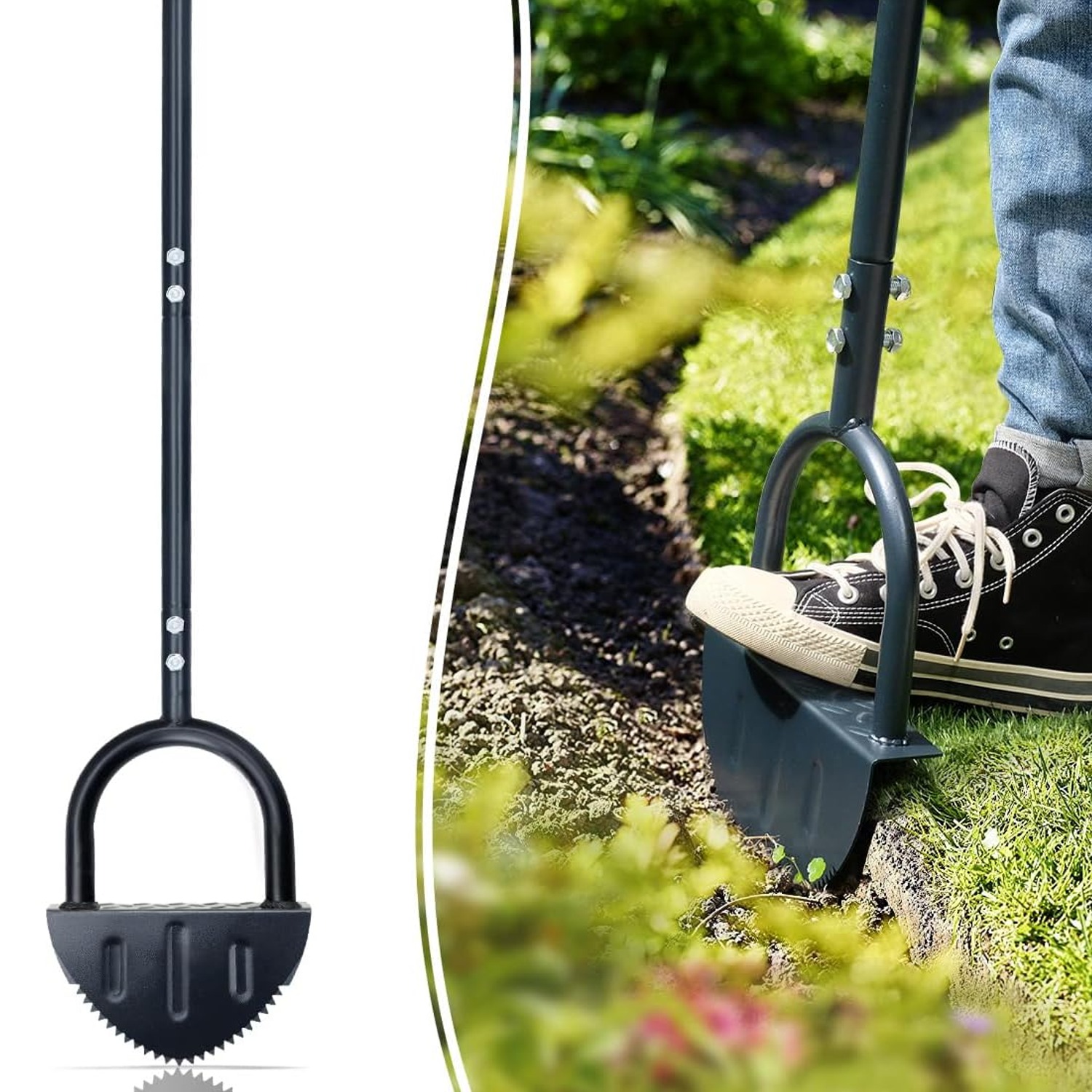
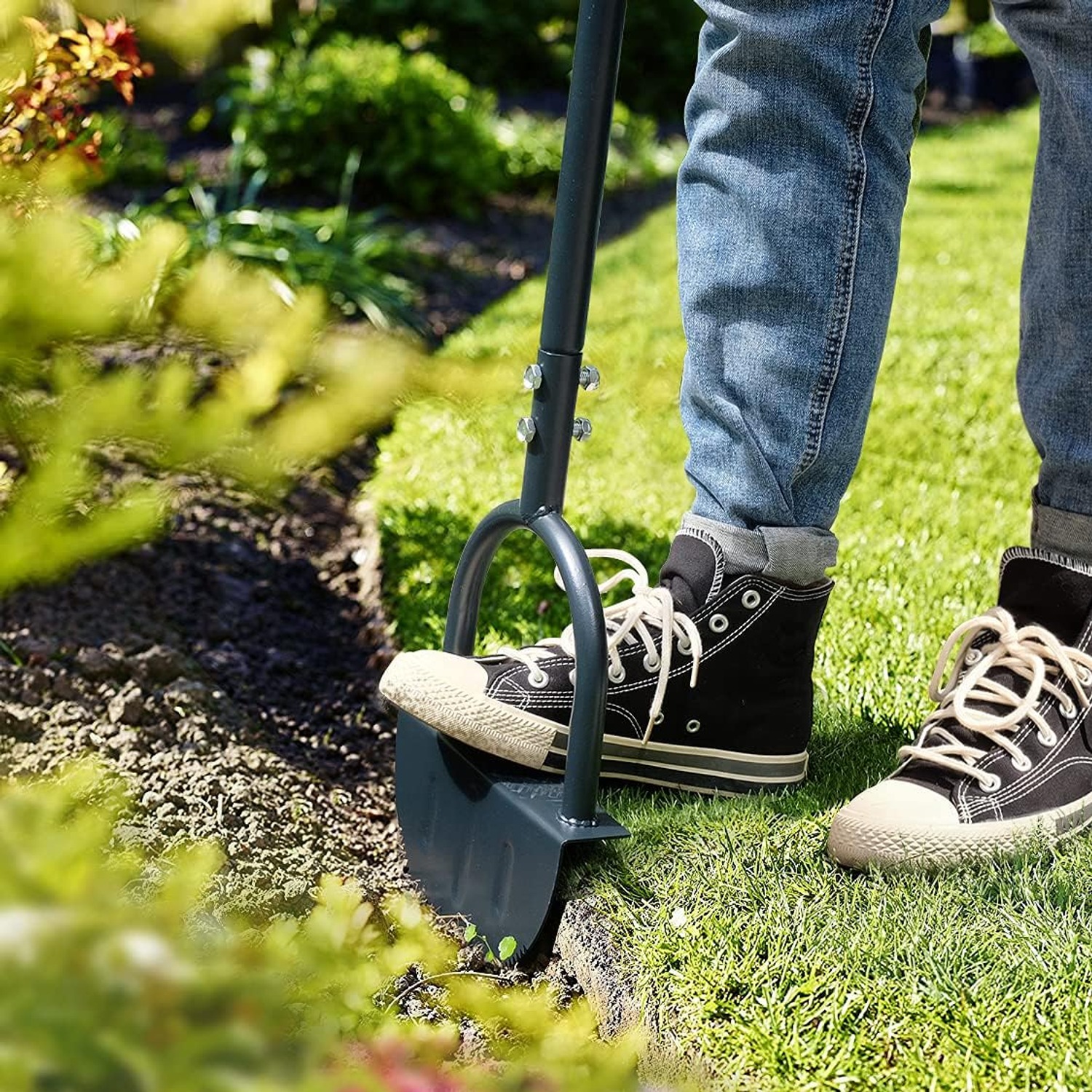
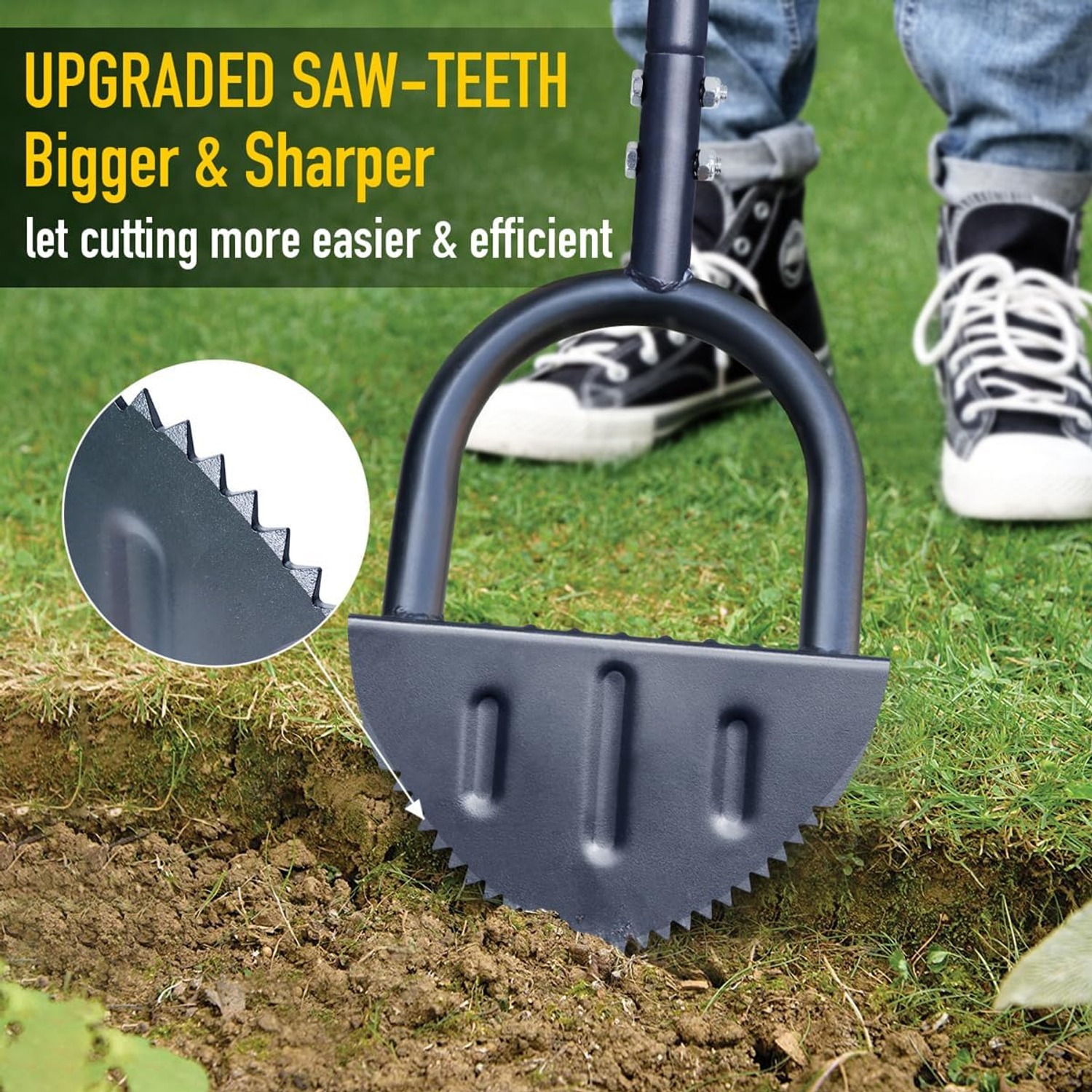
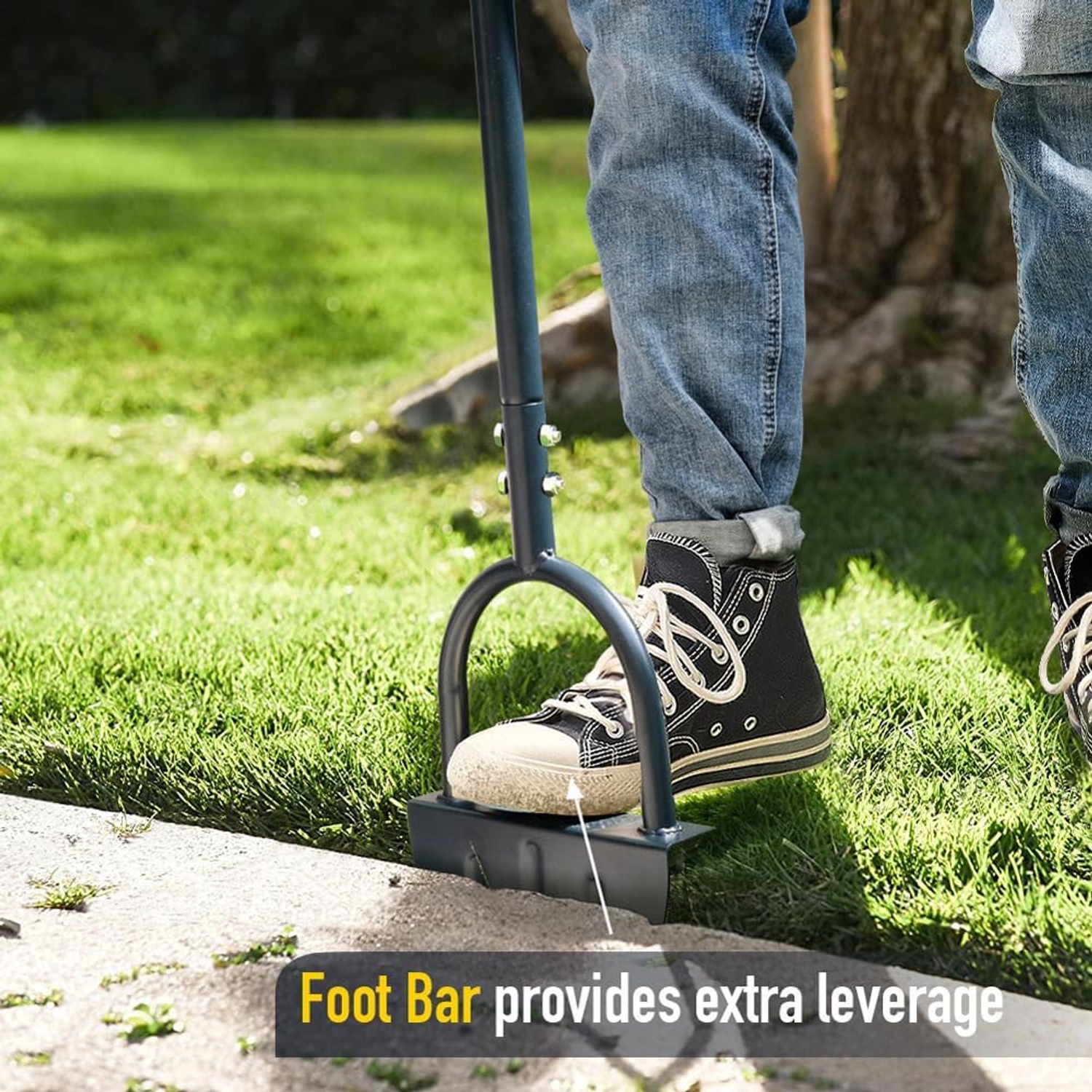
The blade here is arched and made of carbon steel, with ten saw teeth along the cutting edge. You place it on the line you want, step onto the foot platform above the blade, and let your weight drive it into the ground. Then you rock the handle back towards you. That lever action opens the cut and lifts the turf slightly away from the soil. Move along, overlap the last cut, and repeat.
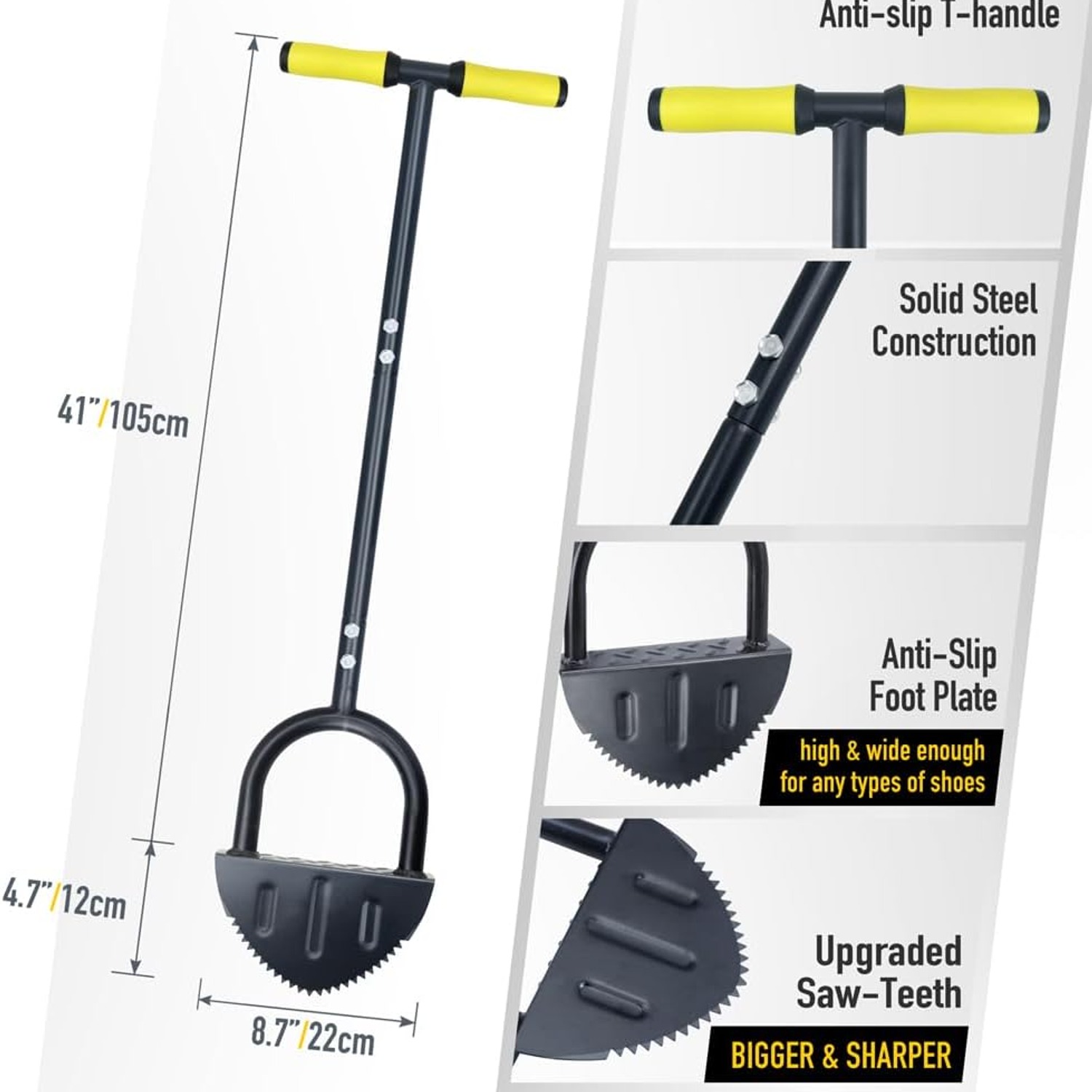
The teeth are the useful part on an established lawn. Grass roots knit into a mat over a few seasons, and a plain smooth blade will often skid across it rather than bite. Teeth grab that mat and pull through. On soft, newly laid turf you barely notice the difference. On a lawn that has been there for five years, it is the whole job.
Blade length is listed at 8.7 inches, which works out to 22.1 cm. That is the width of one bite. Narrow enough to steer around a curve, wide enough that a straight run goes quickly.
Why the handle length matters more than you think
The overall height of this tool is 96.52 cm. On paper that is just a number. In practice it decides whether edging is a pleasant half hour or something you never do twice.
A short handled tool forces you to work bent over or kneeling. Ten minutes of that and most people quit, which is why so many gardens have a beautiful lawn and ragged borders. A long shaft lets you stand with your back straight, step down, lever back, and step along. Your legs do the work, which is what legs are for.
At the top of the shaft is a T-grip with a soft cushion. The T shape matters because edging involves twisting as well as pushing. You need something to brace against when you rock the blade back, and a straight pole gives you nothing to hold onto. A T-grip gives you a crossbar for both hands.
The whole tool weighs 1.69 kg. Light enough to carry around the garden, heavy enough that the blade has some momentum behind it.
The foot platform, and why it is wide
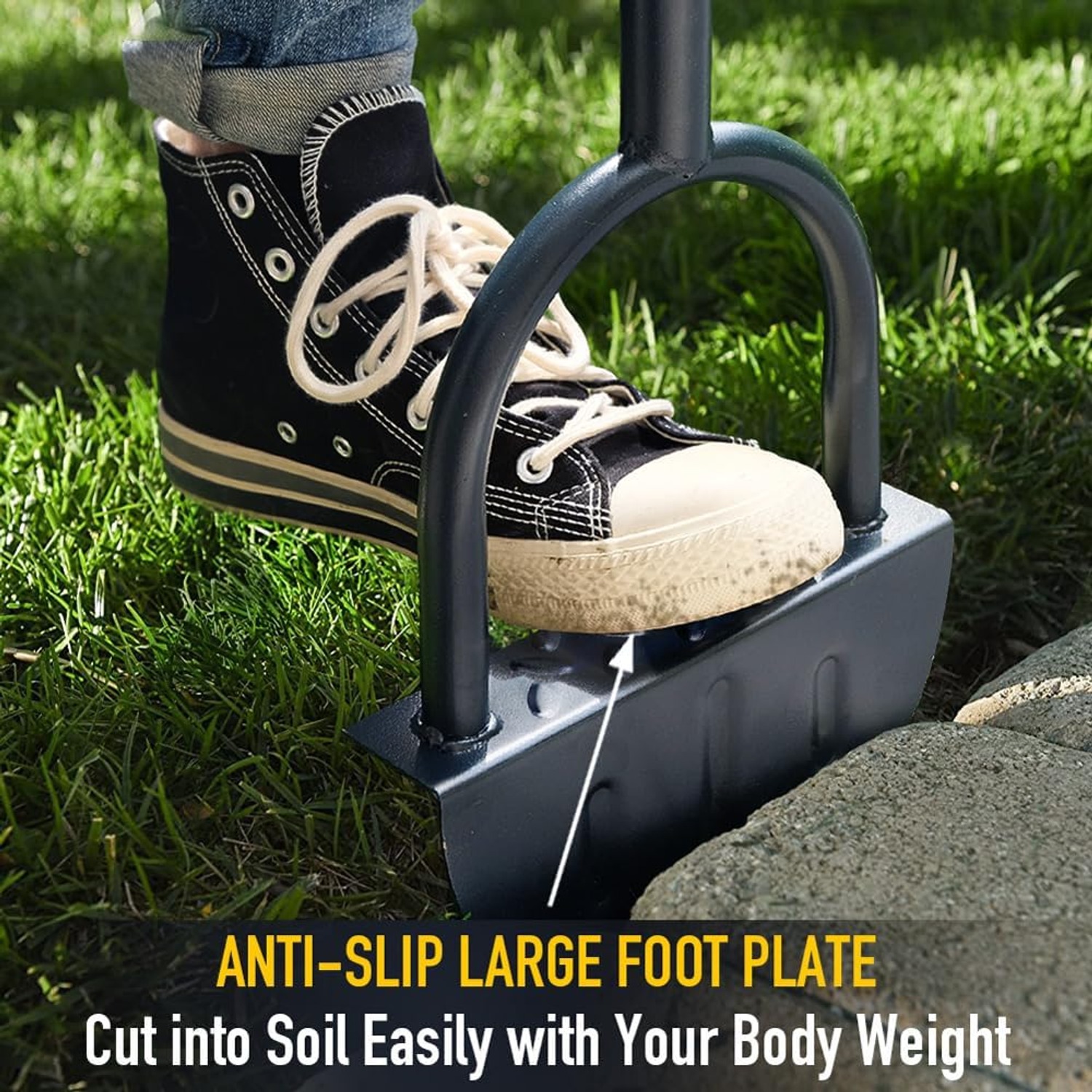
Look at any step edger and the ledge above the blade is the feature doing most of the quiet work. You put your boot on it and transfer your body weight into the cut. A narrow ledge concentrates all that pressure onto a small patch of your sole, which hurts after a while and makes it hard to keep the blade vertical. A wide platform spreads the load and gives you a stable base.
It also helps with accuracy. When your foot is firmly planted on a broad ledge you can feel whether the blade is going in straight or tipping. Keeping it vertical is what produces a crisp wall of soil rather than a sloped, crumbly edge.
Who this suits
This tool is for anyone maintaining their own garden at home. Small gardens, medium suburban lawns, allotment plots, courtyards with a few raised beds. If your edging work consists of a few bed lines, a path and a driveway, a manual tool will do the job faster than setting up anything powered.
It also suits people who would rather not own another thing that needs charging. There is no battery to forget about over winter, no fuel mix, no starter cord. You pick it up and it works.
Where a manual edger is less ideal is very large sites with hundreds of metres of border to cut on a schedule. Groundskeepers with that kind of workload reach for powered equipment for good reason. For a home garden, the best manual lawn edger is the one you will actually pick up, and that usually means a simple one.
Getting a good result
Timing helps more than technique. Edge the day after rain, or water the line the evening before. Damp soil lets the blade sink with a fraction of the effort dry ground demands. Dry, baked clay is the hardest work you can give any edging spade.
For straight lines, lay a plank or run a taut string along the edge and cut against it. Your eye is not as good as you think it is over three metres. For curves, lay a garden hose on the ground and shape it until it looks right, then follow it. Curves want short, overlapping cuts rather than long sweeping ones.
Depth is a one-off decision. Cut to roughly the depth of the blade on your first pass of the season and you create a proper trench wall that grass takes a long time to climb. After that, light touch-ups keep it sharp. Many people do one deep cut in spring and a quick tidy every month or so through the growing season.
If you are installing plastic or metal edging strip, cut the line first and then press the strip into the slot. It is faster and neater than digging a trench, and the strip sits tighter because the soil either side has not been disturbed.
Looking after carbon steel
Carbon steel takes and keeps a good edge, which is exactly why it is used on cutting tools. The trade-off is that it reacts to moisture. Put the tool away wet and you will find orange surface rust in a week.
The routine is simple. Knock the soil off, rinse the blade, dry it with a rag. Every few uses, wipe the metal with a light oil. Store it hanging on a hook or standing upright so the edge is not resting on a damp concrete floor.
Sharpening is a ten minute job with a flat file. Run the file along the existing bevel, keeping the same angle, until the edge feels keen again. You will know it is overdue when the blade starts tearing grass rather than cutting it cleanly. A dull edger makes you work twice as hard for a worse line.
Check the fittings between the shaft and the blade now and then too. Any tool that gets levered against will loosen eventually, and a wobbly head is both annoying and unsafe.
Safety, briefly
It is a sharp steel blade on a long handle. Keep it stored where children cannot reach it. Wear closed shoes, ideally boots, when you are stepping on the platform. The gloves included with the tool are worth putting on, both for grip and for the inevitable moment you grab the blade area while carrying it.
Watch for buried cables, irrigation lines and tree roots before you drive a blade in near a house wall or along a fence line. Most edging is shallow enough not to matter, but it is worth a thought first.
The short version
A garden edging tool fixes the part of lawn care that mowing cannot touch. This one is manual, with an arched carbon steel blade carrying ten saw teeth, a blade length of 8.7 inches (22.1 cm), and an overall height of 96.52 cm so you can work standing up. It weighs 1.69 kg, has a wide foot platform for pressing down with your body weight, and a cushioned T-grip for control. Garden gloves are included.
Keep it dry, keep it sharp, cut after rain rather than in a drought, and use a string line or a hose as a guide. Do that and a job most people avoid turns into the twenty minutes that makes the whole garden look finished.