


The complete guide
How to Choose an Electric Car Jack That Actually Suits Your Vehicle
The job nobody wants to do by hand
A flat tyre is never convenient. It happens on a wet shoulder, or in a car park at night, or ten minutes before you were supposed to be somewhere. And then you open the boot and find the tool the car came with: a small scissor jack and a thin wrench, both designed to be as light and cheap as possible rather than easy to use.
The scissor jack works, eventually. It takes a lot of turns, your knuckles end up near the road, and the whole time you are crouched beside a car with traffic going past. The wheel nuts are often worse. They were put on with a machine at a tyre shop, and a short wrench and your own body weight are not always enough to break them loose.
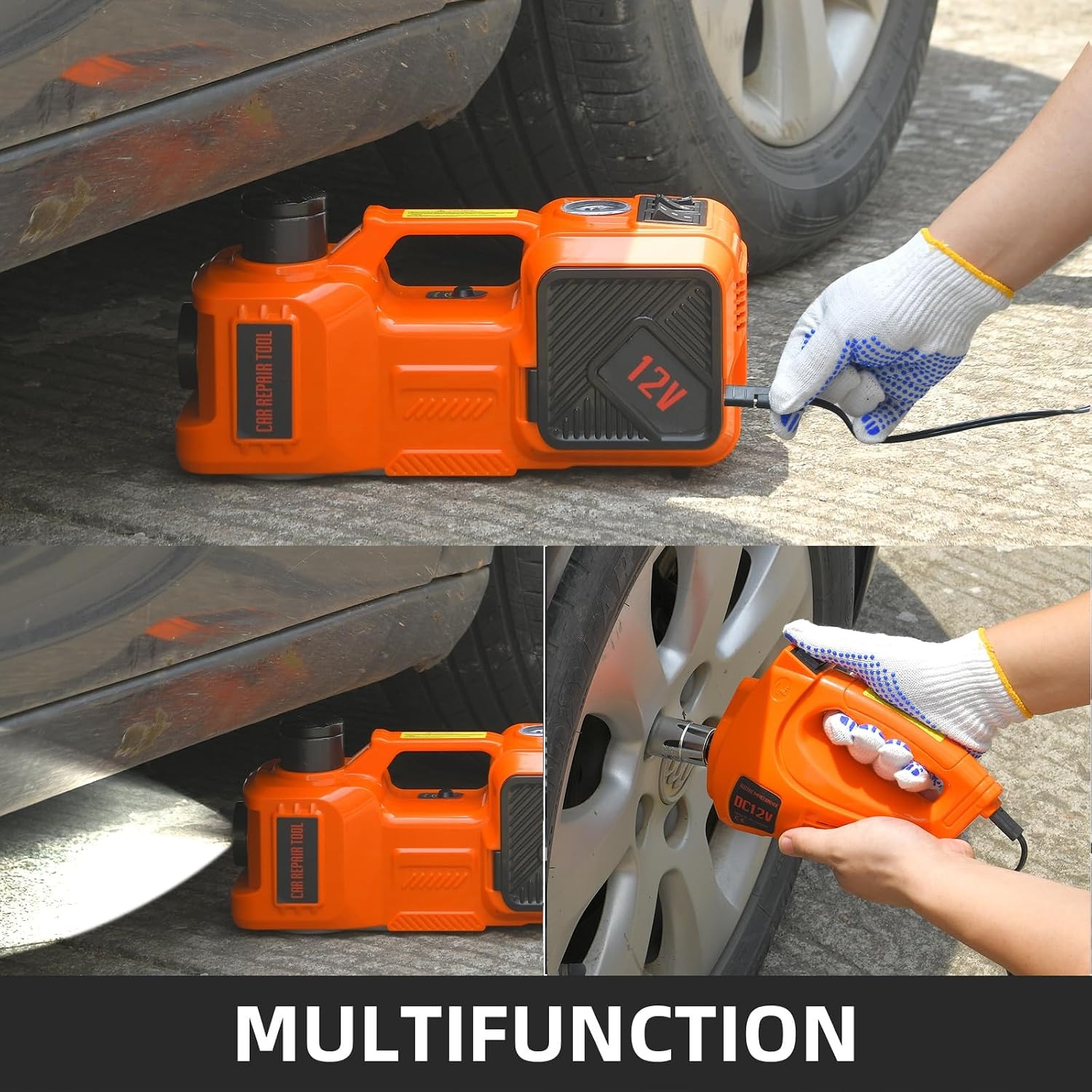
An electric jack changes the shape of that job. Instead of cranking, you plug in a cable, slide the unit under the lift point, and press a button. The hydraulic ram pushes the car up while you stand clear. Paired with an electric impact wrench, the physical effort almost disappears, and what is left is just positioning and patience.
How a 12V hydraulic jack works
The mechanism is not complicated. A small electric motor drives a hydraulic pump, and the pump pushes fluid into a cylinder. The fluid cannot compress, so the ram extends with a lot of force behind it, which is why a unit the size of a toolbox can raise a vehicle weighing several tonnes.
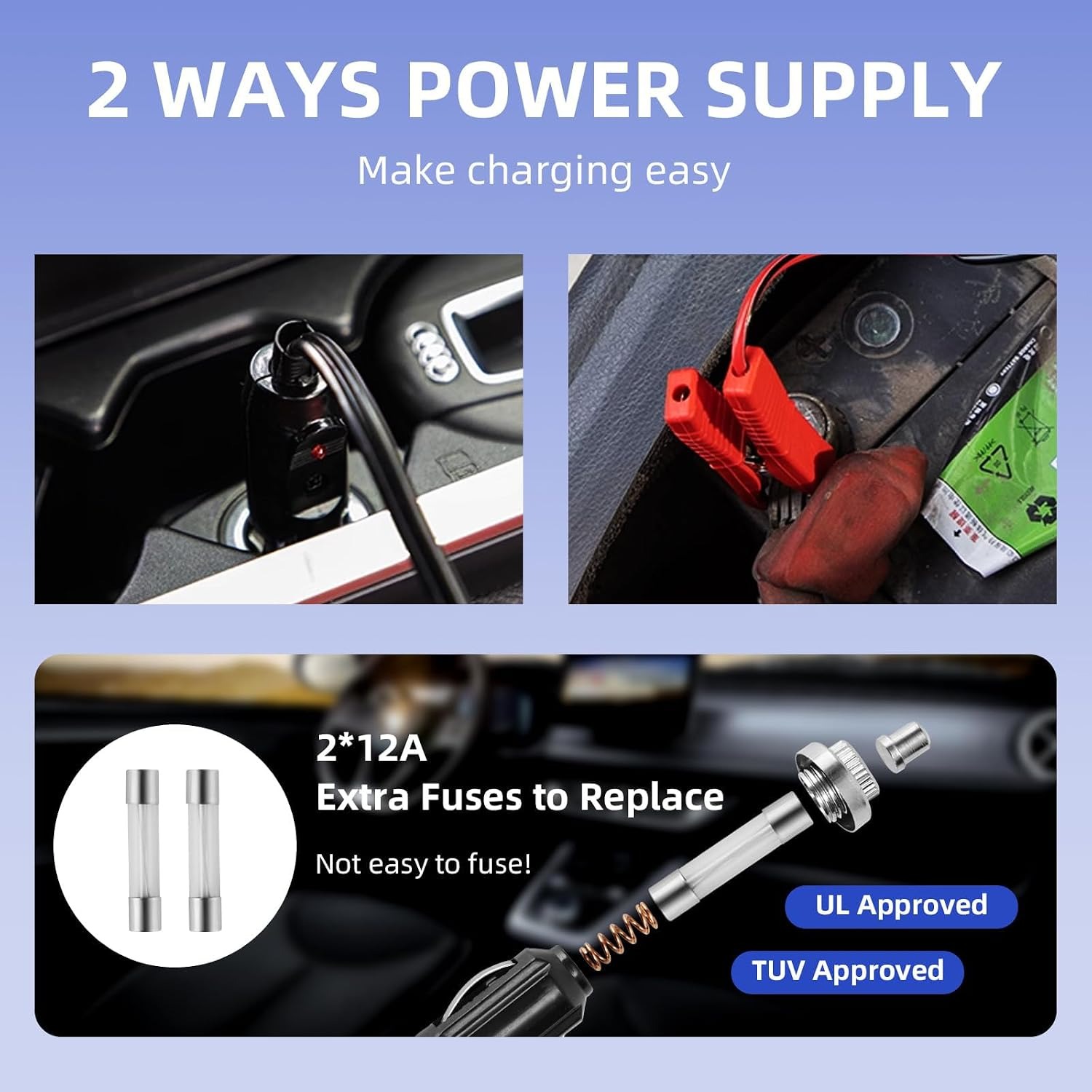
The power comes from your car. A 3.5 m cable connects the jack to the vehicle's 12V supply, and a battery clamp with wire is included if you would rather hook straight to the terminals. That cable length is deliberate. It needs to reach from the power source to whichever corner of the car has the problem, and on most vehicles 3.5 m does that comfortably.
Because lifting draws real current, the instructions say to start the engine before you operate the jack. The alternator then carries the load instead of the battery alone. Skipping that step on an older battery is how people end up with a lifted car and an engine that will not start.
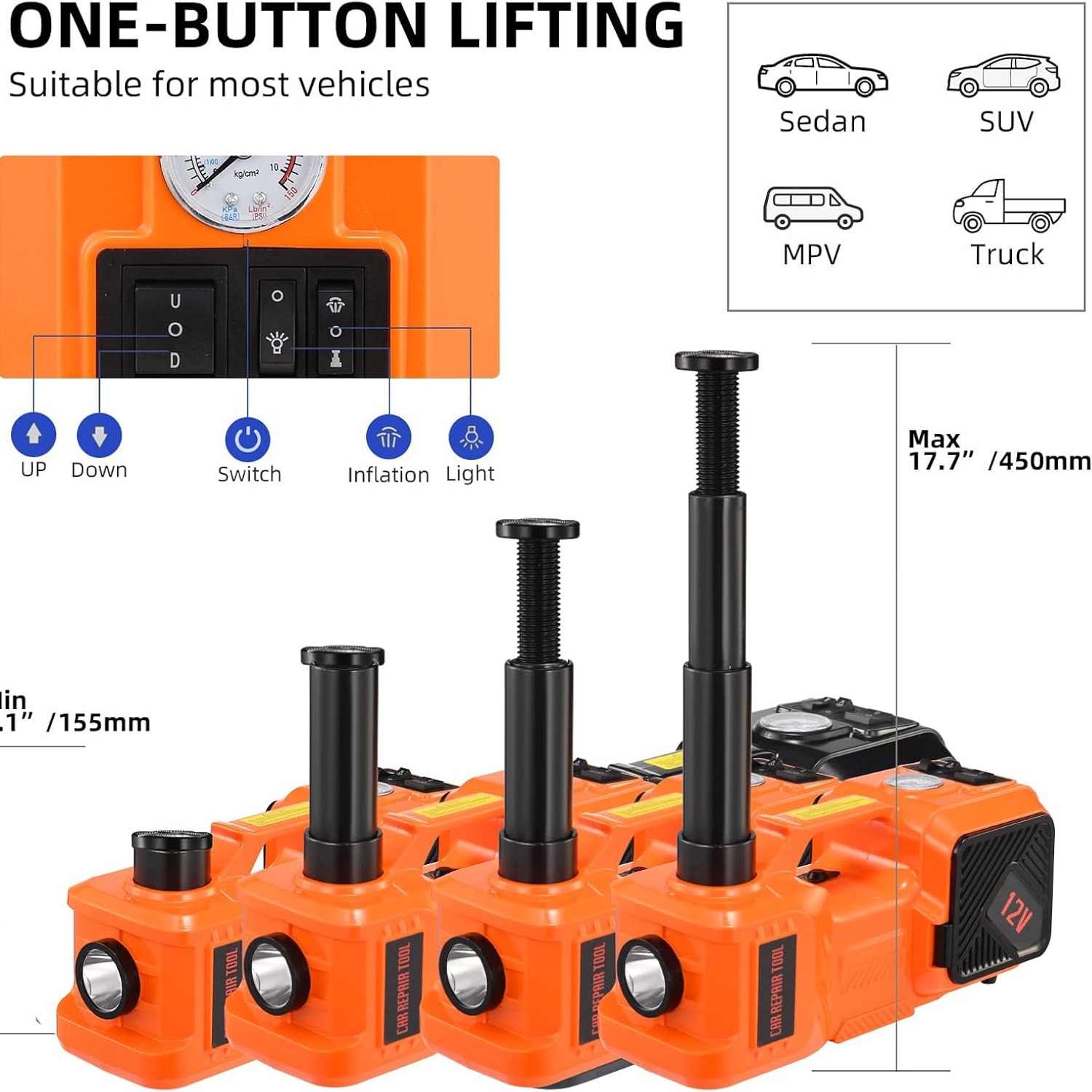
This particular jack is rated to 5 tonnes and lifts from 6 inches up to 17.7 inches. It also cuts out automatically at its height limit, so there is no risk of over-extending the ram while you are concentrating on the wheel.
Capacity and height: the two numbers that matter
Most people look at tonnage and stop there. Capacity does matter, but height range is what catches buyers out.
Start with weight. Find your vehicle's kerb weight, which is usually in the handbook or on the door sticker. A typical family sedan sits somewhere around 1.4 to 1.7 tonnes. A mid-size SUV might be 2 tonnes. A light pickup can reach 2.5 tonnes or more. A 5 tonne rating gives generous headroom across all of those. The firm limit is the limit, though: the maker says never use the jack on a vehicle over 5 tonnes, and that is not a suggestion.
Now height. The minimum height is how thin the jack is when fully collapsed. At 6 inches, it slides under cars with normal ride height without trouble. A very low sports car or a vehicle with an aftermarket lowered suspension may not give you that clearance, in which case you need ramps or a slimmer tool.
Maximum height is the other half. Lifting the body is not enough, you need the wheel clear of the road with space to pull it off and slot the spare back on, and a loaded car sags further than an empty one. A 17.7 inch maximum gives that room on most vehicles, including taller SUVs.
If you are comparing options for the best hydraulic jack for SUV use, run both numbers against your own car rather than trusting a general description.
What a complete kit saves you
Buying a jack on its own solves half the problem. Most roadside wheel changes stall on the nuts, not the lift.
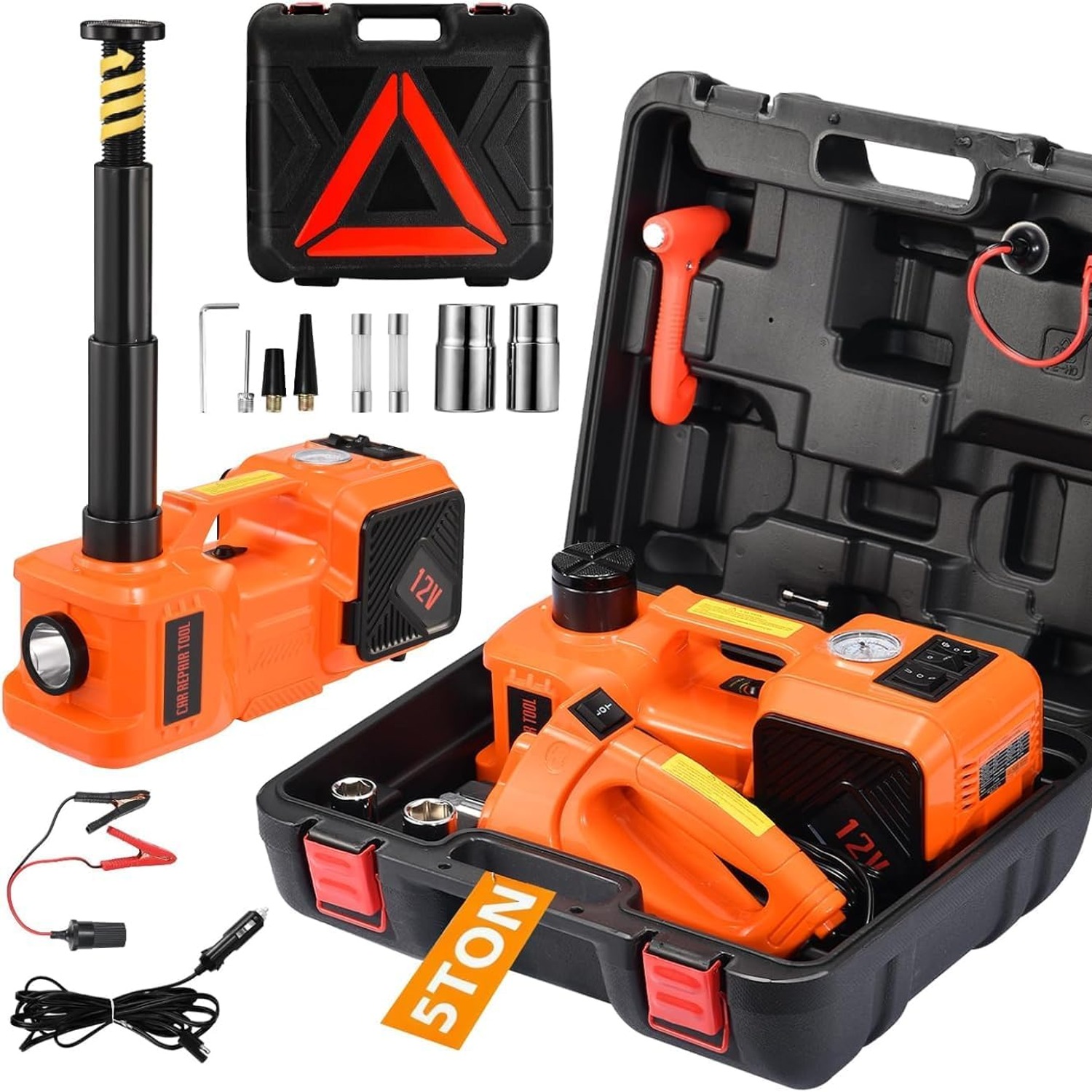
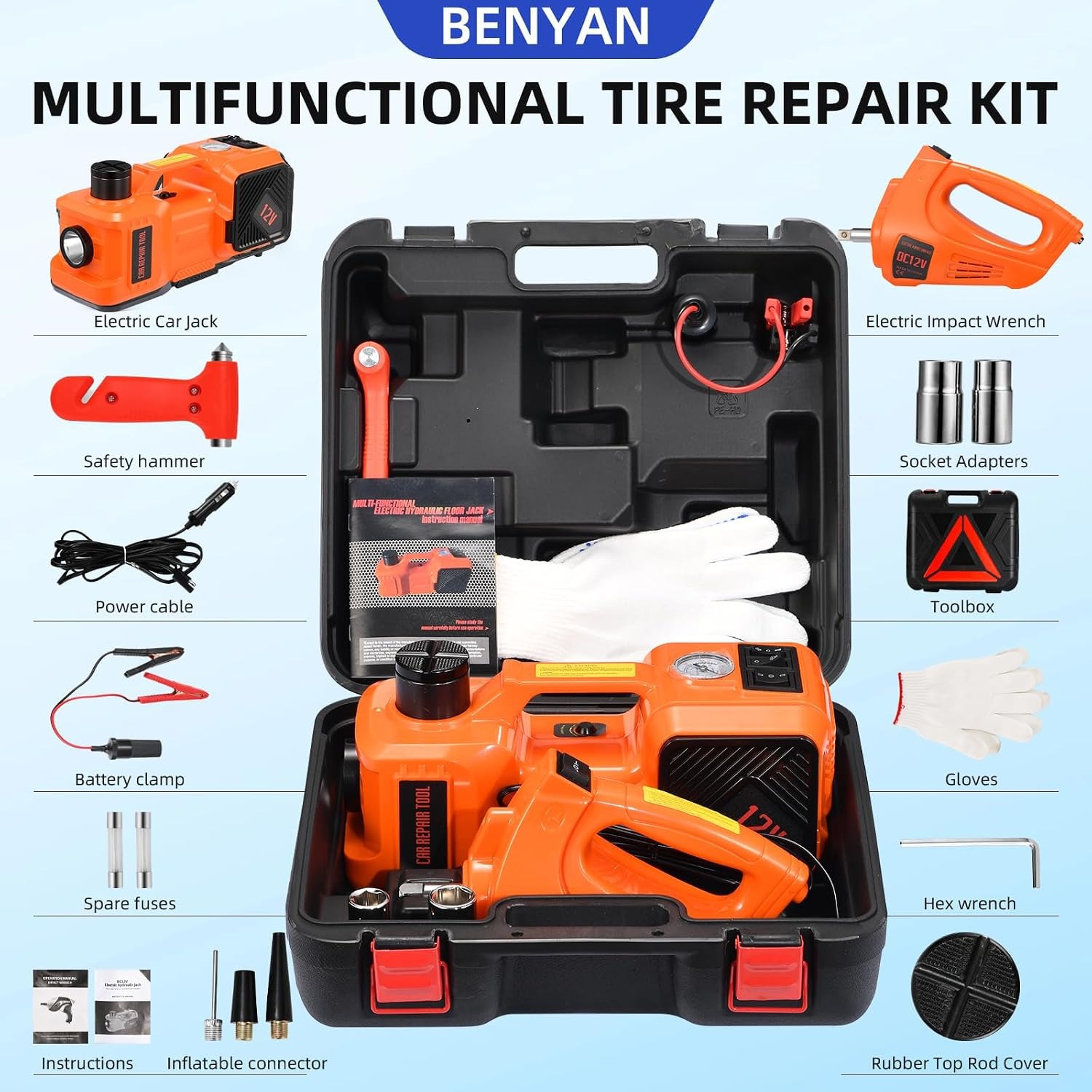
This kit includes an electric impact wrench, which is the piece most people do not already own. It spins the nuts off under power, which turns the worst part of the job into the quickest part. There is also a plastic carry case, a pair of gloves, the power cable, the battery clamp with wire and the user manual.
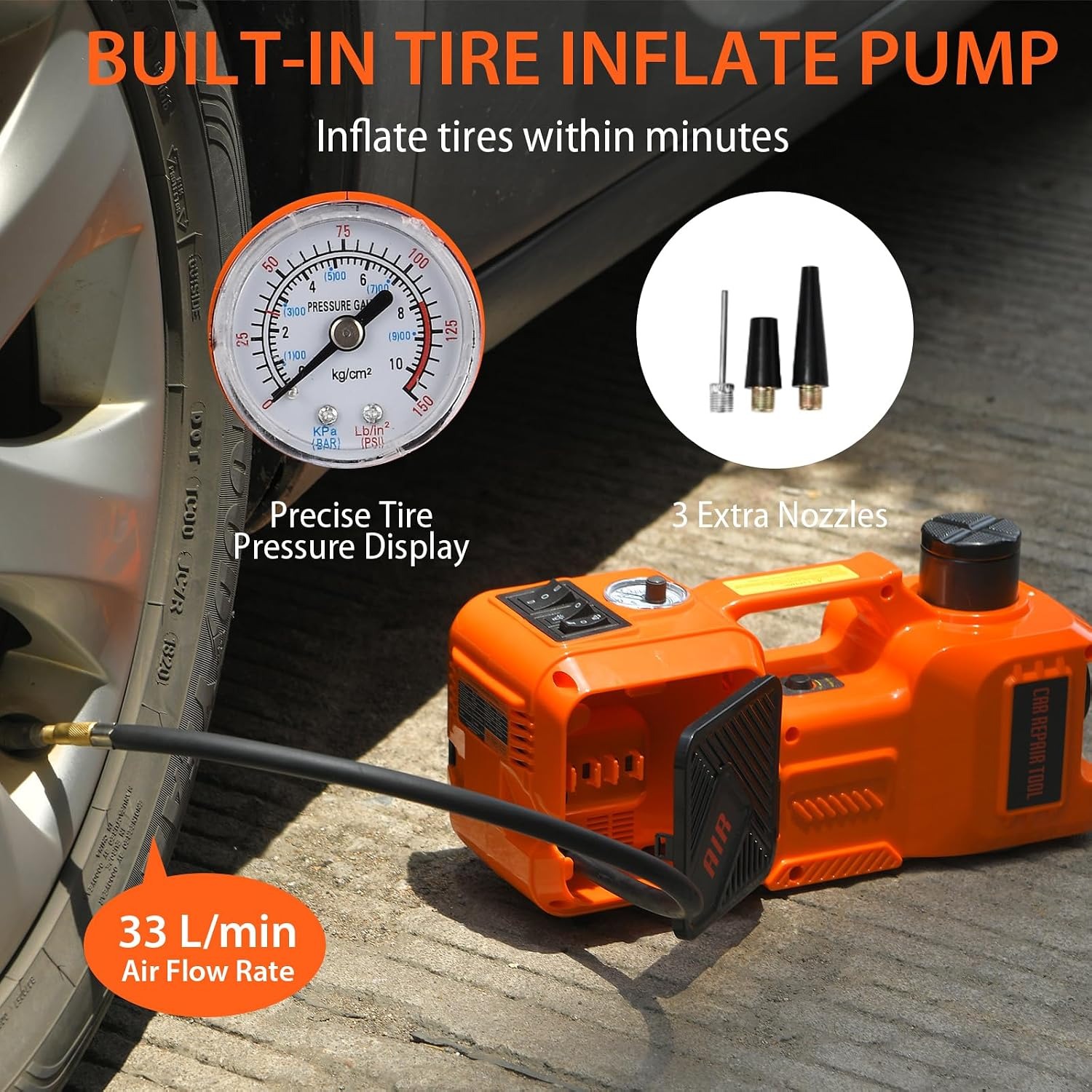
Two features add real value beyond lifting. The built-in LED light means you are not balancing a phone on the kerb. And the automatic air pump covers the case where the tyre is simply soft rather than destroyed. If you catch a slow leak early, you may be able to pump it up and drive to a tyre shop instead of changing the wheel at all.
Having everything in one case also matters more than it sounds. Emergency gear scattered across a boot has a habit of going missing. One box, one place, done.
Who it suits
Long-distance commuters get the most out of it, because the odds of a puncture scale with the kilometres. Anyone driving on rural or unsealed roads is in the same category.
It also suits drivers who simply do not have the strength or mobility to work a scissor jack. That is a larger group than people admit. Age, injury, a bad back, or just not having the leverage on a cold morning: an electric jack removes the physical barrier entirely.
Home mechanics find uses beyond the roadside. Oil changes, brake jobs and rotating tyres all start with lifting the car. For any of that, use rated axle stands before going underneath. A jack lifts, stands hold, and they are not interchangeable.
Finally, it makes sense for new drivers. Someone who has never changed a wheel is far more likely to manage it with a powered kit and a manual than with a bare scissor jack in the dark. Read the manual once at home, before you ever need it.
Using it safely
Pull somewhere flat and firm, well off the traffic lane. Apply the parking brake and, on a manual, leave it in gear. Chock the opposite wheel if you have anything to hand.
Never use the jack on sloping ground. This is the maker's clearest warning and the one most likely to cause a serious accident, because a lifted car on a slope can roll off the saddle.
Find the correct jacking point. Vehicle makers put reinforced points under the sills, usually marked with a notch or an arrow, and the handbook will show you. Lifting from a random spot on the floor pan can bend metal.
Start the engine, connect the cable, position the jack, then lift. Keep hands and feet clear of the car while it is going up. When the wheel is clear, swap it, lower the car, and torque the nuts properly once the weight is back on the ground.
Looking after it
Wipe the jack and wrench down after use, especially after roadside work where grit and road salt get everywhere. Let everything dry before it goes back in the case.
Store the case somewhere dry. A damp boot corner over a winter is not kind to steel or electrical connections. Coil the cable loosely rather than folding it tight, because repeated sharp kinks are what eventually break a conductor inside the insulation.
Every few months, pull the kit out and look it over. Check the cable insulation, the plug, the battery clamps and the housing. Make sure the ram moves freely and nothing has corroded. Finding a problem in your driveway is much better than finding it on a hard shoulder.
The short version
This is a 12V hydraulic electric jack rated to 5 tonnes, lifting from 6 inches to 17.7 inches, built from alloy steel and weighing 8.11 kg. It arrives with an electric impact wrench, a 3.5 m power cable, a battery clamp with wire, gloves, a carry case and a manual. A built-in LED light and automatic air pump cover the two things you usually wish you had at the roadside.
Check your vehicle's weight and your jacking point clearance against those two numbers, use it on flat ground with the engine running, and keep the case dry between uses. Do that and the worst part of a flat tyre becomes a ten minute inconvenience instead of an ordeal.