


The complete guide
How To Choose And Use A Digital Thermometer At Home
The small problem that always shows up at a bad time
Somebody feels off. It is late, the house is quiet, and you want a number rather than a guess. The old routine was a probe held under a tongue or in an armpit for long enough to settle, which works fine on a calm adult and badly on a three year old who does not want to be touched. By the time you get a reading, everyone is awake and cross.
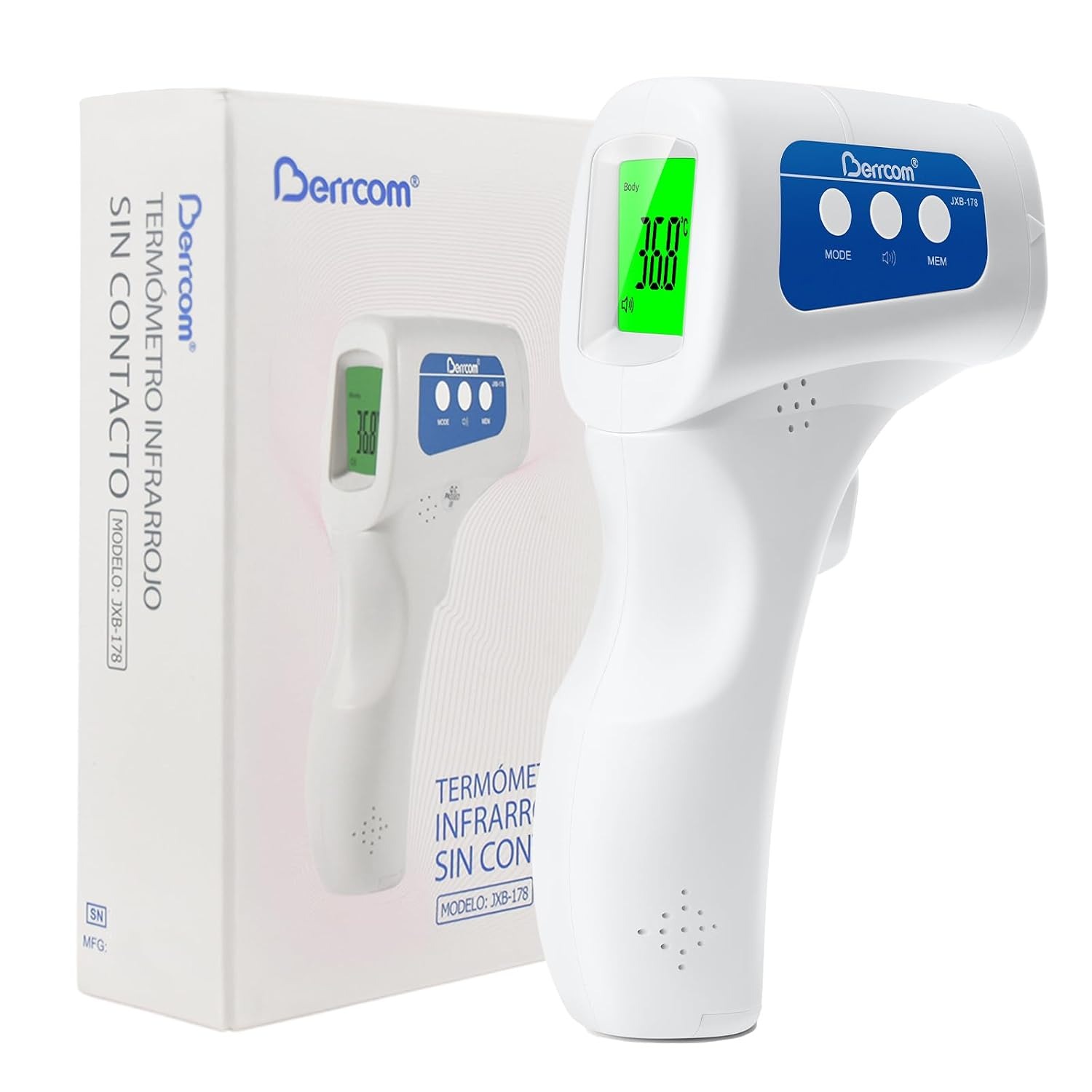
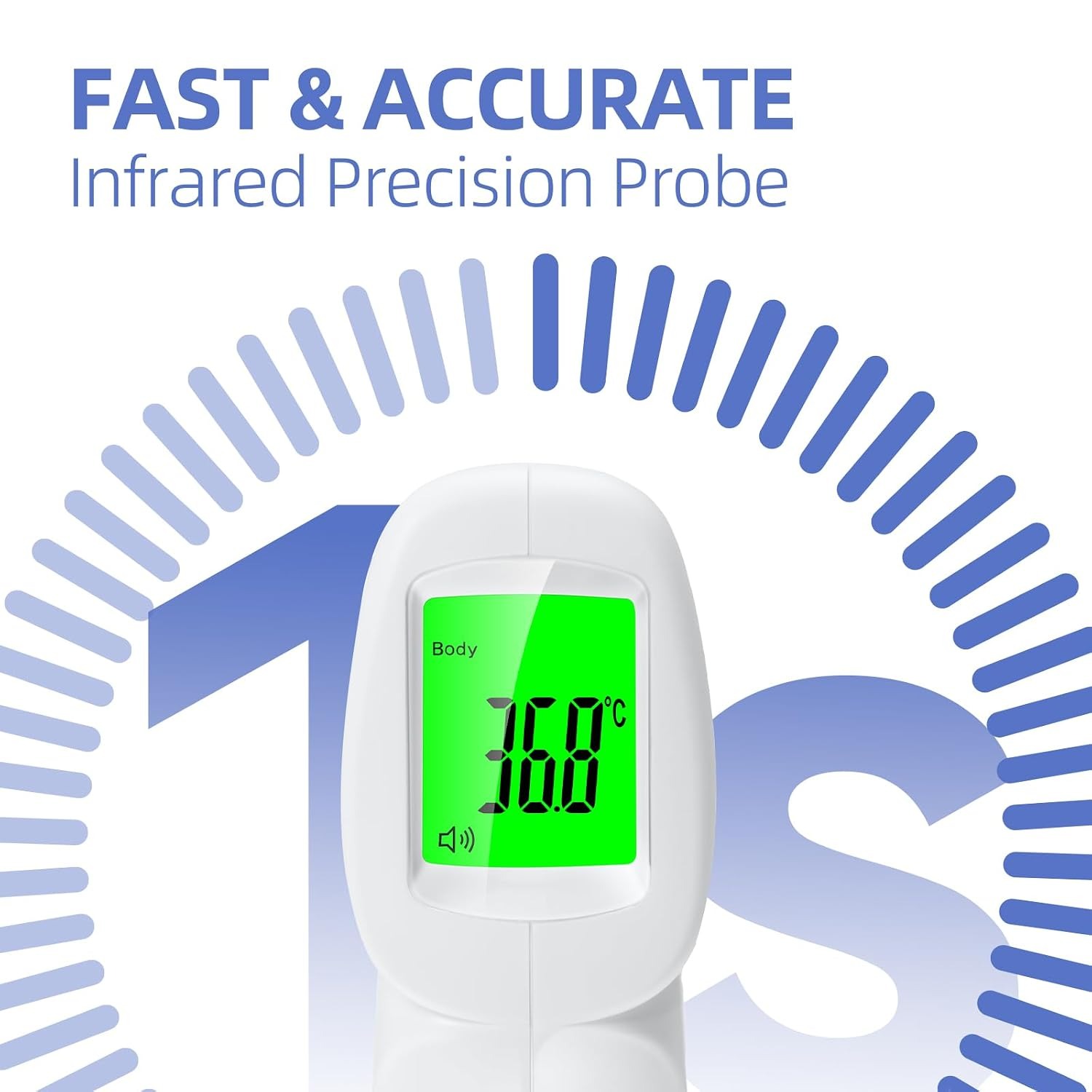
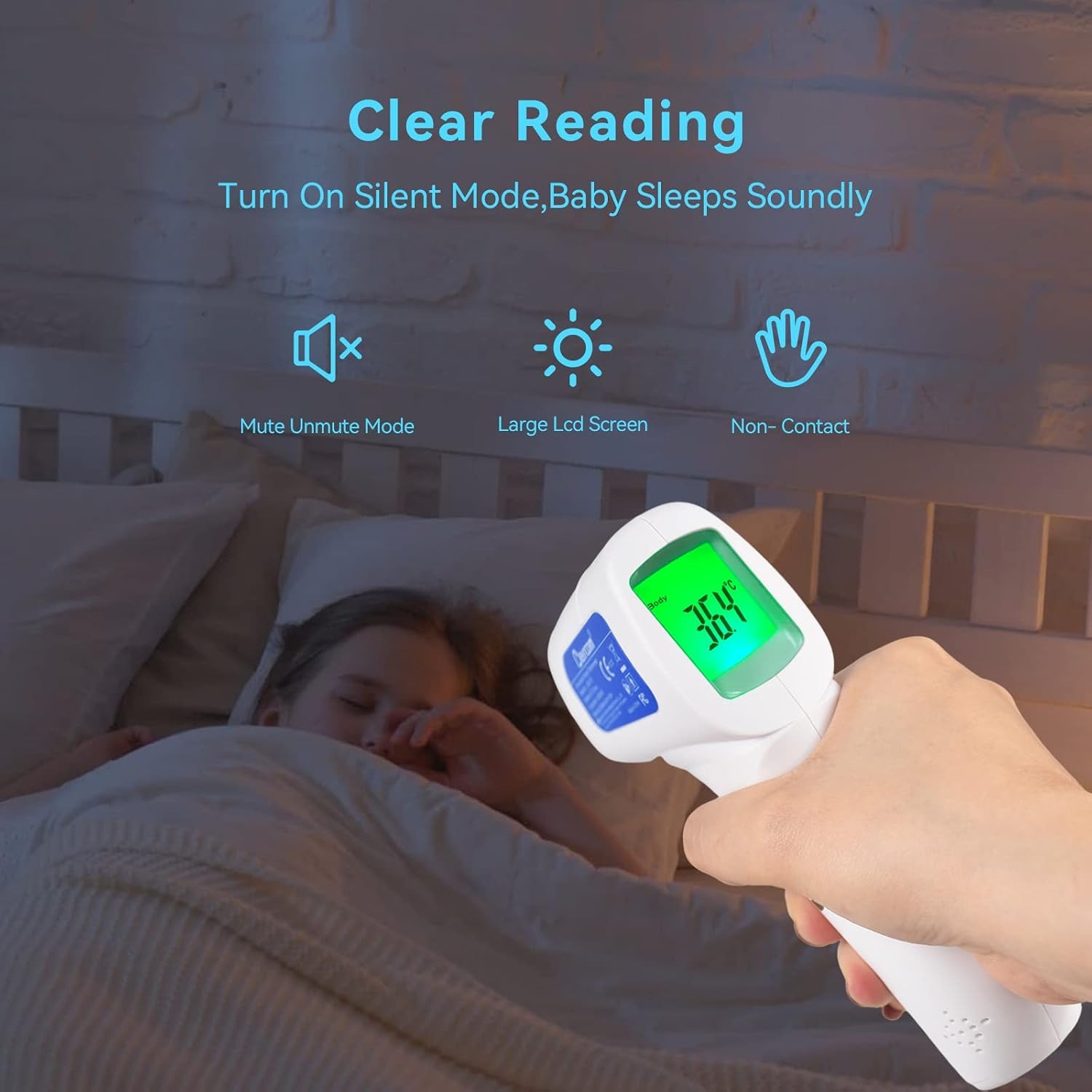
A non contact thermometer removes that friction. You hold it a few centimetres from the forehead, press a button, and the number appears. The listing for this unit gives a response time of 1 second. That is quick enough to check a sleeping child without waking them, and quick enough to check three people in a row without anyone complaining.
How an infrared reading actually works
Everything warm gives off infrared energy. A sensor inside the thermometer measures that energy coming off the skin and converts it into a temperature on the screen. There is no probe, no waiting for heat to transfer, and nothing to clean between people.
The trade-off is that technique matters more than it does with a contact thermometer. Distance affects the reading, so the manual specifies a short gap of roughly 3 to 5 cm. A damp forehead, a fringe of hair in the way, or coming straight in from the cold can all nudge the number. None of this is hard to work around. Wipe the forehead, move the hair, let the person sit indoors for a few minutes, then measure. Use the same spot on the forehead every time and your readings become comparable, which is what you actually want when you are tracking a fever over a day or two.
This unit is rated from 32 °C to 42.9 °C. That spans normal body temperature through the fever range, and it is the window the sensor is designed for.
Reading the screen at three in the morning
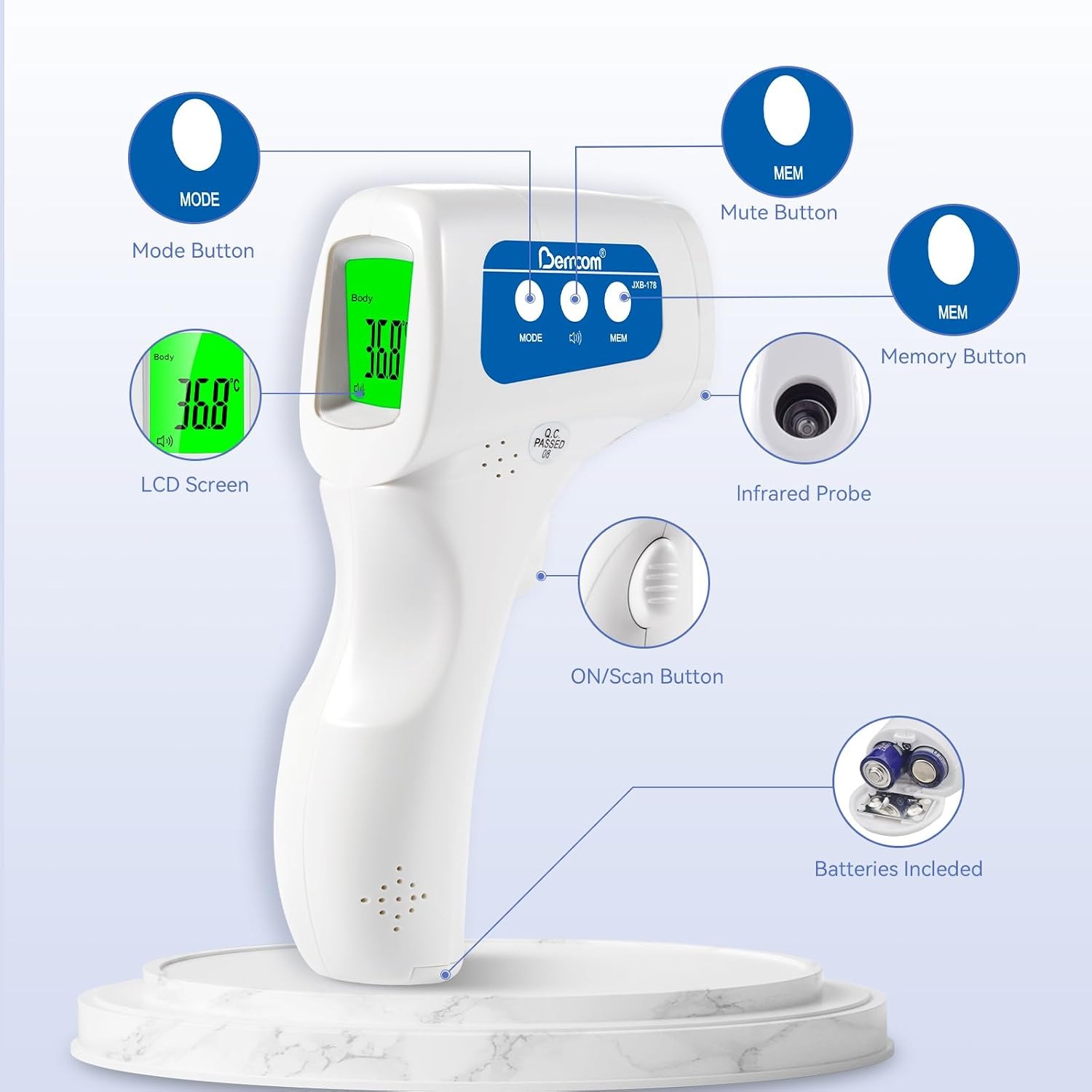
The display is a large backlit LCD. In practice that means you can read it without switching on a ceiling light, which is a bigger deal than it sounds when you are trying not to fully wake a sick child.
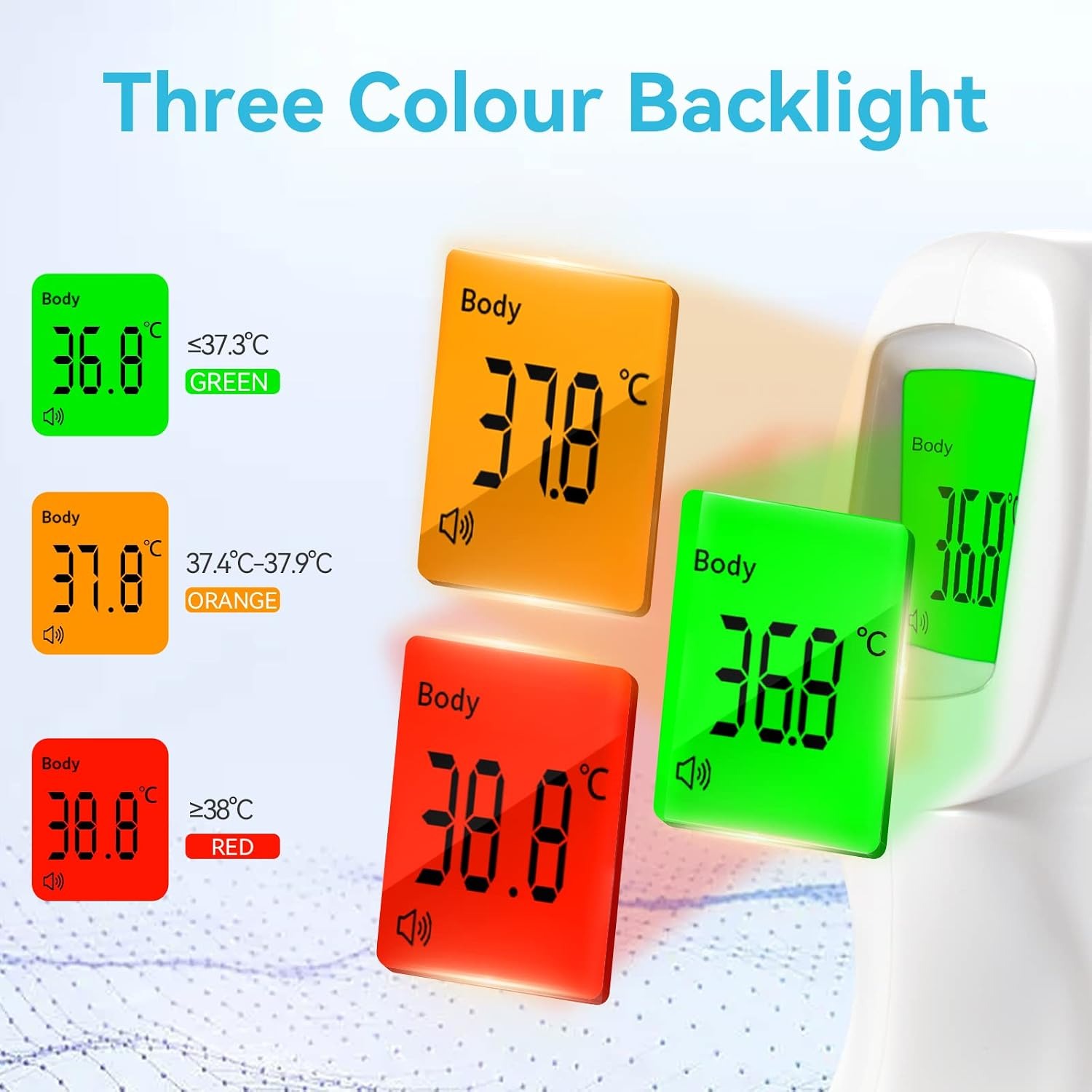
The backlight also does some of the thinking for you. It uses a colour-coded system to separate a normal reading from a mild rise and from a higher fever at or above 38 °C (100.4 °F). You get the gist from across the room before you focus on the digits. There is an audible alarm as well, so if you are holding the unit at arm's length over a cot, you still know something has flagged.
You can switch the display between Celsius and Fahrenheit. In a household where one person thinks in one scale and another thinks in the other, that one button saves a lot of mental arithmetic.
Three jobs, one device
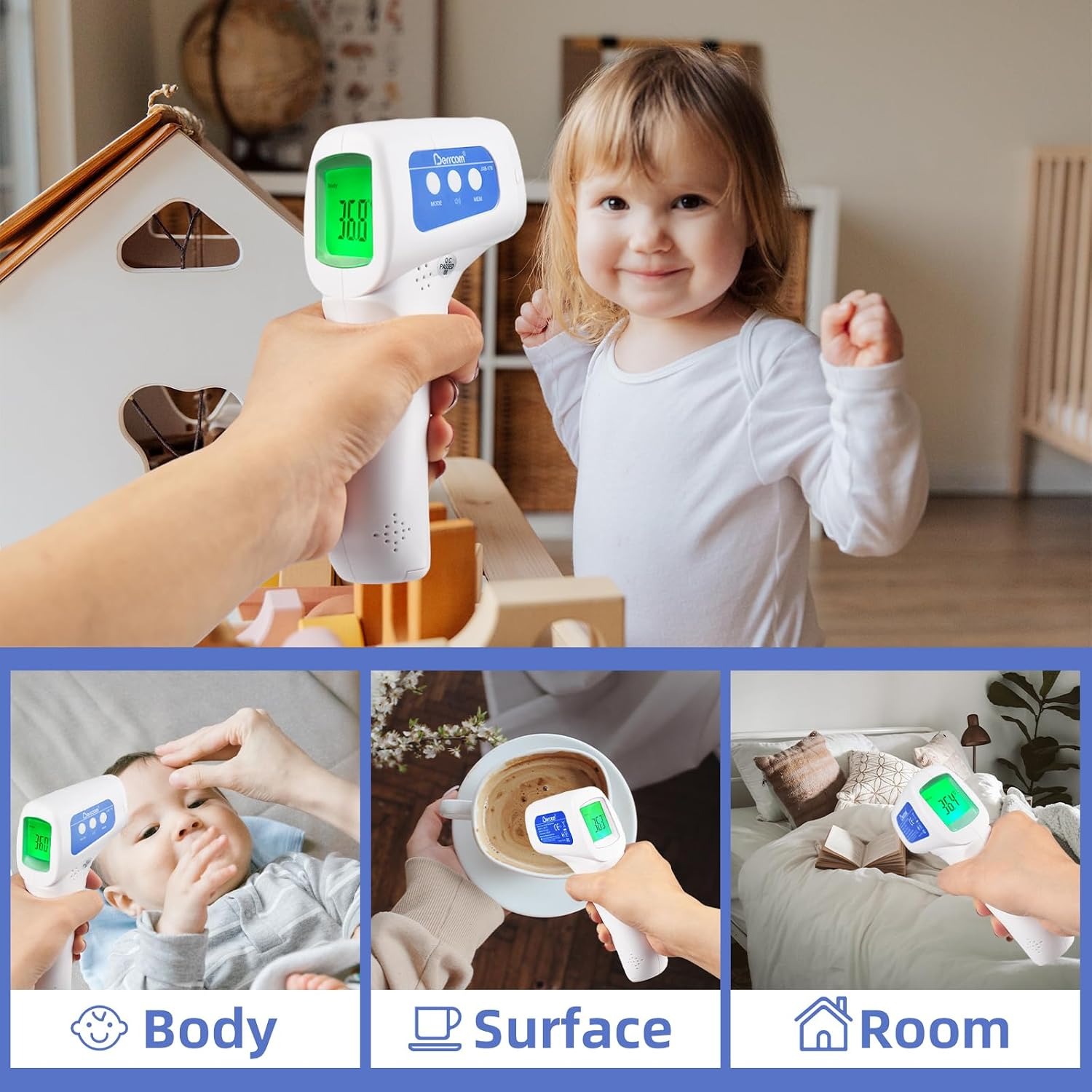
Body mode is the headline use, but the other two modes earn their keep.
Room mode reads the ambient temperature of the space. Useful in a nursery, a home office, or a bedroom where you are trying to work out whether the heating is doing anything. Object mode reads surfaces, which is how most parents end up using it. Point it at a bottle of milk before a feed, or at bath water, and you get an answer in a second. It saves the old method of dribbling milk onto your wrist and hoping.
Keeping all three in one unit means one thing to find in the drawer instead of three. For a small household or a desk drawer at work, that counts.
Who it suits
Families with young children are the obvious group. The touch-free design is the whole point when the patient is a toddler who sees a thermometer and runs.
It also works well in shared spaces. Offices, reception desks, small clinics and classrooms all pass equipment around, and a device nobody has to touch is simpler to manage than one with probe covers to buy and replace. The product information lists homes, schools, daycares and offices as settings, and the stated age range runs from infants and babies up to adults.
If you are putting together a first aid kit for a holiday house, a workshop or a van, the size helps. The unit is 17 cm long and weighs 200 g, so it slips in beside the plasters and the scissors without taking up real space.
What to look at when you compare models
A few things separate a thermometer you keep using from one that ends up at the back of a drawer.
Speed. A one second reading changes how often you bother to check. If a device takes ten seconds and beeps awkwardly, you will use it less.
Battery type. This one takes two AA cells, and two are in the box. AA is easy to buy anywhere, at any hour, in any country. Sealed units and odd button cells are fine until the day they are not.
Display size and lighting. A large backlit screen is worth more than a long feature list, because almost every reading you take in anger happens in poor light.
Auto shut-off. This model powers down after 30 seconds of non-use. Small thing, but it is the difference between the batteries lasting and finding a dead unit when you need it.
Units. Switchable Celsius and Fahrenheit matters more in mixed households and shared workplaces than people expect.
Looking after it
Care is straightforward: wipe clean. Use a soft cloth, dry or very lightly dampened, on the body and around the sensor. Do not submerge it and do not run it under a tap. Let the sensor dry fully before the next reading, because moisture on the lens will throw the number off.
Store it somewhere dry, out of direct sunlight and away from radiators. If the device has been sitting in a cold hallway or a hot car, give it time to come to room temperature before you use it. If you are putting it away for a long stretch, take the batteries out so they cannot leak.
The listing specifies indoor usage. That is partly about the device and partly about getting a sensible reading, since wind and sun interfere with infrared measurement.
A note on what a number means
A thermometer gives you information, not a diagnosis. A reading at or above 38 °C (100.4 °F) is the point this device flags as a higher fever, and that is a reasonable prompt to pay closer attention. What you do next depends on the person, their age, their other symptoms and their history. If you are worried, especially with a baby, call your doctor or a nurse line. Do not let a device make that call for you.
Taking two readings a few minutes apart, with a consistent technique, is more useful than one reading you are unsure about. Write the numbers down with the time. A trend over a few hours tells you far more than a single figure.
The short version
This is a digital thermometer that reads at a distance in about a second, shows the result on a large backlit screen with colour coding and an alarm, and switches between Celsius and Fahrenheit. It covers 32 °C to 42.9 °C, handles body, room and surface readings, shuts off after 30 seconds idle, and runs on two included AA batteries. It is blue, 17 cm long, weighs 200 g, and is listed for indoor use with adults, kids, toddlers, infants and babies.
If you want one device that lives in a drawer, works the moment you pick it up, and does not require a wrestling match with a toddler, this covers it. Delivery is tracked across Canada, free on orders of $75 or more and $25 below that.