



Clearance Warehouse Canada
Company
Shop By Category
T&Cs
Shop Online
  • Free delivery across Canada on orders of $75 or more
  • Lawn and garden, home improvement, bedding, car, kids and health lines in one place
  • Dispatch within 2 working days, then delivery in up to 7 working days by tracked courier
  • Tracking number emailed as soon as your order ships

Commercial CO2 Monitor | CO2 Detector With Alarm | Air Quality Sensor

Keep room conditions on display where you can see them

CO2 Monitor with Alarm

$89.99 $107.99 Save $18
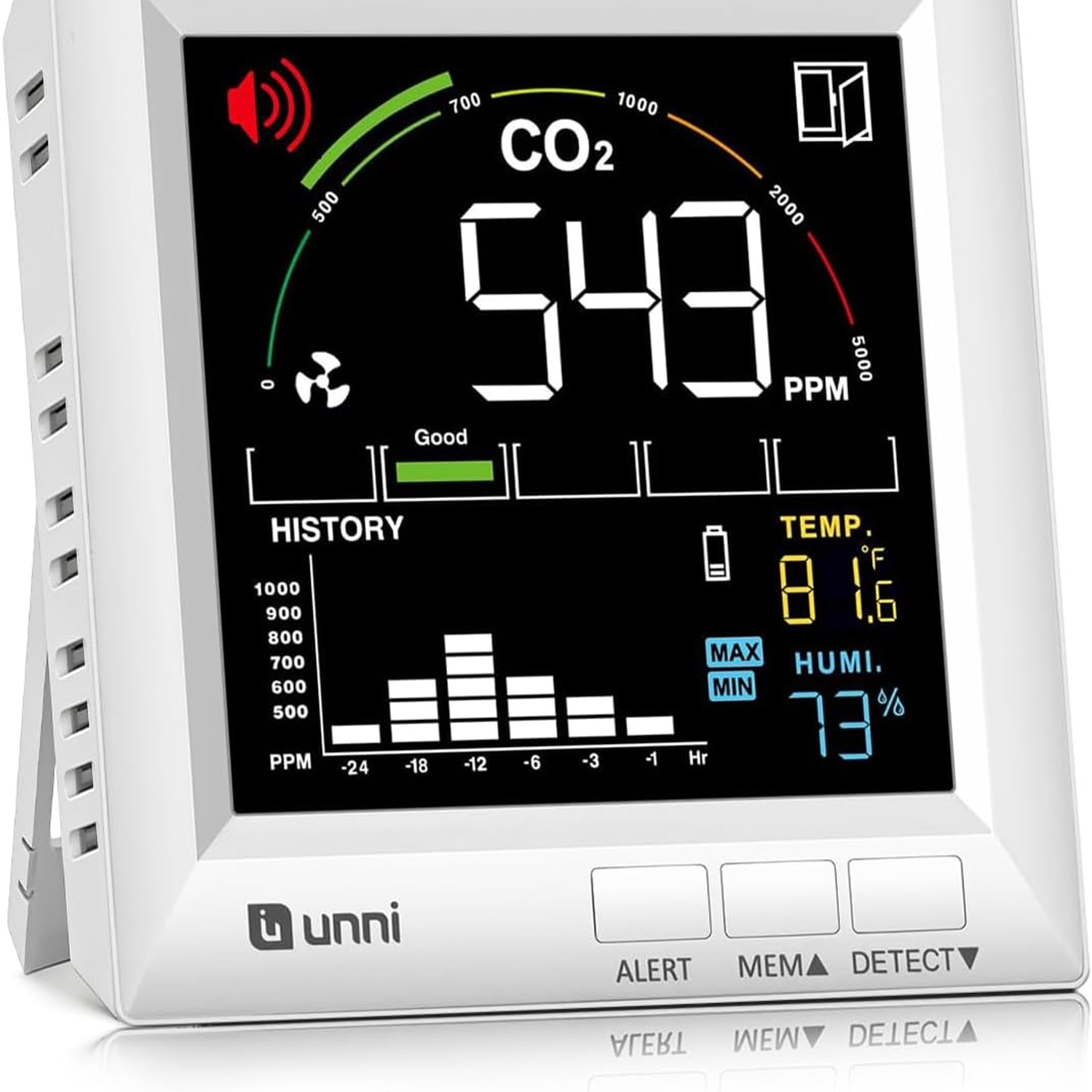
  • Photoacoustic CO2 Sensor
  • Three Alarm Volumes
  • USB Or Battery
  • Desk Or Wall

Price: $89.99 $107.99

  • Delivery time: up to 7 working days by tracked courier, after dispatch within 2 working days
  • Free delivery on orders $75+, otherwise a flat $25
  • Pay by card or PayPal, handled by the payment provider
  • 15 days from delivery to return an unused item, plus your statutory rights
Product specifications
Product TypeCO2 Monitor with Alarm
Sensor TypePhotoacoustic sensor
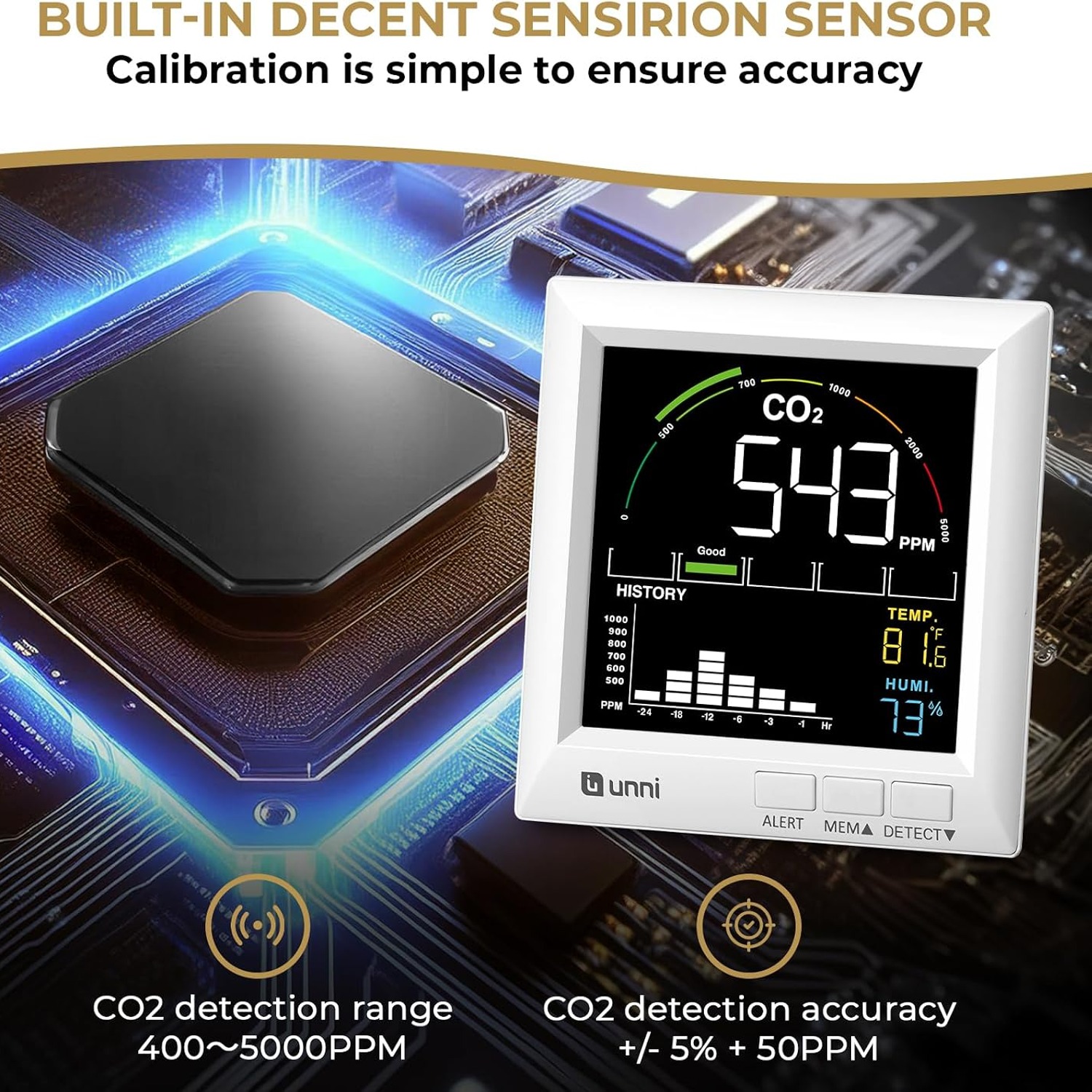
CO2 Detection Range400 to 5000 PPM
CO2 Accuracy+/- 5% + 50 PPM
Temperature Range14.2°F to 122°F (-9.9°C to 50°C)
Humidity Range20% to 95%
Alarm3 adjustable volume settings
Backlight3 adjustable brightness levels
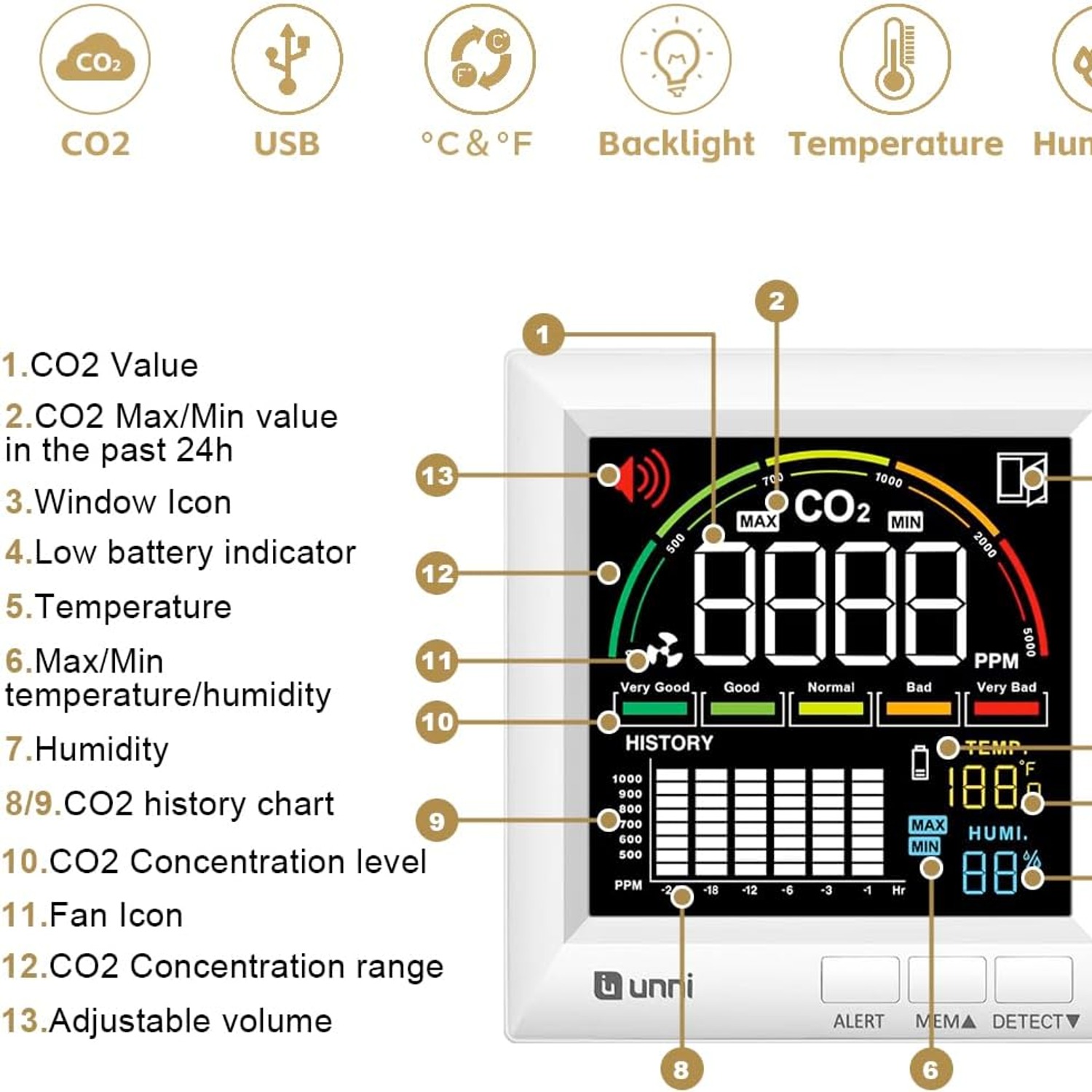
Display DataLive CO2, temperature, humidity, history chart, max/min, low battery indicator
Temperature UnitsSwitchable °C / °F
Power SourceUSB powered, with battery backup
Batteries3 x AAA (not included)
MountingTabletop or wall mounted
ColourWhite
In The Box1 x CO2 monitor, 1 x USB cable, manual
Item Weight150 g
Weight150 g
Shipping & returns

Tracked delivery across Canada. It is free on orders of $75 or more, and a flat $25 below that. Allow up to 7 working days in transit after dispatch within 2 working days.

You have 15 days from delivery to return an unused item in its original packaging for an exchange or a refund. You cover the cost of shipping it back.

If it arrives faulty, damaged or not as described, tell us right away and our customer service team will sort it.

Shipping details · Refunds and returns

Photoacoustic CO2 SensorReads 400 to 5000 PPM with accuracy of +/- 5% + 50 PPM.
Three Alarm VolumesSet the alert loud, quiet or somewhere in between to suit the room.
USB Or BatteryRun it plugged in all day, with 3 x AAA batteries as backup.
Desk Or WallStand it on a tabletop or mount it on the wall where people sit.

Know exactly when a room needs fresh air with a commercial CO2 monitor that reads the air every second of the day.

A photoacoustic sensor tracks carbon dioxide from 400 to 5000 PPM alongside temperature and humidity, with three alarm volumes, three backlight levels, a history chart and USB power with AAA battery backup.

A wall mounted CO2 meter that shows live carbon dioxide readings in parts per million, so you can see when a room has gone stale instead of guessing.

The photoacoustic sensor covers 400 to 5000 PPM with an accuracy of +/- 5% + 50 PPM, and also reports temperature and humidity on the same screen.

Three adjustable alarm volumes and three backlight levels let you set it up for a quiet study, a busy office or a dim bedroom.

A built-in history chart plus max and min data make it easy to spot the times of day when ventilation falls behind.

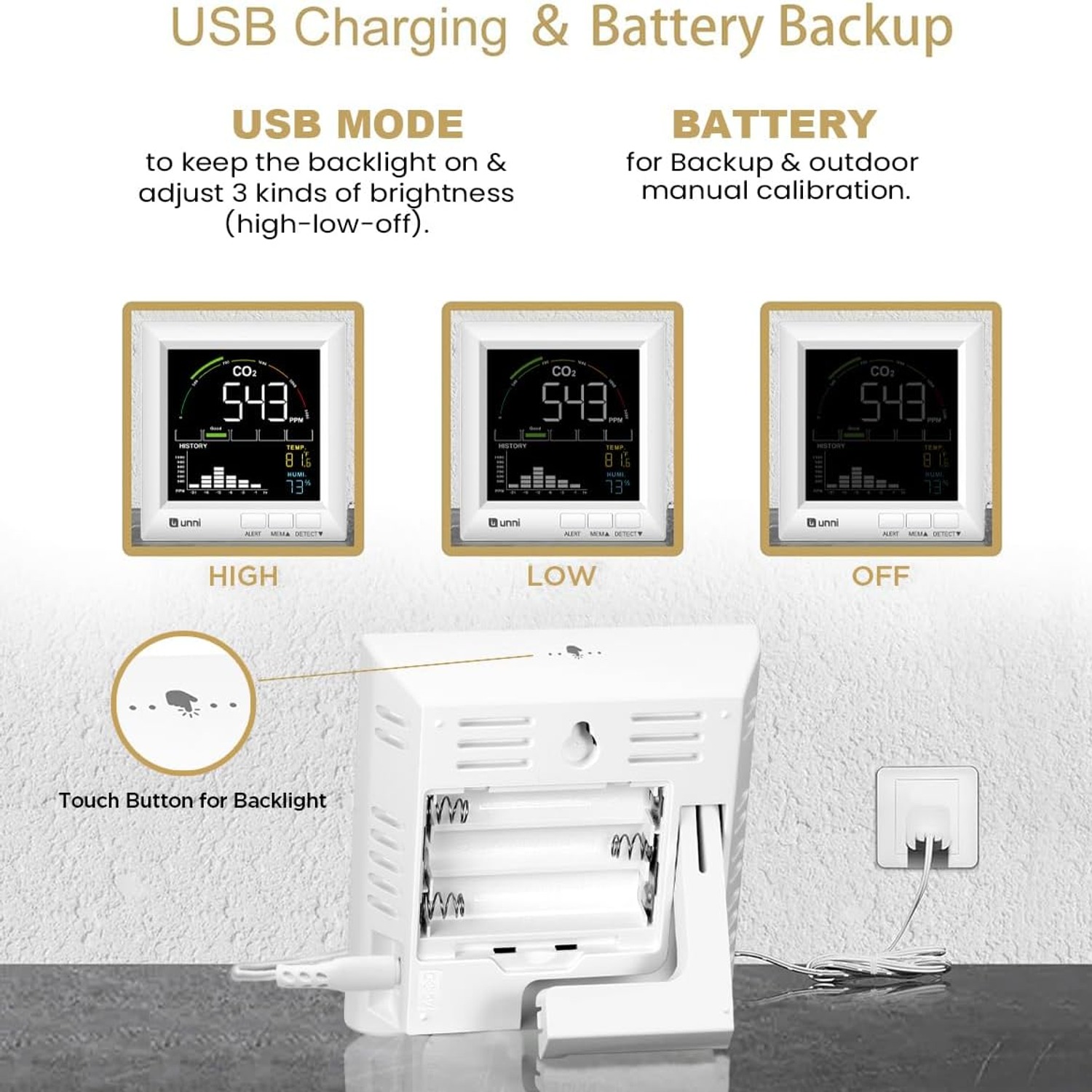
Runs from USB for a permanent always-on display, with 3 x AAA batteries (not included) as backup and for manual calibration away from a power point.

CO2 Monitor with Alarm

Carbon dioxide is the one indoor pollutant you can almost never sense until it is already high. A closed meeting room with six people in it climbs quickly, and the only clues are the yawns, the heavy heads and the sense that nobody is thinking straight after an hour. This commercial CO2 monitor puts a number on that feeling. The main display shows the current reading in parts per million next to temperature and humidity, so a glance tells you whether the room is fine or whether it is time to crack a window.

CO2 Monitor with Alarm

At the heart of it is a photoacoustic sensor with a detection range of 400 to 5000 PPM and a stated accuracy of +/- 5% + 50 PPM. Outdoor air usually sits near 400 PPM, which is where the scale begins, and readings climb from there as people breathe, cook or run a stove in an enclosed space. Alongside CO2 the unit tracks temperature from 14.2°F to 122°F and humidity from 20% to 95%, and you can switch the temperature display between Celsius and Fahrenheit.

CO2 Monitor with Alarm

The alarm is the part most people end up relying on. Three volume settings mean you can have a firm beep in a workshop or a gentler one in a bedroom or study, and the three backlight levels let the screen stay readable at a desk or dim down at night. There is a history chart on board too, which is more useful than it sounds. Watching the curve over a day shows you the pattern, like the spike after lunch when the room fills, or the slow creep overnight in a closed bedroom.

CO2 Monitor with Alarm

Power is flexible. Plug it in over USB and the display can stay on permanently, which suits an office, a reception area or a wall position near a thermostat. Add 3 x AAA batteries (not included) and you have backup if the power drops, plus the freedom to carry it outside for manual calibration. Calibration is straightforward, done in a standard 400 PPM environment by holding the alert button while powering on, waiting for the CAL display to finish and the PASS character to appear.

CO2 Monitor with Alarm

It suits more rooms than you might expect. Home offices, classrooms, meeting rooms, bedrooms, caravans and RVs, grow tents, and kitchens where cooking pushes levels up all benefit from a visible number. The unit weighs 150 g and sits on a tabletop or mounts on the wall, so you can put it where the people are rather than where the cable happens to reach.

Not sure yet? That is fine.

You can change your mind. You have 15 days from delivery to return an unused item in its original packaging for an exchange or a refund. You cover the cost of shipping it back.

If it turns up faulty, damaged or not as described, tell us and our customer service team will sort it. Read the full detail on our refunds and returns page, or ask us anything before you order.

Frequently Asked Questions

What does this device actually measure?

It measures carbon dioxide concentration in the air, shown in parts per million (PPM), plus temperature and humidity. All three appear on the same screen, so you get a full picture of the room in one glance. There is also a CO2 history chart and max and min data.

What is the CO2 detection range?

The sensor reads from 400 to 5000 PPM. Fresh outdoor air normally sits near the bottom of that scale, around 400 PPM, and indoor readings climb from there as people breathe in a closed room. The stated accuracy is +/- 5% + 50 PPM.

What kind of sensor does it use?

It uses a photoacoustic sensor. This type of sensor responds to carbon dioxide specifically rather than estimating it from other signals. That is why it can be stated with a defined accuracy figure and a clear detection range.

Why should I care about indoor CO2 levels?

High carbon dioxide in an enclosed room is linked with headaches, drowsiness and trouble concentrating. You cannot smell or see it, so without a reading you are working on guesswork. The best indoor air quality monitor simply replaces that guesswork with a number on a screen.

Is this a carbon monoxide detector?

No. This unit measures carbon dioxide (CO2), which is what people breathe out, not carbon monoxide (CO), which is a toxic gas from incomplete combustion. They are different gases and need different detectors, so you should keep a separate carbon monoxide alarm if your home needs one.

Does it have an alarm?

Yes, there is an audible alarm with three adjustable volume settings. You can set it loud for a workshop or garage, or quieter for a bedroom or study. The best co2 monitor with alarm is the one you can actually live with in the room it sits in.

Can I turn the alarm off?

The alarm volume is adjustable across three settings, so you can choose the level that suits the space. Check the included manual for the exact button sequence on your unit. Many people keep it on the lowest setting for a home office and higher in shared rooms.

How bright is the screen?

There are three backlight levels. The brightest is easy to read across a meeting room, and the lowest is dim enough for a bedside table at night. When the unit is plugged in over USB the display can stay on continuously.

How is it powered?

It runs from USB using the supplied cable, and it also takes 3 x AAA batteries as backup. The batteries are not included. Running it on USB is the usual choice for a fixed position, since the display can then stay lit all day.

How long do the batteries last?

Battery life is not specified in the product information we have. The batteries are intended mainly as backup for power interruptions and for carrying the unit outdoors during calibration, rather than as the everyday power source. There is a low battery indicator on the display.

Can I mount it on a wall?

Yes. It is designed to sit on a desk or shelf, or to be mounted on a wall. A wall position near seated head height tends to give the most representative reading, which is why the best wall mounted co2 meter setups usually sit on an interior wall rather than beside a window.

Where is the best place to put it?

Put it where people actually sit or sleep, roughly at breathing height, away from open windows, vents and doorways. Avoid placing it directly in front of a fan or air conditioner outlet, because moving air will give a falsely low reading. Keep it out of direct sunlight too, as that affects the temperature reading.

What temperature range does it cover?

The temperature range is 14.2°F to 122°F, which is roughly -9.9°C to 50°C. You can switch the display between Celsius and Fahrenheit. The humidity range is 20% to 95%.

Does it show a history of readings?

Yes, there is a CO2 history chart on the display along with max and min data. The chart is handy for spotting patterns, like a steady climb through a long meeting or an overnight rise in a closed bedroom. It tells you more than a single live number ever could.

What counts as a good CO2 reading?

Outdoor air sits near 400 PPM. Indoor readings under about 800 PPM generally mean ventilation is keeping up, while readings well above that suggest the room needs more fresh air. The monitor shows the number, and you decide what to open.

Do I need to calibrate it?

It supports manual calibration, which is done in a standard 400 PPM environment such as fresh outdoor air. Hold the alert button while powering on or inserting the batteries, wait for the CAL characters to stop blinking, and the PASS message appears after about three minutes. Then power it off and on again.

How often should I calibrate it?

The product information does not state a calibration interval. Most people re-run the process if readings start to look consistently off, such as never dropping near 400 PPM outdoors. Since calibration takes a few minutes and uses outdoor air, it is easy enough to repeat occasionally.

Will it work in a grow tent?

It is suited to grow tents as well as homes and RVs. The 400 to 5000 PPM range covers both normal room air and the elevated levels growers often work with. Keep it away from direct water spray and high humidity above 95%.

Is it suitable for a classroom?

Yes. Classrooms fill quickly and CO2 can climb through a lesson, which is exactly the situation a visible meter helps with. The best classroom co2 monitor is one with a large readable display and an alarm, both of which this unit has.

Can I use it in a caravan or RV?

Yes, it is suited to RV use. Small enclosed spaces reach high CO2 faster than rooms in a house, especially overnight with the vents closed. Battery backup means it keeps running if you switch off the power supply.

Will it tell me about other pollutants?

No. It reports carbon dioxide, temperature and humidity only. It does not measure particulates, VOCs, radon or carbon monoxide, so treat it as a ventilation gauge rather than a complete air testing kit.

Does it connect to an app or WiFi?

There is no app or wireless connection mentioned in the product information we have. Readings, the history chart and the max and min data are all viewed on the device screen itself. That keeps setup simple, with nothing to pair or log into.

What is in the box?

You get the CO2 monitor, a USB cable and the manual. Batteries are not included, so pick up 3 x AAA cells if you want the backup power option. The unit weighs 150 g.

What colour is it?

It is white, in a plain classic style that blends into most offices and homes. There is no alternative colour listed for this model in our record.

How do I clean it?

Wipe the outside with a dry or barely damp soft cloth. Keep the sensor vents clear of dust and never cover them with tape or stickers. Avoid cleaning sprays, solvents and alcohol near the sensor, since the vapours can throw the readings off for a while.

Is it noisy?

In normal operation it is silent, since it has no fan. The only sound is the alarm when CO2 passes your set point, and that has three volume levels so you can keep it discreet. There is also a short beep during the calibration routine.

Who is this monitor for?

It suits anyone in a room that fills up and does not air out easily, including home offices, meeting rooms, classrooms, bedrooms, caravans and grow tents. People who get afternoon headaches at a desk often find it the most useful thing on the wall. It is also a sensible pick for anyone comparing the best co2 meter for office use.

Does it make a good gift?

It works well as a gift for anyone who works from a small room, studies at home, keeps a caravan or grows indoors. It is practical, it needs no subscription, and it does something useful on day one. The white casing suits most desks without looking out of place.

How is it delivered?

Delivery is tracked across Canada. Orders of $75 or more ship free, and orders under that amount are $25. You will get tracking details so you can follow the parcel through.

What if it is not right for me?

If the monitor does not suit your space, get in touch with us and we will walk you through the return process. Keep the box and the accessories where you can find them, since returning a complete unit is always simpler. Tell us what went wrong as well, because often it is a placement or calibration issue we can sort out in a message or two.

The Practical Guide To Choosing A CO2 Monitor With Alarm

6 min read Clearance Warehouse

The problem nobody notices until the afternoon

Most people have had this experience. You are in a small meeting room, or a home office with the door shut, and after about forty minutes everyone gets slow. Thinking becomes hard work. Someone yawns, then everyone yawns. You blame lunch, or a bad night's sleep, or the topic.

Quite often it is the air. Carbon dioxide builds up in any closed room where people are breathing, and it climbs faster than most of us guess. Two people in a small bedroom with the door and window shut can push levels well past outdoor air within an hour. You cannot smell it. You cannot see it. The only honest signal is a number.

That is the entire point of a CO2 monitor with alarm. It replaces a vague feeling with a reading in parts per million, and it tells you something you can act on in five seconds by opening a window or a door.

How a CO2 monitor works

This unit uses a photoacoustic sensor. The short version is that carbon dioxide absorbs light at a particular wavelength, and the sensor measures the tiny pressure pulse that absorption creates. That pulse maps directly to how much CO2 is in the air. It is a direct measurement of the gas, not an estimate pulled from temperature and humidity trends.

The detection range here is 400 to 5000 PPM with an accuracy of +/- 5% + 50 PPM. The bottom of that range is not arbitrary. Outdoor air across most of the world sits around 400 PPM, so that is the floor a healthy room can reach with the window open. Everything above it is air you have breathed.

Alongside CO2 the display shows temperature, from 14.2°F to 122°F, and humidity from 20% to 95%. Temperature switches between Celsius and Fahrenheit. These two readings matter because comfort is usually a combination. A room at 1200 PPM and 78% humidity feels far worse than the same room at 1200 PPM and 45%.

Reading the numbers without overthinking it

You do not need a chart on the wall to use this well. Outdoor air is roughly 400 PPM. A well-ventilated indoor room usually sits somewhere between 400 and 800. Once you are heading past that, the room is holding more exhaled air than it is clearing, and that is when the headaches and dull concentration tend to show up.

The alarm is there so you do not have to keep looking. Set your threshold, set the volume, and let the device tell you. Three volume settings cover the range from a quiet study where a gentle tone is plenty, to a workshop or a busy office where a soft beep would vanish into the background.

The history chart is the part people grow to like most. A single reading tells you about right now. The chart tells you about the day. You start to notice things, like the fact that the room is fine all morning and then climbs every afternoon when the second person comes in, or that the bedroom is perfectly good at bedtime and twice as high by 3am.

Who actually benefits

Home offices are the obvious one. Small room, closed door, one person breathing all day, often with heating or cooling running and no fresh air coming in. Anyone looking for the best desktop air quality sensor is usually solving exactly this problem.

Meeting rooms and classrooms are next. Both fill up and empty on a schedule, which means CO2 moves in waves. A visible monitor in a classroom does something that policy cannot: it gives whoever is in the room a reason to open the window now, rather than at the next break.

Caravans and RVs are small sealed boxes, and they climb fast overnight. Battery backup matters here, since you may be running off a switched supply. Grow tents are another natural fit, because growers care about CO2 as an input rather than a nuisance, and the 400 to 5000 PPM range covers the levels they work with.

Kitchens deserve a mention too. Cooking indoors, especially on gas, adds carbon dioxide along with everything else. A monitor near the kitchen tells you when the extractor is genuinely keeping up.

Choosing between a monitor and a cheap sensor

There is a gap in the market between devices that measure CO2 and devices that estimate it. Estimating sensors watch temperature and humidity, then guess at CO2 from the pattern. They are cheap and they look convincing, but they do not respond to the actual gas, so they can read high in a steamy bathroom and low in a crowded office.

A direct sensor with a stated range and a stated accuracy figure is a different kind of tool. When a listing gives you 400 to 5000 PPM and +/- 5% + 50 PPM, it is making a specific claim about performance that you can hold it to. That is what you want from the best photoacoustic co2 sensor in a home or office.

Then look at the practical side. Does the display stay on? Can it be powered permanently? Can you mount it where people are? Does it keep a history? This unit covers all four, which is why it works as a fixed fitting rather than a gadget you test once and put in a drawer.

Power, placement and setup

Power is flexible. Plug it in over USB and the backlight can stay on all the time, which suits a permanent wall or desk position. Add 3 x AAA batteries (not included) and you have backup if the power drops, plus portability for the calibration step. There is a low battery indicator so you are not caught out.

Placement does more for accuracy than people expect. Put the unit at roughly breathing height, near where people actually sit or sleep. Keep it away from open windows, air conditioner outlets and doorways, because moving fresh air flowing straight past the sensor will give you a reading for the draught rather than the room. Avoid direct sunlight, which skews the temperature figure.

Calibration is worth doing once at the start. Take the unit outdoors into clean air, which should be around 400 PPM. Hold the alert button while powering on or inserting the batteries. The unit beeps and shows a blinking CAL on screen. After about three minutes it displays PASS. Power it off and on again, and you are set.

Living with it

Day to day, there is very little to do. Wipe the case with a dry or slightly damp cloth when it gets dusty. Keep the vents clear, and never cover them with tape, a sticker or a cloth, because the sensor needs air to reach it.

One habit worth building: do not use cleaning sprays or anything alcohol-based near the sensor opening. Those vapours can push readings up temporarily and make you think something is wrong with the room. Clean around it, not at it.

If readings ever stop making sense, for example if the number never comes down near 400 outdoors, run the calibration again. That fixes most drift issues. Beyond that, the unit is a fit-and-forget item.

The short version

A CO2 monitor does one job and does it plainly. It tells you how stale the air in a room has become, with a number you can trust and an alarm that nudges you when you stop paying attention.

This one reads 400 to 5000 PPM through a photoacoustic sensor, at +/- 5% + 50 PPM, with temperature and humidity on the same screen. Three alarm volumes, three backlight levels, a history chart and max and min data give you enough control to put it in a nursery or a workshop and have it behave sensibly in both. USB power keeps the display on, and AAA backup keeps it working when the power does not.

At 150 g it sits on a desk or mounts on a wall. Put it where people breathe, calibrate it once outdoors, set your alarm, then get on with your day. The window-opening will take care of itself.

Browse the shop

Not sure where to put it?

Tell us about the room and we will suggest the best spot and alarm setting for your space.

Ask us a question

Page summary

It uses a photoacoustic sensor to measure carbon dioxide from 400 to 5000 PPM with a stated accuracy of +/- 5% + 50 PPM, and also displays temperature from 14.2°F to 122°F and humidity from 20% to 95%, with switchable °C and °F units. The screen shows live CO2, a CO2 history chart, max and min data and a low battery indicator. There are three adjustable alarm volumes and three backlight levels. Power comes via USB with 3 x AAA battery backup (batteries not included). Manual calibration is performed in a 400 PPM environment. Colour is white and item weight is 150 g.