


The complete guide
How To Choose And Use A CO2 Meter At Home Or Work
The problem you cannot see
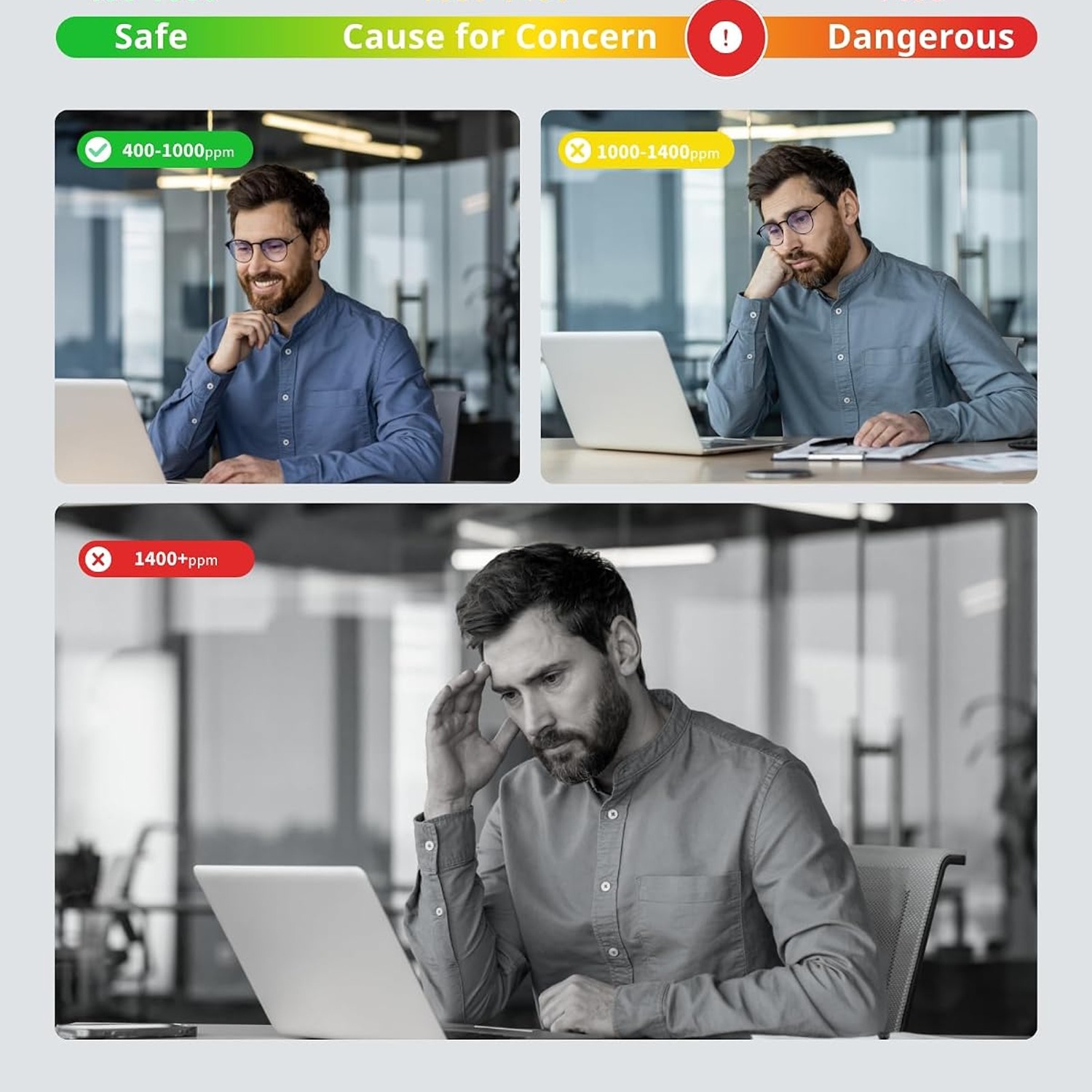
Most people have had the experience. You sit in a room for two hours, the work gets slower, your head feels thick, and you blame coffee, sleep or the task itself. Then someone opens a door and within five minutes the room feels different.
That change is usually carbon dioxide. We breathe it out constantly. In a sealed room with the door shut and the window closed, it accumulates. Nothing smells, nothing looks different, and the only clue is how you feel, which is a terrible instrument because you adapt to it.
A CO2 meter fixes that by turning an invisible thing into a number on a screen. Once you can see the number, the decision about when to open a window stops being a guess.
What this device does
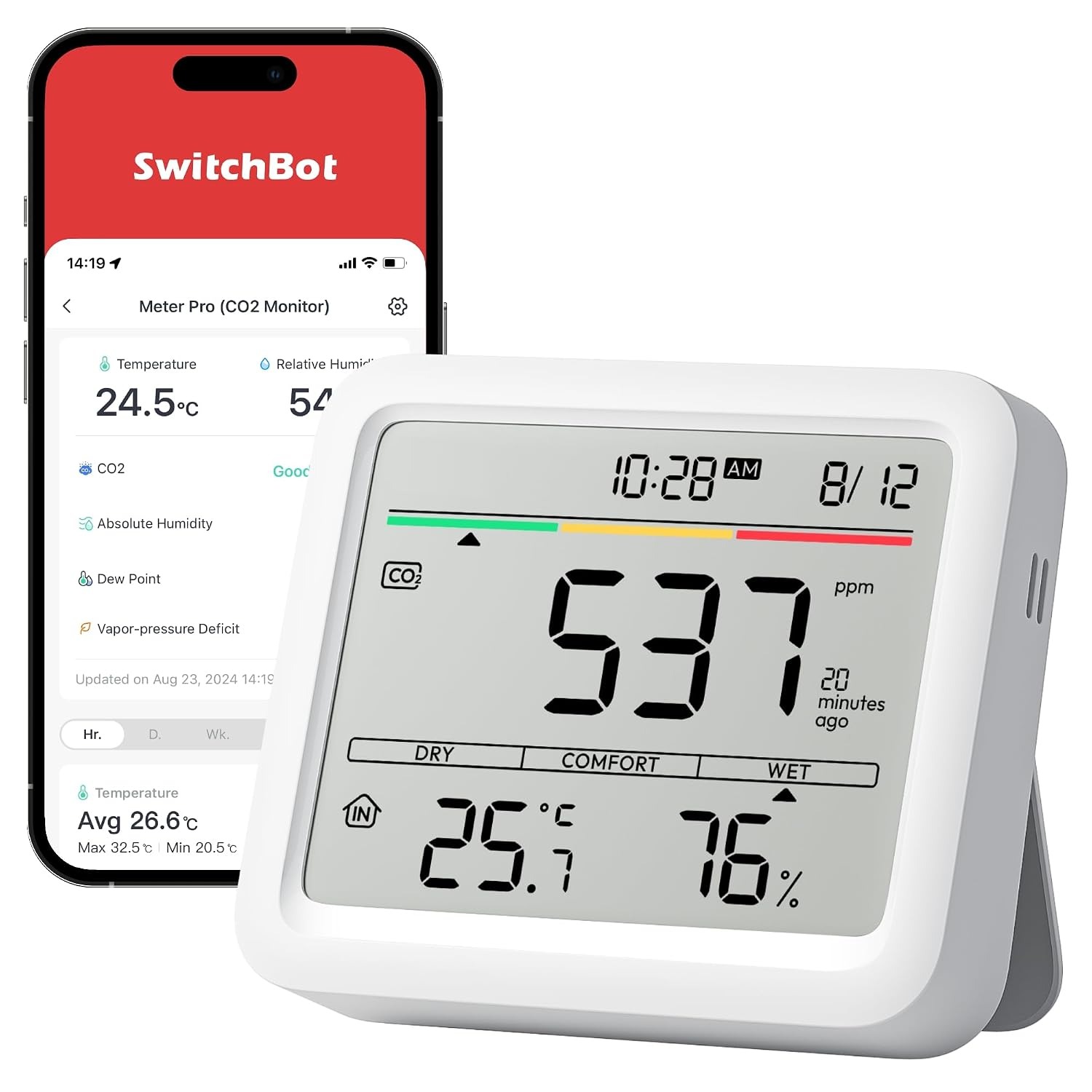
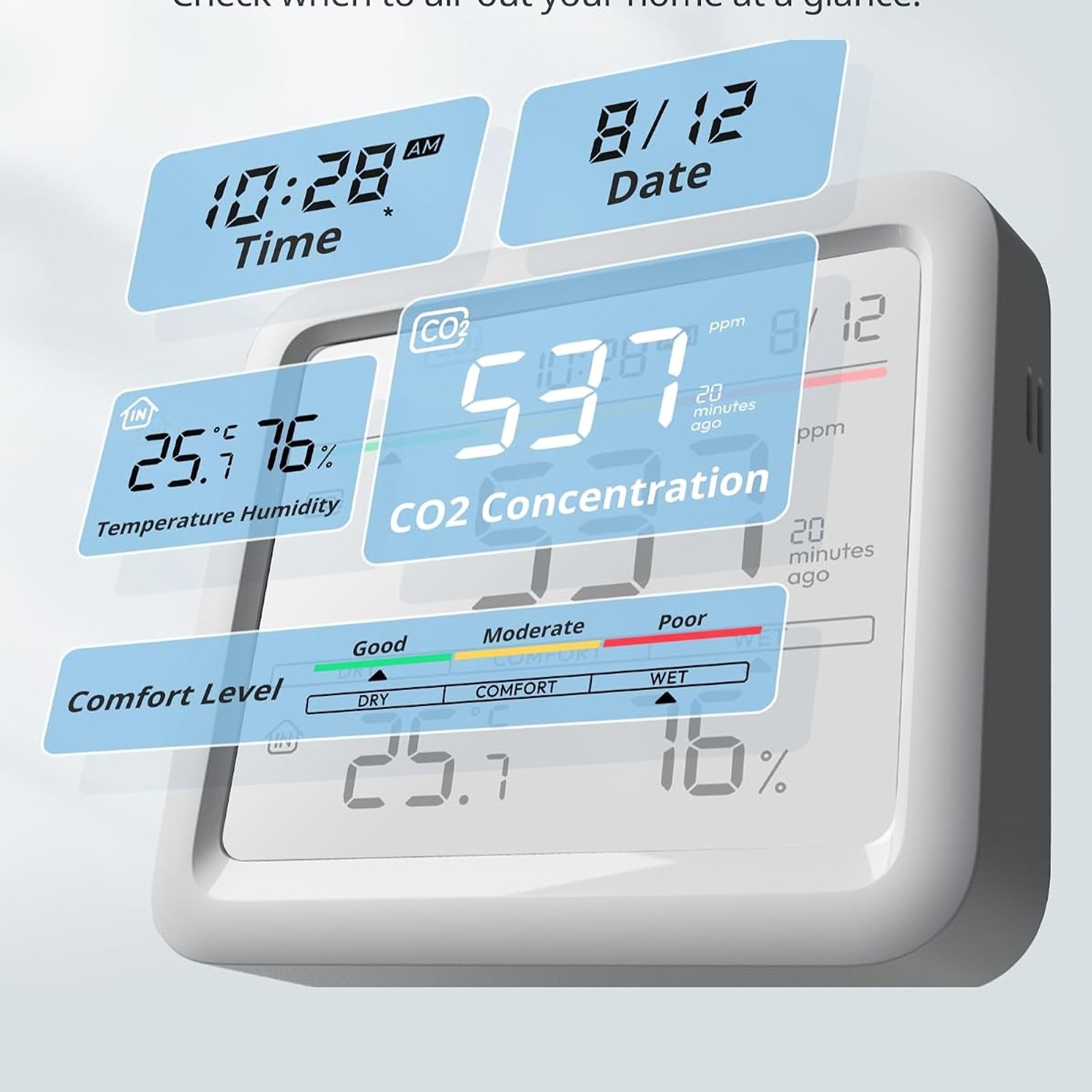
It reads the carbon dioxide in the air around it in parts per million, and shows that figure on a 92 mm screen along with temperature, humidity, the time, the date and a simple comfort level. Everything is visible at once, so a glance from across the desk is enough.
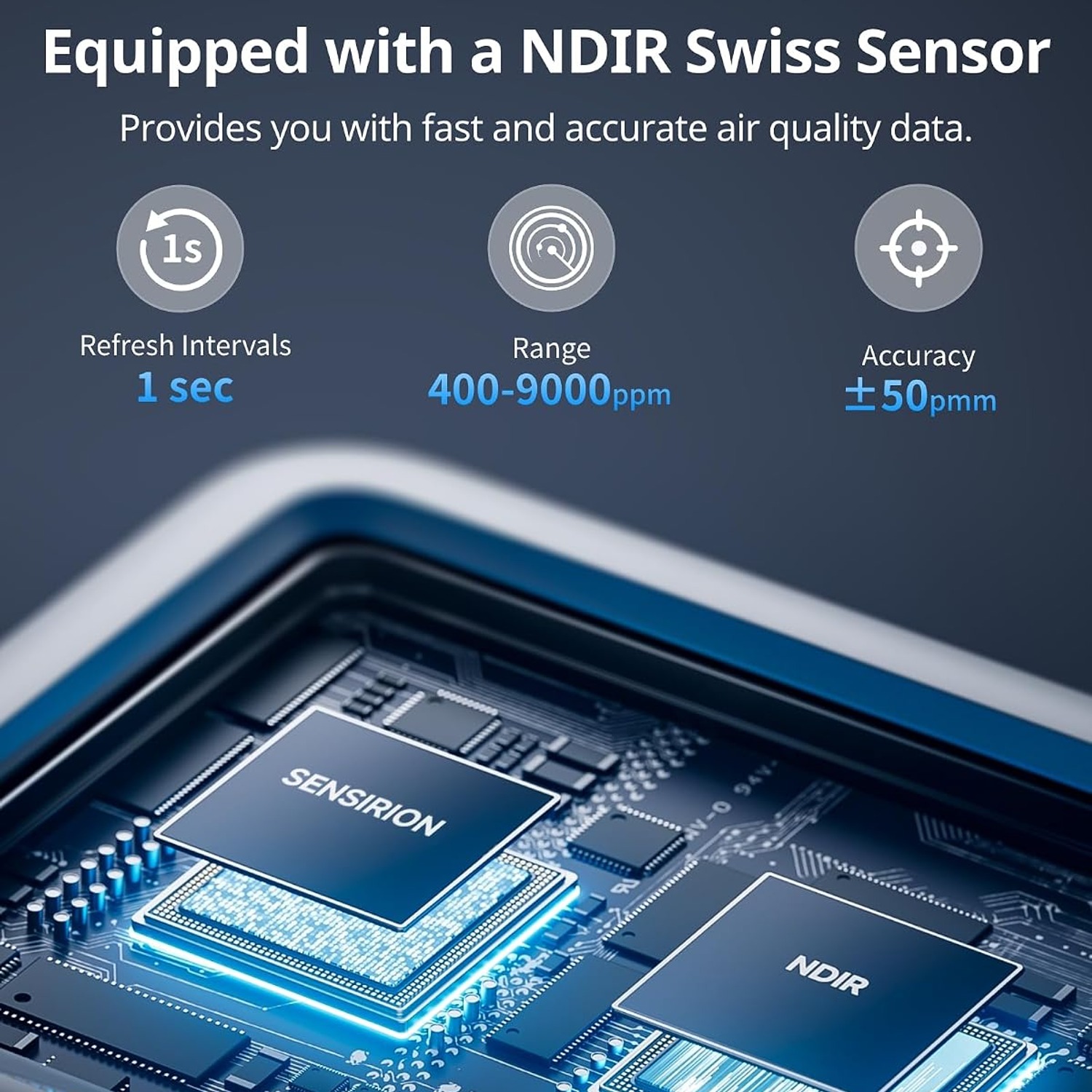
The sensor is an NDIR type, made in Switzerland. NDIR means non-dispersive infrared. In plain terms, the sensor shines infrared light through a small chamber of air and measures how much of that light the carbon dioxide absorbs. The more gas, the more absorption. Because nothing is being consumed, the method does not degrade the way older chemical sensors do.
It samples once every second, over a range of 400 to 9000 ppm, with an accuracy of plus or minus 50 ppm. Outdoor air is a bit above 400 ppm, so that bottom of the range is the floor you would expect with the windows wide open. Temperature readings are accurate to within 0.5 °C, humidity covers 0% to 99%, and the unit is rated to operate up to 60 °C.
Why the alerts matter more than the display
A screen only helps if you look at it. Plenty of people buy a monitor, watch it for a week, then stop noticing it entirely.
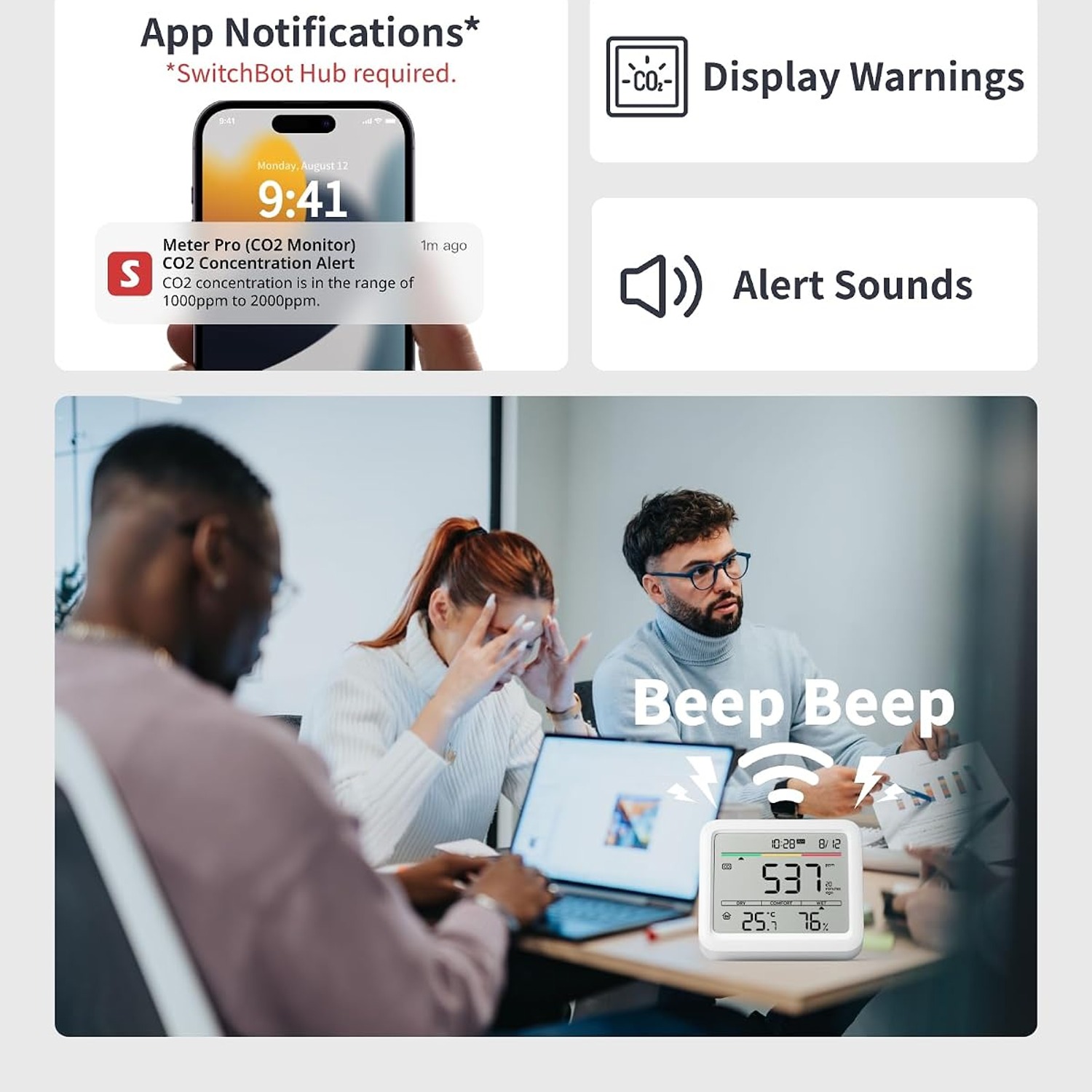
That is why the alerts are the practical part. You set your own limits for carbon dioxide, temperature and humidity, and when a limit is crossed the meter responds three ways. A sound alarm, a visible alert on the screen, and an app notification if you are running the matching hub.
The hub also opens the door to automation. A compatible circulator fan or evaporative humidifier can be configured to switch on when carbon dioxide passes your threshold, which means the room starts fixing itself before you have even noticed. Supported third-party voice control runs through the hub too. None of this is required. Without a hub, you still get the screen, the readings and the audible alarm, and for a lot of households that is enough.
Who gets the most out of it
Home office workers are the obvious group. A spare bedroom converted to a study is often the smallest, most sealed room in the house, and it is where people sit longest. A desk monitor gives a direct prompt to crack the window every so often.
Anyone who sleeps with the bedroom door closed is the second group. Overnight is when levels climb highest, because the room is small, occupied for eight hours and usually shut. A lot of people buy a bedroom air monitor expecting nothing interesting and are surprised by the morning figure.
Then there are shared rooms. Classrooms, meeting rooms, studios, treatment rooms and workshops all fill up with people and empty out again, and the air changes fast. A wall mounted air quality monitor at eye level gives everyone in the room the same information, which makes the decision to open a door much less awkward.
Parents often want one for a nursery, and musicians and crafters want one for a small studio where the door stays shut for hours. The use case is the same each time. A small, sealed space with people in it.
Choosing the right spot
Placement changes the number more than people expect.
Put it roughly at the height of where people's heads are. A desk, a shelf, or a wall at seated eye level is right. Floor level and ceiling level both give readings that are less relevant to what you are actually breathing.
Keep it away from direct draughts. Right next to an open window, an air vent or a fan, it will read the incoming air rather than the room. Same with heaters and direct sunlight, which skew the temperature side of the readings.
Do not park it directly in front of your face. Exhaled breath is extremely high in carbon dioxide, and a unit sitting 20 cm from your mouth will show numbers that say more about your breathing than your room. A slight offset, beside or behind the seating position, is better.
The unit is 9.2 x 2.4 x 7.9 cm and weighs 154 g, so you have options. It stands freely, it fits the included adjustable bracket, and it has wall-mount holes for a fixed position.
Reading the numbers without overthinking
You do not need a target figure to get value from this. The useful skill is knowing your own room.
Leave it running for a few days and watch the pattern. You will see the reading sit low in the morning, climb through the afternoon, and drop sharply whenever a door opens. Once you know that shape, pick an alert level a bit above your comfortable range and let the meter tell you when you have drifted past it.
Humidity is worth watching alongside it. A room that feels heavy is sometimes damp rather than stale, and the two problems have different fixes. Having both numbers on one screen saves you from treating the wrong thing.
Power and upkeep
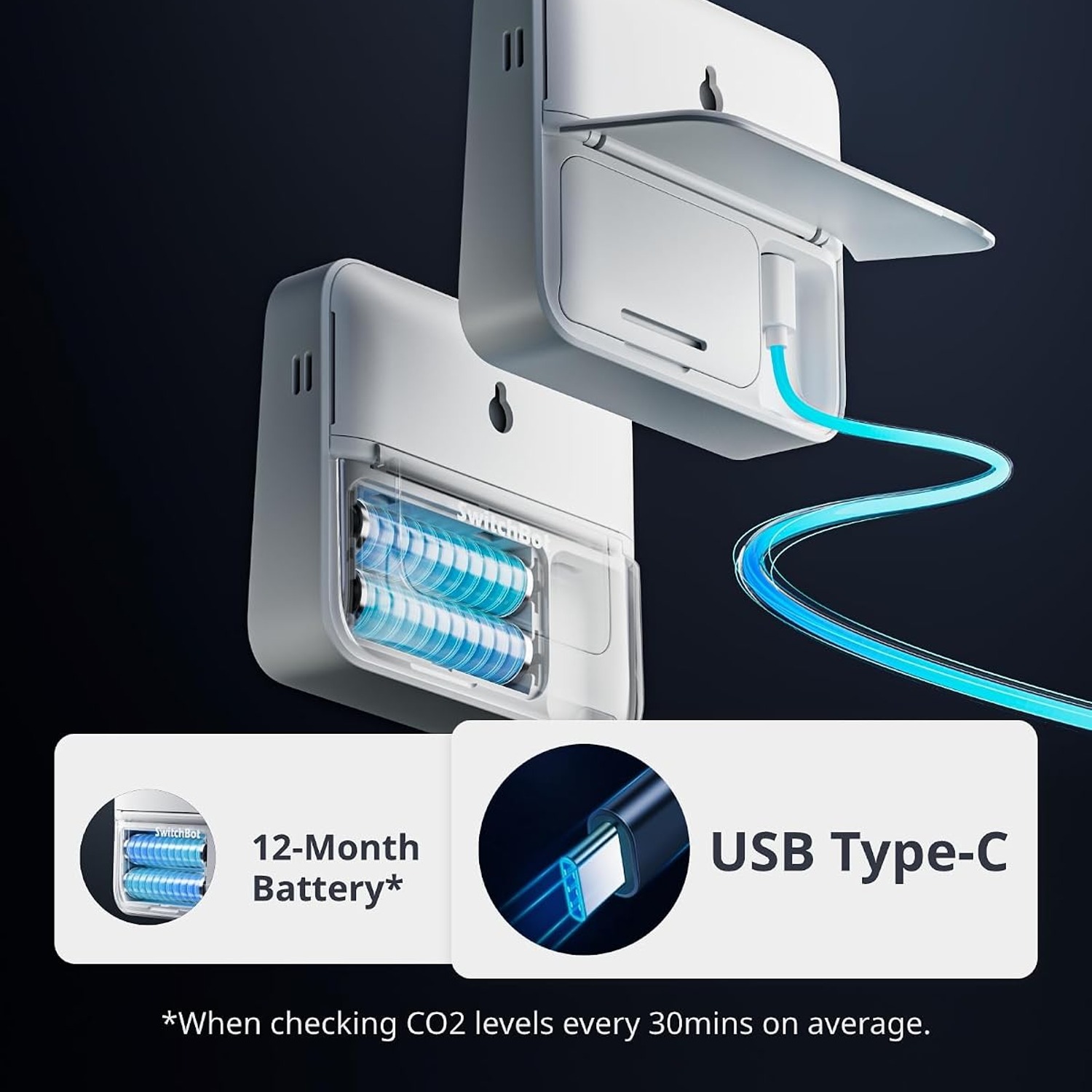
The built-in rechargeable battery is rated for up to 12 months of use, with a low battery warning before it goes flat. Two AA batteries are included as well. A year between charges is long enough that it becomes furniture rather than a gadget you maintain.
Care is simple. Wipe the casing with a dry or barely damp cloth, never a soaking one. Keep cleaning sprays away from the vents, because the sensor needs clear airflow to read properly. Do not cover the openings with paper, tape or fabric, and brush away dust around them now and then. Keep the unit indoors, out of the rain and away from radiators.
It comes with a one year manufacturer warranty. The unit is made in China, and the box contains one monitor.
What it is not
Worth being clear. This is a carbon dioxide, temperature and humidity monitor. It does not detect smoke, carbon monoxide, dust particles or volatile organic compounds, and it is not a replacement for the smoke and carbon monoxide alarms your home needs. Keep those installed and tested as usual.
Think of it as an information device for comfort, concentration and ventilation habits, not a safety alarm.
The short version
If a room in your home or workplace consistently feels stale by the afternoon, this gives you the number behind that feeling. An NDIR sensor reading every second, 400 to 9000 ppm, accurate to plus or minus 50 ppm, with temperature and humidity alongside it on a 92 mm screen.
Set your own limits, let the sound and screen alerts do the reminding, and add the hub later if you want app notifications or automatic fan control. It is 154 g, it runs up to a year between charges, and it will sit on a desk or a wall without asking anything of you.
Delivery is tracked across Canada, free on orders of $75 or more and $25 below that.