







The complete guide
The Practical Guide to Choosing and Using a Cigar Humidor
The problem with keeping cigars anywhere else
A cigar is dried leaf wrapped around more dried leaf, and it never really stops reacting to the air around it. Put one in a kitchen drawer and within a week or two it starts giving up moisture to the room. The wrapper tightens, sometimes it cracks along a seam, and when you finally light it the burn runs crooked and the smoke turns harsh. Go the other way and store cigars somewhere damp, and the filler packs down, the draw tightens, and you can end up with mould on the foot.
Neither of those outcomes is dramatic on day one. That is what makes it frustrating. The cigar you bought in good condition quietly turns into a worse cigar over a month, and you do not notice until you smoke it.
A humidor fixes the problem by shrinking the environment. Instead of trying to control a whole room, you control a sealed box about the size of a hardback book. Inside that box, a small amount of moisture goes a long way, and cedar does most of the balancing work for you.
How a cedar humidor actually works
Three things are happening at once inside a box like this one.
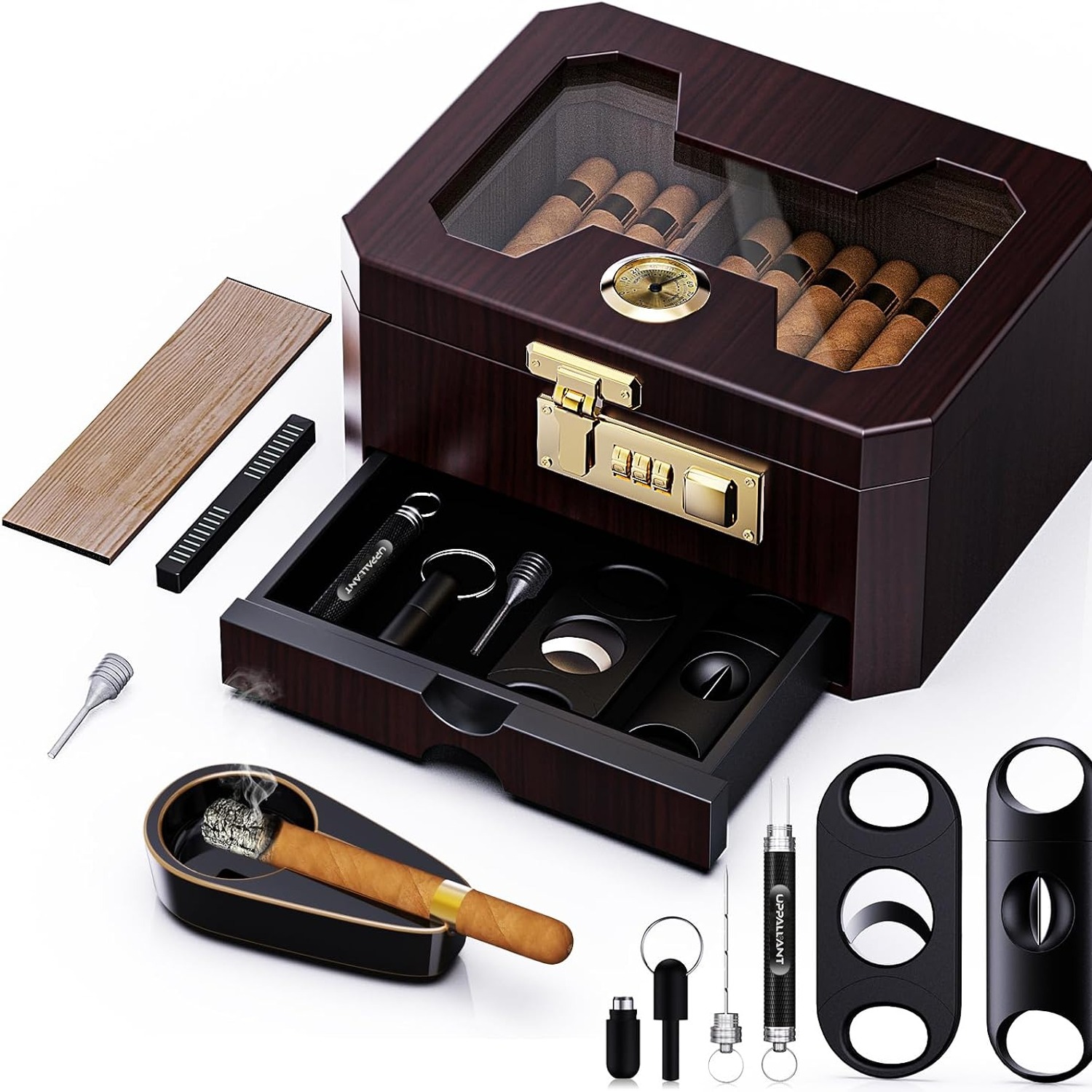
The first is the seal. A closed lid means the air inside is mostly separate from the air in the room. Every time you open it, some of that stable air escapes and room air comes in, which is why a glass top is genuinely useful. You can count what you have, or just enjoy looking at the collection, without breaking the seal.
The second is the cedar lining. Cedar is not there only for looks or the smell, though both are part of the appeal. It is a wood that takes on moisture slowly and gives it back slowly, which acts like a buffer. When you open the lid and let dry air in, the cedar releases a little moisture back into the space. When things get slightly damp, it absorbs some. That buffering is why cedar has been the default humidor wood for well over a century.
The third is active humidification. The built-in humidifier adds moisture when the cedar alone cannot keep up, and you refill it using the supplied dropper. The dropper matters more than it sounds. Pouring liquid in freely risks soaking the lining, and wet cedar is a different problem from dry cedar.
Watching over all of it is the mechanical hygrometer. It reads the humidity inside so you are not guessing. The suggested working range here is 65 to 75 percent humidity with a temperature of 60 to 68 F. Pick a point in that band and keep it steady. Cigars tolerate a settled 68 percent far better than they tolerate bouncing between 60 and 78 every few days.
Who this size suits
This is a desktop humidor, 24 x 18.01 x 11.99 cm and 1.9 kg, described as holding roughly 20 to 30 cigars. In practice that is a good fit for a few kinds of smoker.
If you smoke occasionally, maybe once a week or on special evenings, 20 to 30 sticks is several months of supply. You can buy a box at a time, keep it properly, and not worry about waste.
If you are new to cigars and have been storing them in the bag they came in, this is the step that makes the biggest difference. A proper box with a hygrometer and the cutters included means you are not shopping for four separate things and hoping they work together.
If you already have a large cabinet, a desktop box still earns its place as a working humidor. Keep the bulk of the collection in the cabinet and move a handful of ready-to-smoke cigars into the small box so the big one stays shut.
Where it is not the answer is for a serious collector with hundreds of cigars in rotation. At that point you want cabinet storage, and a small box becomes a travel companion instead.
What to look for when you compare humidors
Capacity, measured honestly. Published cigar counts assume a mix of ordinary sizes. A box rated for 30 will hold fewer if you favour thick ring gauges. Always assume the real number is at the lower end of the range, and leave a gap so air can move.
The lining. Cedar is the standard and there is a reason for that. Anything that is not lined in a suitable wood is a presentation box, not a humidor.
A hygrometer you will actually read. The mechanical type fitted here needs no battery and stays readable for years. Digital units are often more precise but eventually need a new cell. Either is fine. The one that fails you is the one you never look at.
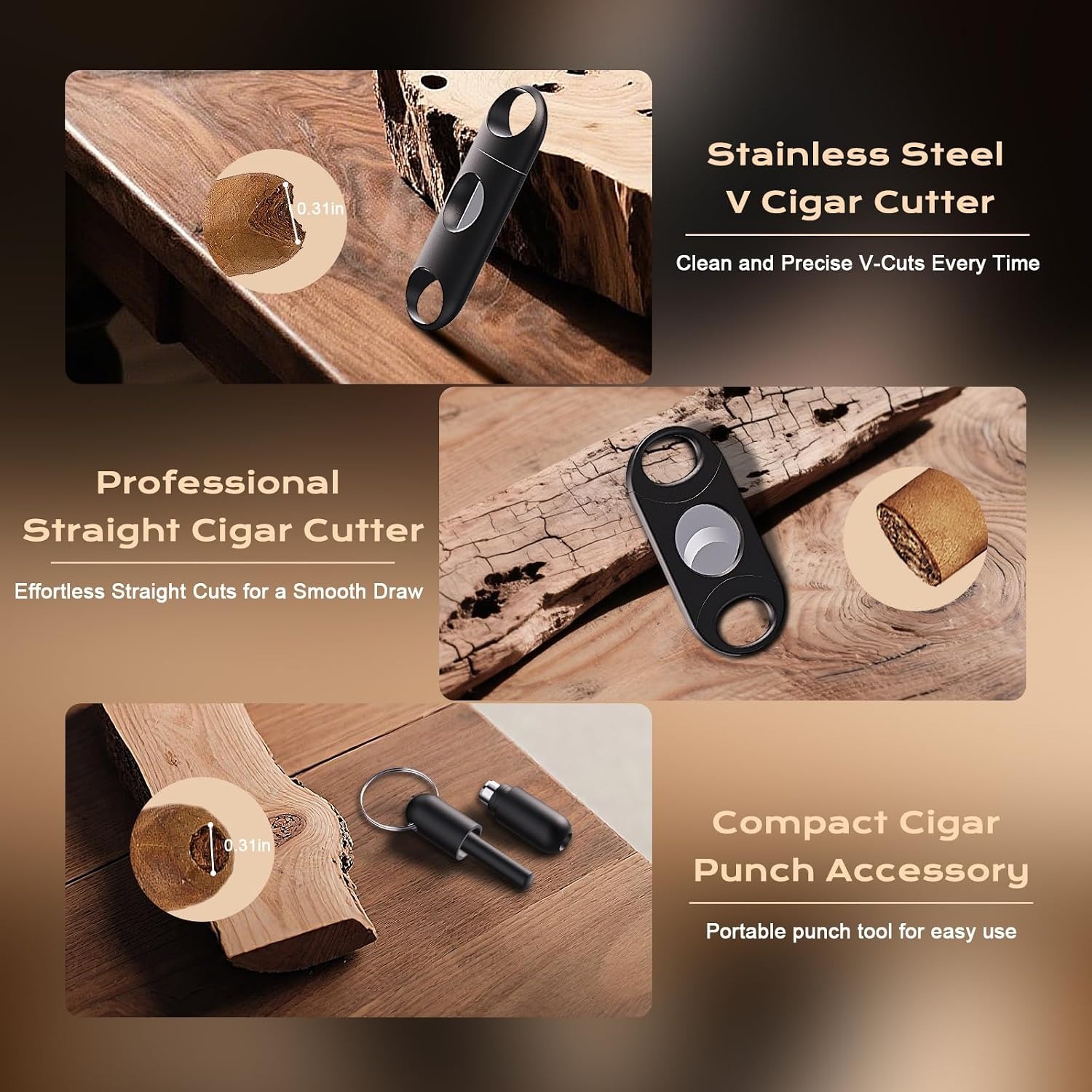
Dividers and a drawer. A detachable cedar divider lets you keep sizes apart rather than having everything shift around. A velvet-lined drawer gives the cutters and the punch somewhere to live so they are not scattered across a desk.
Security, if you need it. The three-digit combination lock on this box is a practical feature rather than a vault. It keeps the lid closed in a shared house, and it keeps the box shut when it is in a bag.
Portability. At under 2 kg this travels without much trouble. If you want the best travel cigar case for a weekend away, a small locking box with its own accessories does the job of two or three separate items.
Setting it up for the first time
Do not load it with cigars the moment it arrives. New cedar is dry, and dry cedar will pull moisture straight out of your cigars while it settles.
Set up the humidifier first, close the lid, and let the interior come up to the target range. Check the hygrometer over the following day or two rather than hovering over it. Once the reading sits steady in the 65 to 75 percent band, you can load the box.
After that, the routine is simple. Glance at the hygrometer when you pass the box. Top up the humidifier with the dropper when the reading starts drifting down. Keep the lid closed the rest of the time.
Placement matters more than people expect. Keep the humidor out of direct sunlight, since a glass top lets heat through. Keep it away from radiators, heating vents and the back of electronics that run warm. A shelf, a sideboard or a quiet corner of a desk is ideal.
Care over the long term
Wipe the outside with a soft cloth, dry or barely damp, then dry it off. The inside gets nothing but a dry cloth if dust gathers. Never put cleaner, polish or solvent in a cedar lining, because the wood absorbs the smell and hands it straight to your cigars.
Keep an eye on the lid seal. If the box starts losing humidity faster than it used to, check that nothing is propping the lid open and that the hinges are sitting square.
Rotate your cigars occasionally, bringing the ones at the bottom up to the top. In a box this size the difference is small, but it costs nothing and keeps everything evenly conditioned.
The accessories need almost no attention. Wipe the cutter blades clean after use and keep them dry, and rinse the ashtray rather than letting ash sit in it.
The short version
A cigar humidor is a small sealed box that stops good cigars quietly turning into bad ones. This one is cedar-lined with a glass top, sized 24 x 18.01 x 11.99 cm, weighing 1.9 kg, and described as holding roughly 20 to 30 cigars. A built-in humidifier and a mechanical hygrometer let you hold the suggested 65 to 75 percent humidity, a detachable divider and a velvet-lined drawer organise the space, and a three-digit combination lock keeps the lid shut.
The accessory set, a straight cutter, a V-cutter, a punch, an ashtray and a draw enhancer, means it works out of the box. Season it before you load it, keep it out of sun and heat, check the hygrometer now and then, and it will take care of the rest.