


The complete guide
How to Choose a Car Key Signal Blocking Box
The problem with a key that never stops talking
Keyless entry is one of those features that is genuinely good until you think about how it works. Your fob sends out a small radio message, the car listens, and when the two are close enough the car unlocks and lets you press the start button. No fumbling in a bag. No scratched paintwork from a key in the lock.
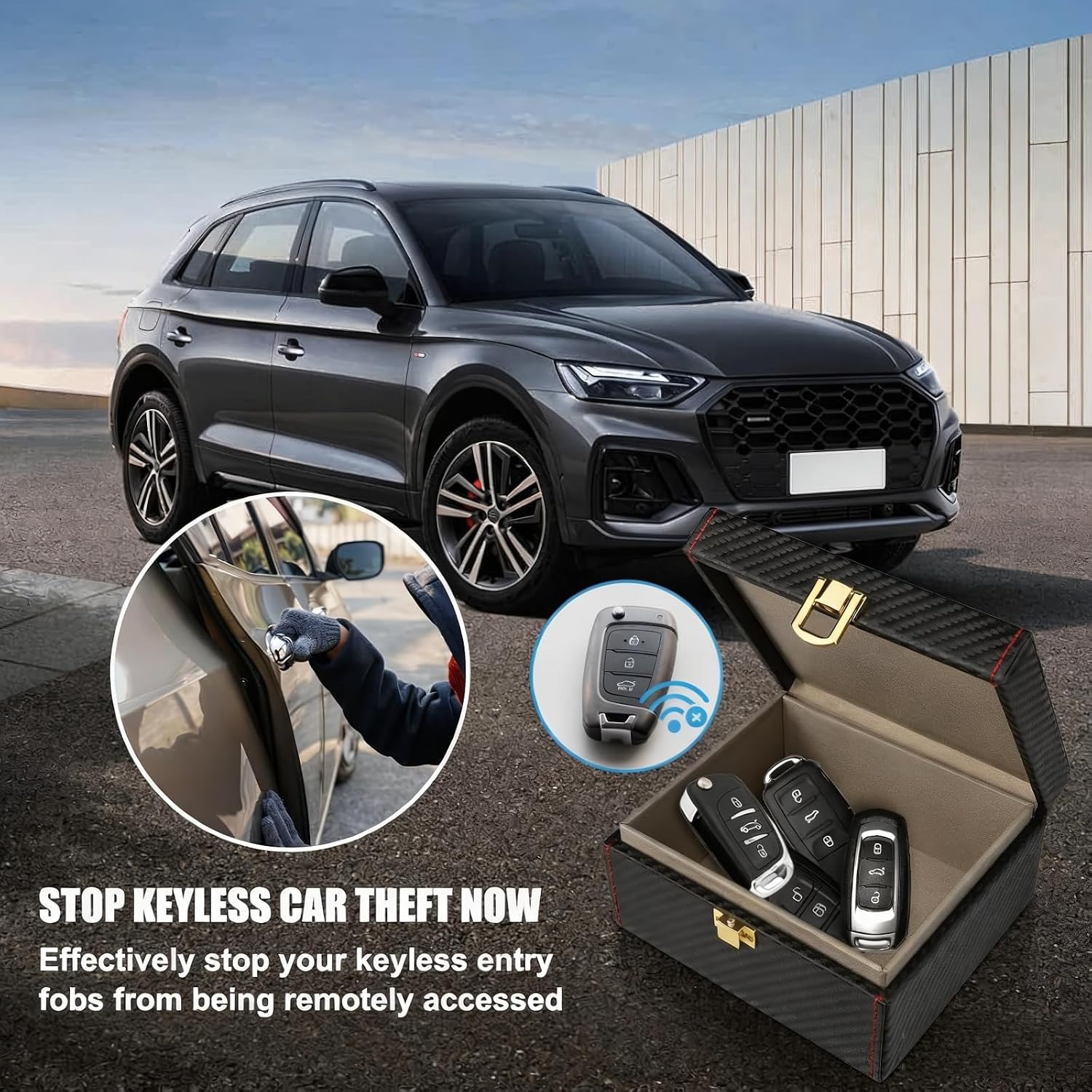
The catch is that the fob does not know where it is. It keeps broadcasting whether it is in your hand, in your coat pocket, or in a dish on the hall table half a metre from a front door. Someone standing outside with the right kit can pick up that message, pass it along to a second device next to the car, and the car behaves as if the key just walked up. The whole thing can be over in under a minute and nothing gets broken.
The fix is not complicated. If the key cannot send a signal out, there is nothing to relay. That is the entire job of a car key signal blocking box.
How a faraday box works
The idea goes back to Michael Faraday and a simple observation: a conductive enclosure around something will carry an outside electrical charge around the outside rather than letting it pass through. Wrap a radio transmitter in the right material and the signal has nowhere to go.
In a modern product like this one, that material is a shielding fibre layer sitting inside the box. The key goes in the middle. Close the lid and the lining forms a continuous barrier around the fob. The radio message still gets produced, it just does not get out.
There are two practical things to know about this. First, coverage has to be complete. A lid left slightly open, or a strap trailing out, gives the signal a route. Second, shielding materials degrade when they get creased or torn. That is one of the quieter advantages a rigid box has over a fabric pouch. A box holds its shape, so the lining stays flat and intact instead of being folded in half twice a day.
What you actually get here
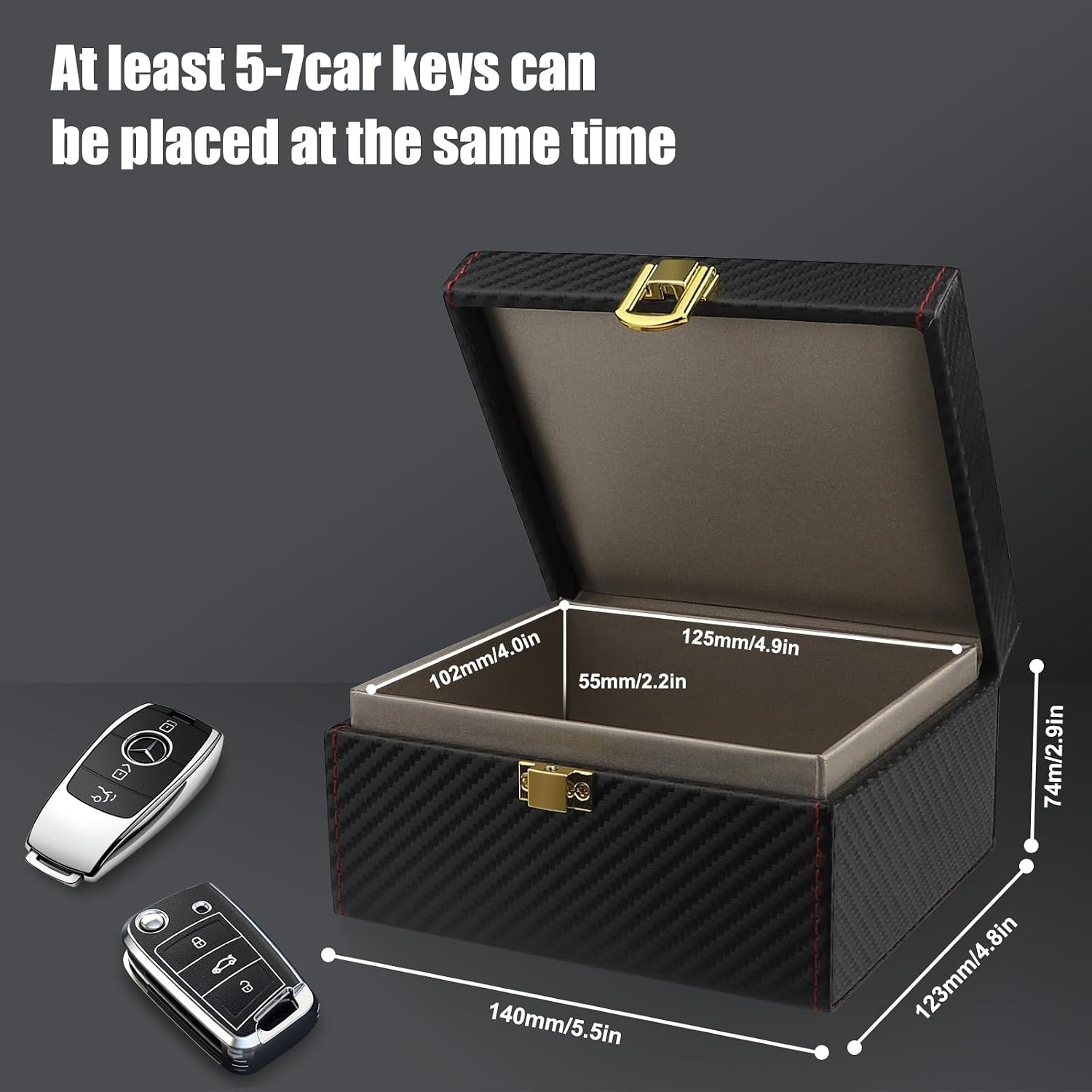
This is a compact rectangular box finished in black PU leather. The lid is a hinged flip top, and the front has a key lock. Inside there is a single compartment lined with shielding fibre, with no dividers getting in the way.
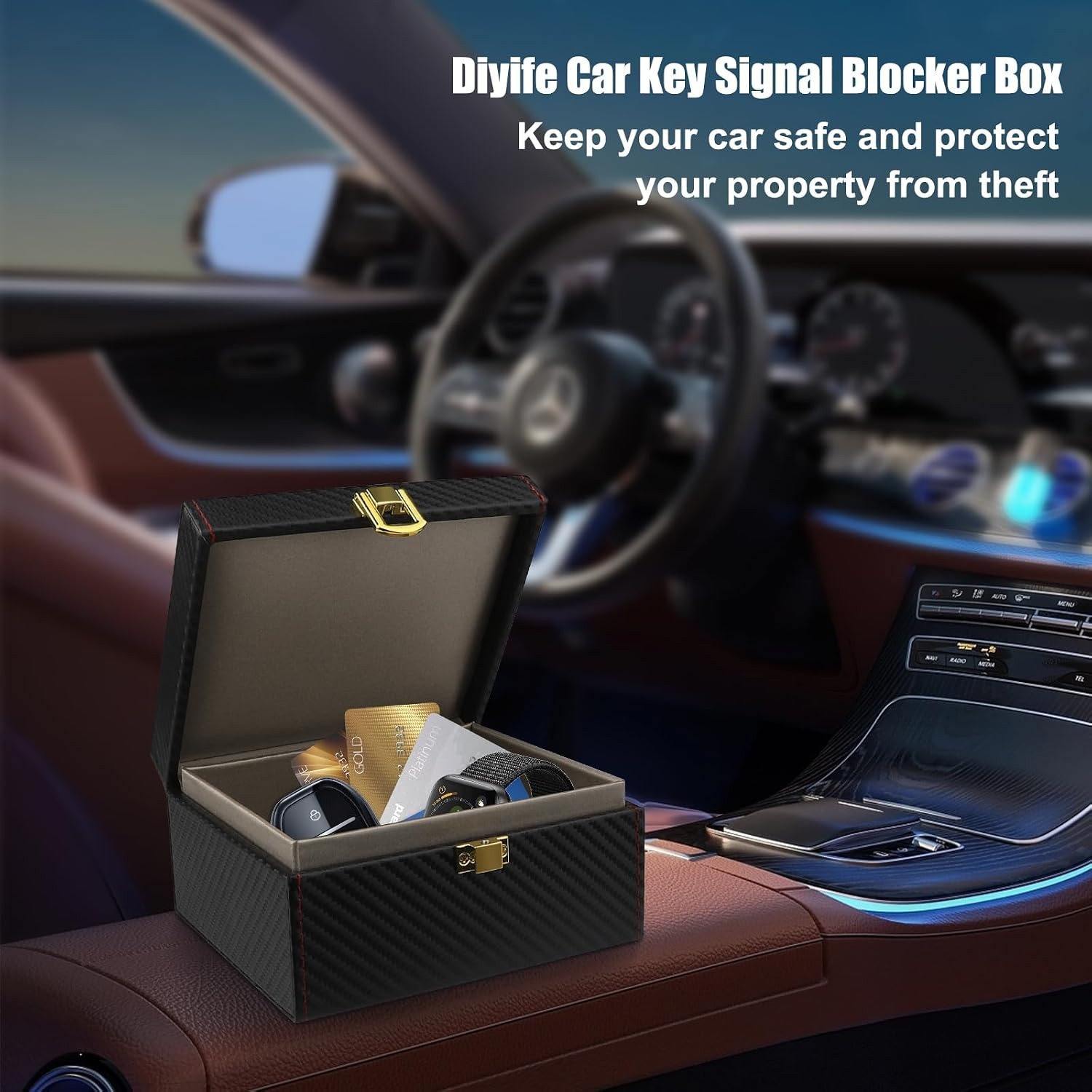
One compartment sounds basic, and that is the point. You can drop in several fobs at once, so a household with two cars does not need two boxes. There is also room for contactless cards, a spare transponder key, or small items you would rather not have scanned. Plenty of people buy one as a faraday key box and quietly end up using it for half their wallet as well.
It weighs 320 g, which is a useful middle ground. Heavy enough that it sits still on a table rather than sliding about when you drop keys in, light enough that packing it for a trip is not a decision.
What it is not is waterproof. The listing records it as not water resistant, so this lives indoors or in a dry bag, not loose in a boot or on a porch.
Who it suits
Anyone with keyless entry and go is the obvious answer. If you can walk up to your car and open it without pressing anything, your fob is broadcasting all day and a shielded box is worth having.
It is also worth it if you park on a driveway or street close to the house, since the shorter the distance between the key and the pavement, the easier a relay attempt becomes. A key sitting at the back of a large house is a harder target than one by the front door, but harder is not the same as safe.
Households with more than one driver benefit from a box rather than individual pouches. Having a single landing spot by the door means keys stop going missing, which is a small domestic win on top of the security one.
Renters and frequent travellers get use out of it too. A hotel room near a car park is a standard scenario for this kind of problem, and a portable box solves it without needing to modify anything.
If your car uses a traditional key you turn in the ignition, the risk is much lower. You might still want somewhere tidy and lockable to keep spares, but the shielding is less relevant to you.
Choosing between a box and a pouch
Both do the same job. The differences are practical.
A pouch is cheaper, lighter and slips into a jacket. It is good for one key and good for carrying. The downside is that fabric pouches get folded, stuffed into bags and worn at the seams, and shielding performance drops when the material creases repeatedly.
A box holds more, stays flat and looks like a normal object on a shelf. It is the better pick for a permanent home spot. It also handles multiple fobs and cards without you having to think about it. The trade-off is bulk, which only matters if you were planning to carry it in a pocket.
A lot of people end up with both. Box at home, pouch in the bag.
Testing it when it arrives
Do not take anyone's word for it, including ours. Put your fob inside, close the lid properly, then walk to your car holding the box. Try the door handle. Try the start button with the box in the cabin. If the car refuses to respond, you have your answer.
Repeat that test every few months. It takes thirty seconds and tells you whether the lining is still doing its job. If the car suddenly responds when it did not before, check the lid is closing flat and nothing is wedged in the hinge.
Looking after it
Care here is simple because there is very little to go wrong. Wipe the PU leather outside with a soft cloth, dry or barely damp. Skip solvents and harsh cleaners, which can strip the finish.
Leave the lining alone. Do not wash it, soak it or scrub it. If something damp goes inside, open the lid and let it air out before closing it again.
Do not overfill. If the lid will not shut flat, the shielding has a gap and the box is doing nothing useful. If you regularly need more space, get a second box rather than forcing the first one.
Keep it away from water generally, since the water resistance level is listed as not water resistant.
A sensible routine beats any single product
Shielding your fob closes one door. It does not close all of them. The households that have the least trouble tend to do a few small things consistently rather than one big thing occasionally.
Keys go in the box as soon as you walk in, not later. Spare keys live in the box too, because a spare left in a drawer by the door is just as readable as the main one. The box sits somewhere not visible through a window or a glass front door. If your car supports it, check whether the fob has a motion-sensing sleep mode and turn it on.
Beyond that, the old-fashioned stuff still helps. A steering lock is visible and annoying. A tracker helps after the fact. Parking under a light, or nose-in on a driveway, makes a car less appealing to someone scanning a street.
The short version
Keyless cars are convenient because the fob never stops talking, and that is exactly why a fob needs somewhere quiet to sit. This box gives it one. Black PU leather outside, shielding fibre lining inside, a hinged flip top with a key lock, and a single compartment with room for several fobs plus cards.
It weighs 320 g, ships as one box, and carries a stated 12 month warranty. It is not water resistant and it is not a safe, so keep it dry and treat the lock as a deterrent.
Test it with your own car when it arrives, build the habit of using it every time you come home, and you have removed the easiest route into your vehicle for roughly the price of a tank of fuel.