


The complete guide
Choosing a Bird Repeller Device, A Practical Buyer's Guide
The problem with birds (and everything else that visits)
There is a point where garden wildlife stops being pleasant and starts being a cost. Seedlings pulled out before they root. Soft fruit pecked the week before you planned to pick it. Patio furniture, railings and car bonnets covered in mess that takes a bucket and a brush to deal with. And it is rarely only birds. Once a garden becomes a reliable food stop, squirrels, rodents and the odd raccoon tend to follow.
The traditional fixes all come with a catch. Netting works if you put it up properly, but it sags, it tears, and it can trap the things you were trying to protect yourself from. Sprays and gels need reapplying after rain and leave residue where you grow food. Visual scarers like reflective tape and plastic predators work for a fortnight, then the local birds work out that nothing ever happens and go back to business as usual.
An ultrasonic animal repeller takes a different approach. Instead of blocking access or coating surfaces, it makes the space uncomfortable enough that animals choose somewhere easier. Nothing goes on your plants. Nothing gets strung across your beds. And when the problem shifts to a different corner of the garden, you pick the unit up and move it.
How this one works
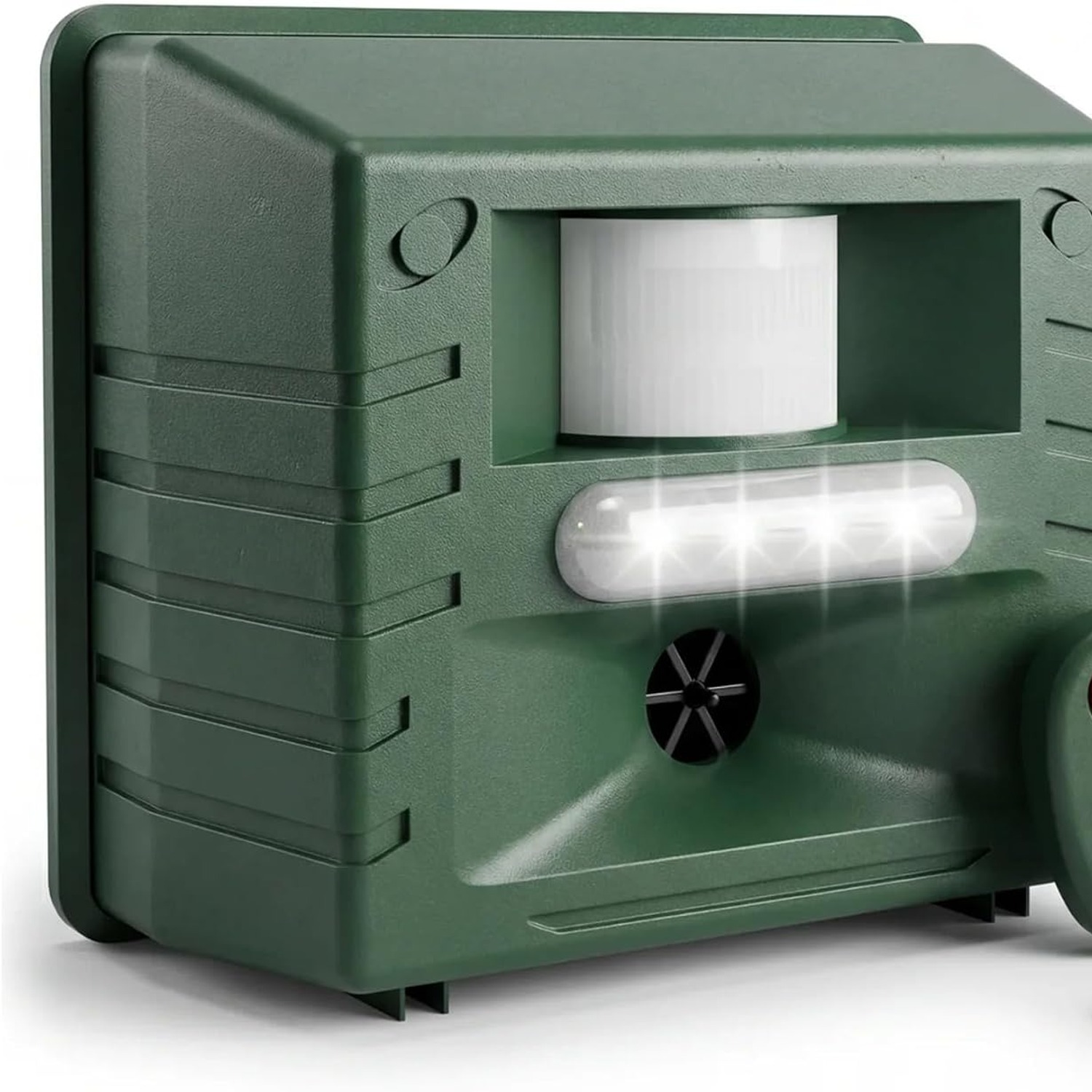
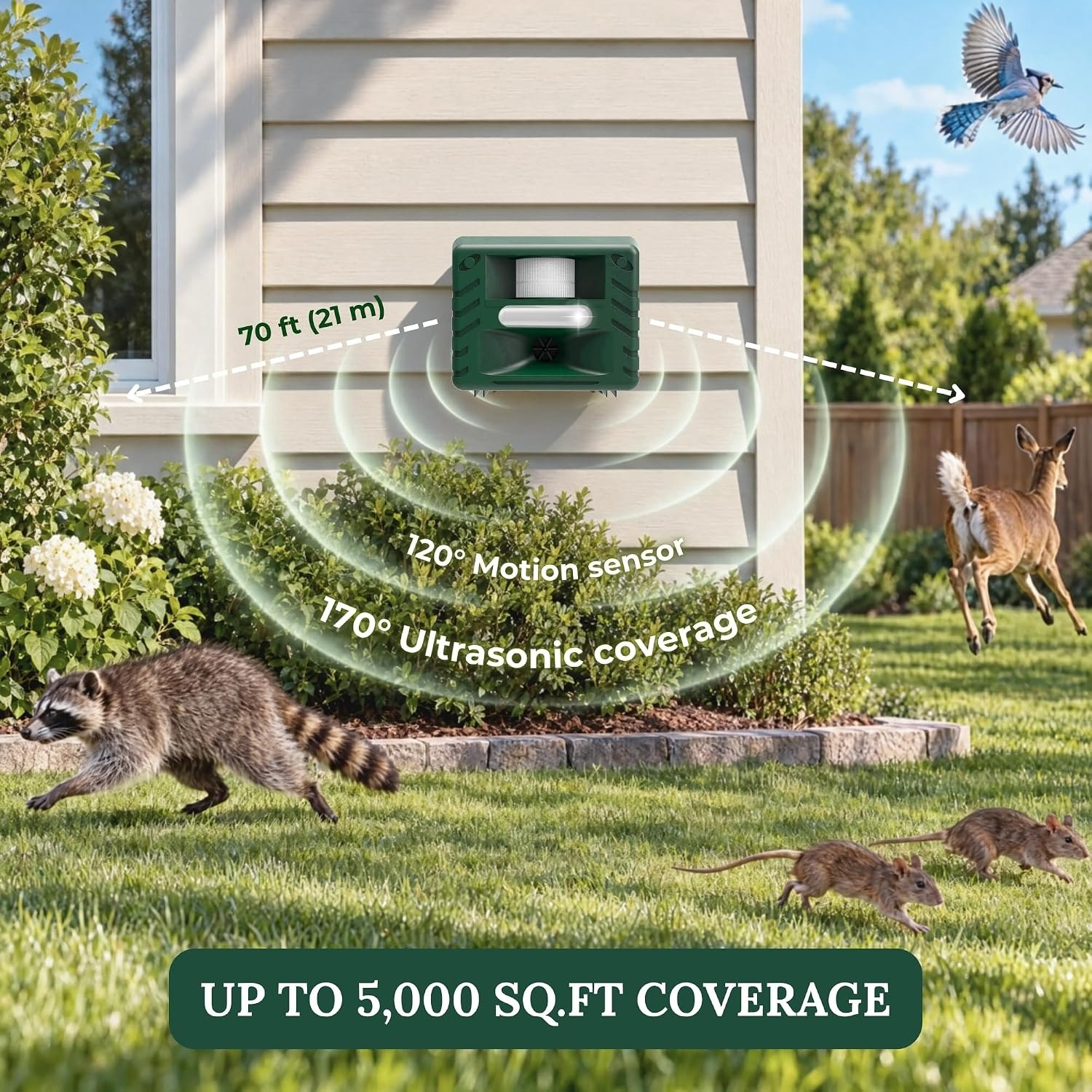
The device has a motion sensor built into the front. When something moves within the detection area, the unit switches on and emits ultrasonic sound. Because the sensor does the triggering, it is not running flat out all day, which helps battery life and means the sound is tied to an actual event rather than to a timer.
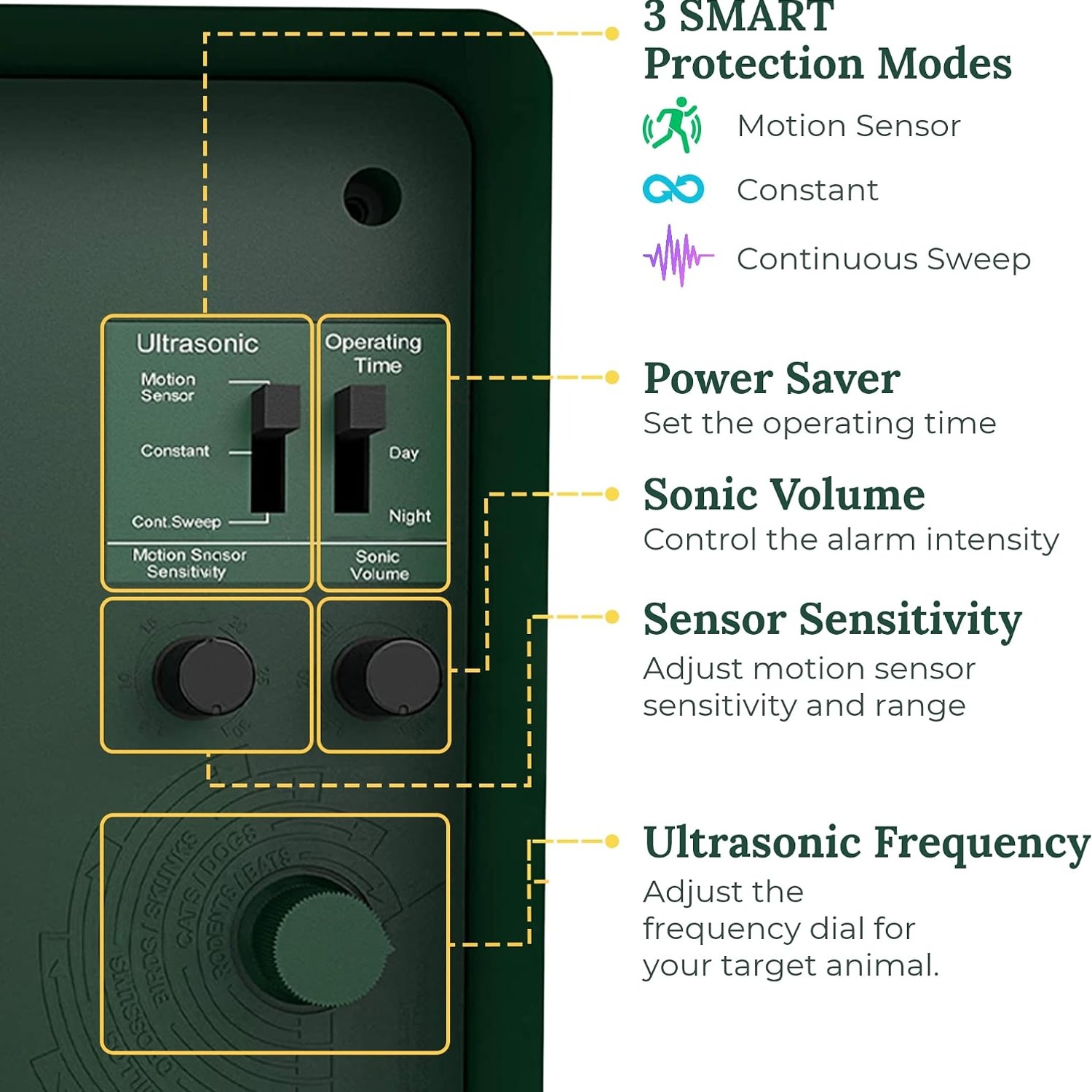
Three things are adjustable. The ultrasonic frequency, so you can match the band to the animal giving you trouble. The sensor sensitivity, so you can cut down on false triggers from swaying branches or a passing cat you do not mind. And the alarm volume, which is the audible part of the deterrent, useful in some situations and better turned down in others.
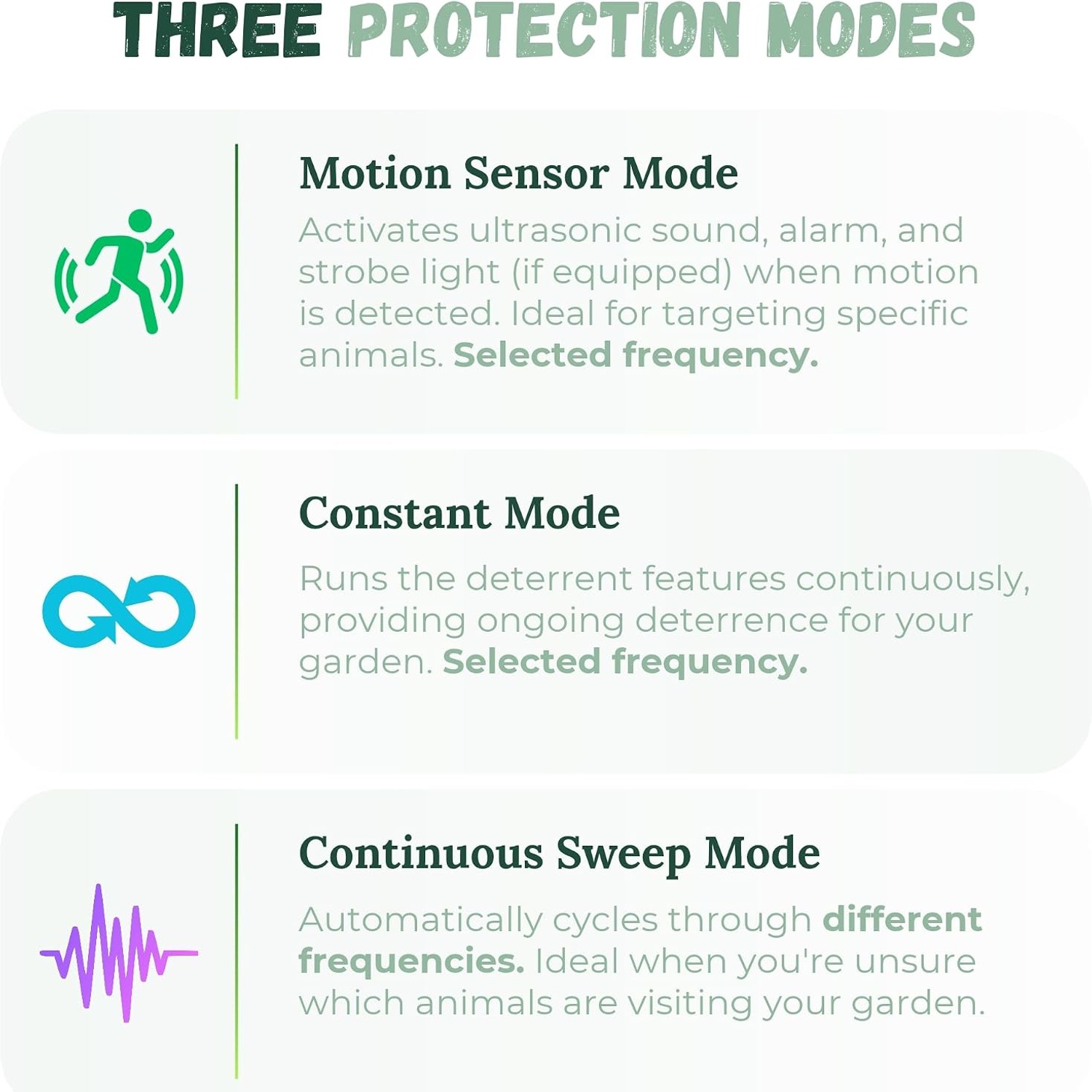
On top of that there are three operating modes. Day, night, or 24 hours. Most people do not have a round-the-clock problem. Birds are a daytime nuisance. Rodents and raccoons turn up after dark. Picking the mode that matches your actual problem means less noise, less power use and fewer pointless triggers.
The four-key remote is the part people end up appreciating most. Without it, every tweak means walking out, crouching, finding the switch, walking back and watching. With it, you stand at the spot where the birds actually land and change the setting from there. That shortens the trial and error enormously, and some trial and error is simply part of using an ultrasonic deterrent honestly.
Who it suits
If you grow vegetables or soft fruit, this is the kind of thing worth having before planting season rather than after. Seedling beds and fruit cages are the two places where a week of damage undoes a month of work.
If you have a patio, deck or balcony that attracts pigeons, the appeal is more about mess than damage. A compact unit facing the railing or the favoured perch is often enough to shift the habit.
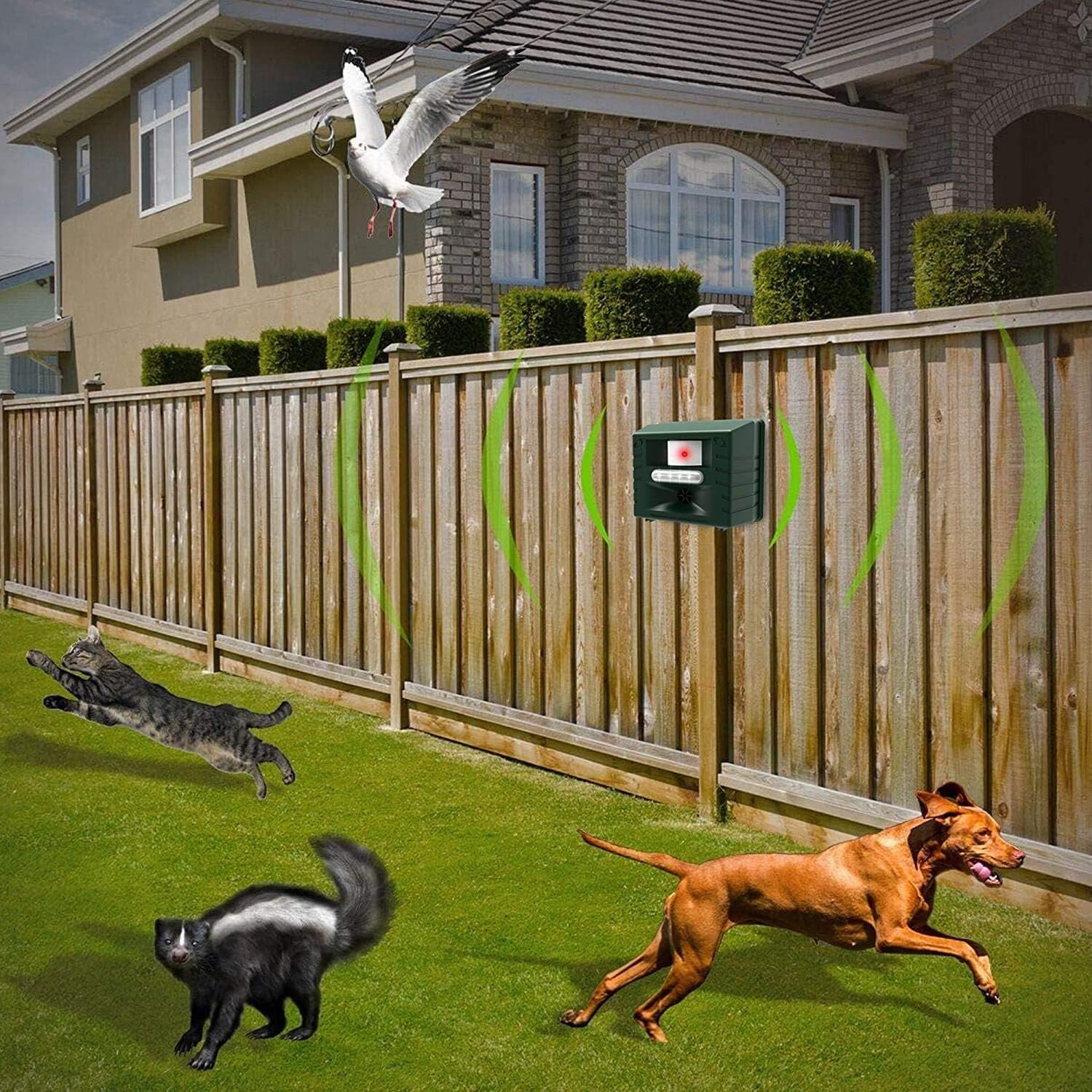
If your issue is broader, squirrels in the bird feeder, rodents around the compost, something going through the bins at night, the adjustable frequency and the night mode give you a way to target it. The listing names raccoons, skunks, squirrels, rodents, rabbits, deer and cats alongside birds as animals the unit is designed to help deter.
Where it suits less well is a large open field, or a site where you need an absolute guarantee that nothing gets through. Ultrasonic sound is directional and it loses strength with distance and obstacles. Think of this as a tool that shifts behaviour over days, not a wall.
Reading the specs that matter
Coverage is stated as up to 5,500 sq. ft. under suitable conditions. That last phrase is doing real work. It assumes clear line of sight with nothing absorbing the sound. A dense hedge between the unit and the target area will cut it down considerably, so place the device where it can actually see the ground you want to protect.
Power is 4 C batteries or an AC adapter. Batteries let you put the unit at the far end of the garden with no cable to think about. Mains power is the better choice for continuous use near the house, and it removes any worry about the batteries dying quietly in mid-season. Cold weather in particular pulls battery performance down, so if you want winter coverage, mains is the safer bet.
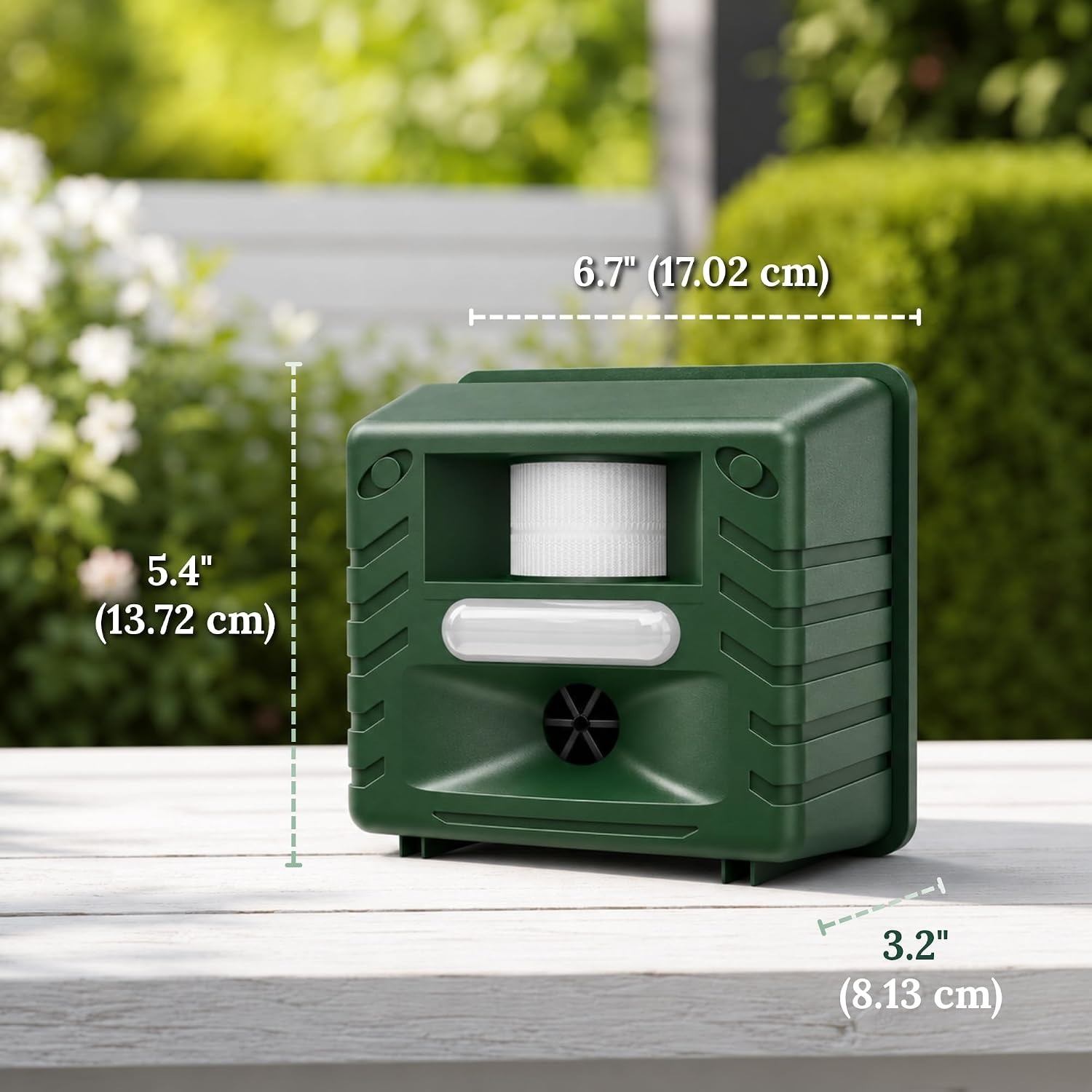
Size and weight are 16 x 8.51 x 13.49 cm and 200 g. That is small enough to sit on a fence post, screw to a bracket or clip to a garden stake without any structural work. The housing is plastic and the colour is green, which disappears into foliage better than it does against a white wall.
A manufacturer warranty of 1 year is listed. Keep your order confirmation somewhere you can find it.
Getting the placement right
Placement decides more than the settings do. Three rules cover most situations.
Face it at the approach, not the destination. If pigeons land on a railing, the device should be watching the airspace and ground they use to get there, not pointed at the rail from behind.
Match the height to the animal. A unit mounted at eye level is too high to catch rodents moving along the ground. One sitting on the soil is too low to notice a bird on a fence top. Set it roughly where the thing you are deterring actually travels.
Keep the view clear. Leaves, cobwebs and a branch that moves in the wind will all cause false triggers or block detection altogether. Thirty seconds of tidying around the sensor every couple of weeks keeps it behaving.
If your garden has two separate problem spots, one unit will not cover both. A second device facing the other direction works better than endlessly repositioning one.
Settings, patience and food sources
Start conservatively. Mid-range frequency, moderate sensitivity, modest alarm volume. Run it for several days and watch what actually changes. If nothing shifts, change one setting at a time rather than everything at once, or you will have no idea what made the difference.
The other half of the job is food. No deterrent beats a reliable meal. Spilled seed under a feeder, fallen fruit left on the lawn, an open compost bin or a bin lid that does not latch will keep animals coming back regardless of what the device is doing. Clear those first and the repeller has a much easier task. People who combine the two usually get results in days rather than weeks.
Looking after it
Wipe the housing with a soft, damp cloth and dry it off. Keep the sensor window and the speaker grille clean, since a dusty sensor is the single most common reason one of these stops working properly.
Check the batteries at the start of each season and look at the contacts for any corrosion. If the unit is going into storage over winter, take the batteries out first.
The listing describes the unit as weather resistant and designed for outdoor use, but it does not give an IP rating. Treat it accordingly. Mount it where it gets a little shelter from direct downpours if you can, do not hose it, and bring it in during severe storms or long freezes. At 200 g, lifting it off a bracket takes a moment.
The short version
This is a compact, motion-activated ultrasonic deterrent with a remote control, adjustable frequency, sensitivity and volume, and day, night or 24-hour modes. It runs on 4 C batteries or mains power, covers up to 5,500 sq. ft. under suitable conditions, and carries a 1 year manufacturer warranty.
It is a good fit if you want something chemical-free, movable and low-maintenance for a garden, patio or lawn. Give it a sensible position, pick the mode that matches when your problem actually happens, clear away the food that is drawing animals in, and give it a week before you judge it. Delivery is tracked, free on orders of $75 or more and $25 below that.